Category: Ancient History

  • How Did Alexander the Great Defeat the Persian Empire?

    A winning army still has to eat the next morning. Before Alexander reached the battlefield of Gaugamela, his route through Mesopotamia had to account for provisions, water and fodder. Arrian’s account explicitly connects the route chosen with supplies and conditions for marching. It is a useful starting point for a conquest so often explained through one man’s personality. Arrian, Anabasis III.7: the approach through Mesopotamia

    Alexander’s leadership mattered. So did the army he inherited, the decisions of Persian commanders, control of cities and resources, and the difficult business of turning victory into government. His success becomes more understandable when those parts of the story are brought together.

    The army Alexander inherited

    Alexander became king of Macedon after Philip II’s assassination in 336 BCE. Philip had already strengthened the kingdom and reorganised its military forces. Infantry carrying the long pike known as the sarissa formed part of that system, alongside cavalry and siege capabilities. Alexander crossed into Asia in 334 BCE with an established military instrument, not an army created from nothing. The Met: Macedon and Alexander’s conquests

    The advantage lay in coordination. A formation that could hold an opponent in place had different uses from cavalry able to move rapidly against an opening. Neither worked independently of terrain, discipline and the actions of the enemy. It would be misleading to treat the sarissa as a single invention that made every battle inevitable.

    The opponent was the Achaemenid Persian Empire: a vast realm with provincial governors, important cities and long-distance communications. Its territories and populations were diverse. Darius III’s difficulties should not be turned into a claim that the whole empire lacked administrative sophistication or military resources. The Met: The Achaemenid Persian Empire

    Victory was not one uninterrupted charge

    At Issus in 333 BCE, Alexander defeated an army commanded by Darius himself. In Arrian’s telling, fighting continued in different parts of the field as the Persian position broke down. Darius escaped; his family and camp fell into Macedonian hands. The king’s survival meant that a battlefield defeat had not yet eliminated the rival centre of authority. Arrian, Anabasis II.11: Issus and Darius’s retreat

    The famous mosaic from Pompeii compresses a clash between Alexander and Darius into a dramatic encounter. It belongs to a later ancient setting and is conventionally associated with Issus. We should read it as evidence of how the confrontation was represented, rather than as a photograph of the manoeuvres. Alexander Mosaic from Pompeii: photograph and source record
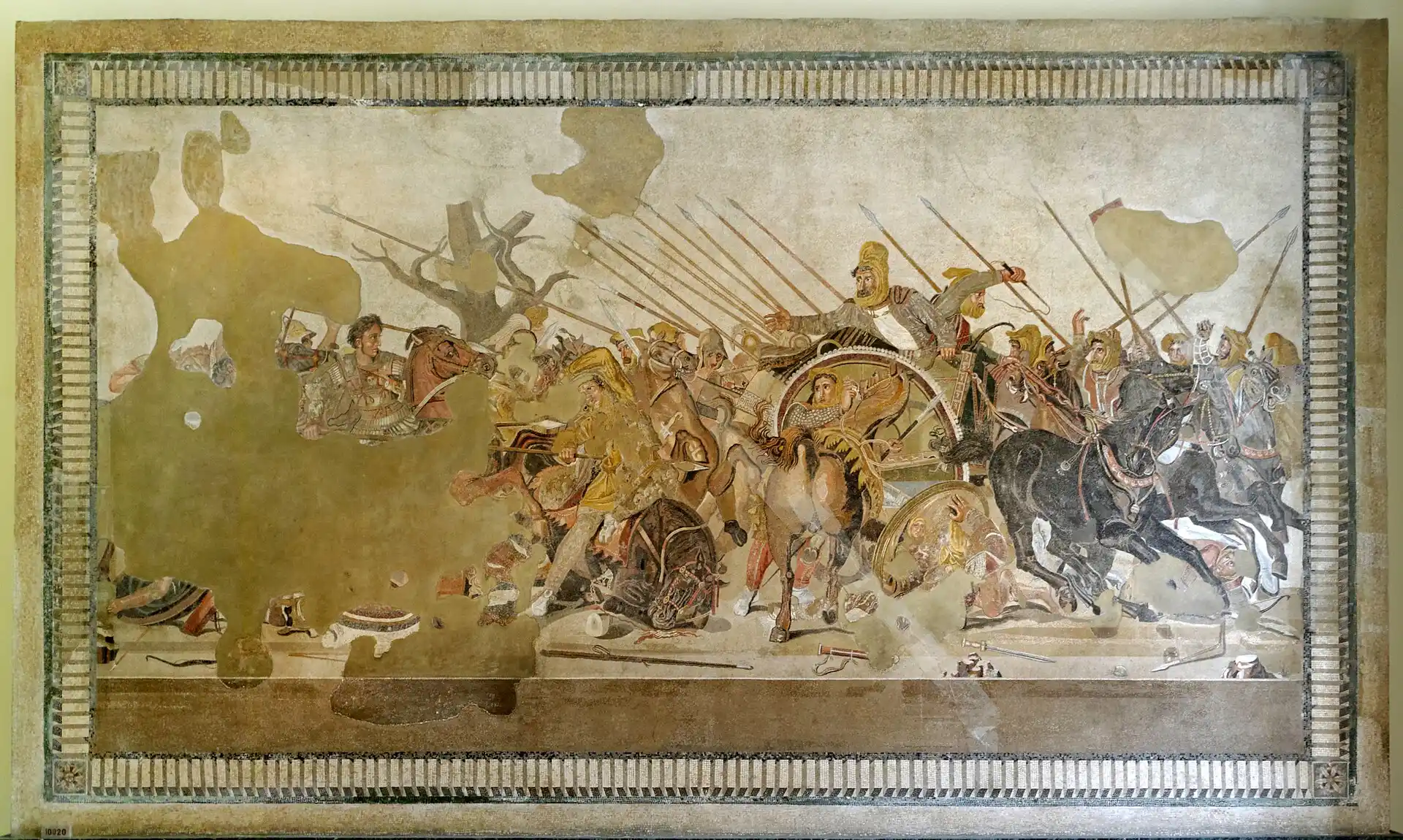
    Mosaic battle scene with Alexander approaching Darius’s chariot amid soldiers and horses.
    The Alexander Mosaic from the House of the Faun at Pompeii, now in Naples. This later ancient artwork is conventionally associated with Alexander’s battle against Darius at Issus; it is not an eyewitness record. Photograph: Berthold Werner, via Wikimedia Commons, CC BY-SA 3.0. Converted to WebP for publication. Image source. Licence.

    The picture encourages the eye to follow the two rulers. A military explanation has to widen the frame: which troops remained engaged, where lines were disrupted, and whether pursuit left other formations exposed. Even a commanding royal image cannot substitute for those questions.

    Gaugamela: exploiting an opening

    At Gaugamela in 331 BCE, Arrian describes Alexander turning towards a gap in the Persian front and attacking with Companion cavalry and nearby infantry. That is a specific explanation of how a local opportunity could affect the centre of the opposing army. It is also an account written long after the campaign, not a surviving field report. Arrian, Anabasis III.14: fighting at Gaugamela

    Arrian’s own narrative complicates a simple picture of effortless victory. The Macedonian left was under pressure; some opposing cavalry reached the baggage area. Different parts of the battle were unfolding at once. Alexander’s attack towards Darius was decisive in the account, but the soldiers resisting elsewhere also belonged to the explanation.

    Ancient battle narratives often provide extremely large army and casualty figures. Those numbers should not be reproduced as if they came from audited muster rolls. Nor can a historian directly verify a defeated king’s private feelings simply because a later author describes them. Here the emphasis is on the reported actions and the problems of command, rather than an exact numerical ratio or a diagnosis of Darius’s character.

    Getting the army to the battlefield

    Arrian’s description of the approach to Gaugamela brings the countryside back into view. He explains that Alexander did not take the most direct route towards Babylon because another route offered easier access to food and horse fodder and less punishing heat. Crossing the Tigris still proved difficult because of its current, even without enemy troops defending the crossing. Arrian, Anabasis III.7: the approach through Mesopotamia
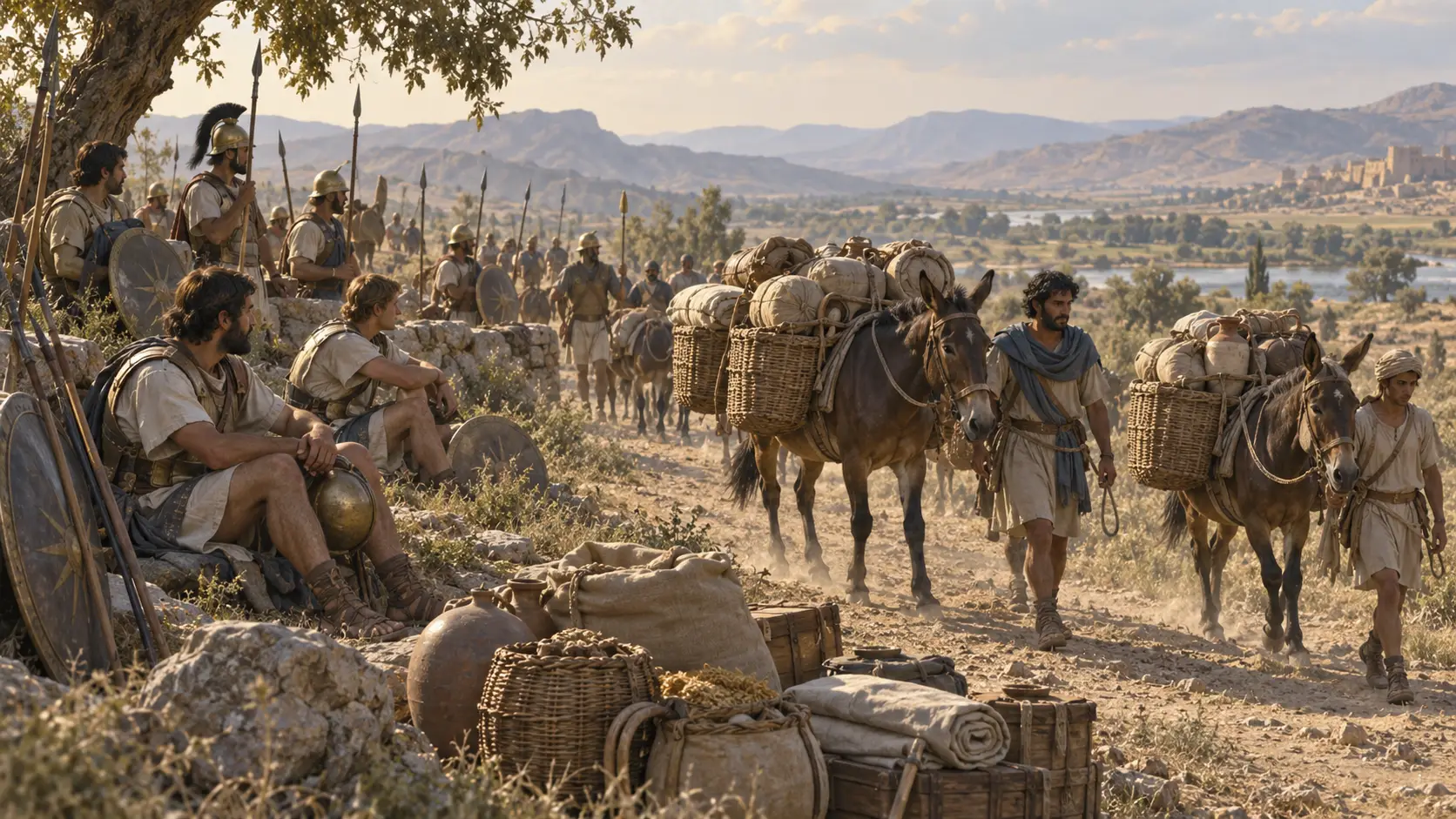
    AI illustration of Macedonian soldiers resting while attendants lead pack animals carrying supplies.
    An imagined pause on a Macedonian campaign in the late fourth century BCE. AI-generated interpretative illustration; not a documented march, a named battlefield or a portrait of Alexander. Libradia.

    A commander could win a tactical opportunity only if the army arrived capable of using it. Pack animals needed feeding as well as loading. River crossings constrained movement. Rest affected whether soldiers could fight. The illustration is an imagined campaign scene; the evidence for the route and the crossing comes from the written account.

    Thinking about supplies also brings local people into the story. Obtaining provisions from a region transferred resources to the invading army. Arrian’s short passage does not describe every transaction or every household’s experience. It nevertheless makes clear why the march cannot be understood solely as movement across an empty map.

    How victory became a change of government

    After Gaugamela, the contest involved cities, treasuries and officeholders as well as the pursuit of Darius. Arrian records the surrender of Babylon and Alexander’s appointment of Mazaeus as its governor, alongside separate military and revenue officials. At Susa, he describes another surrender and the takeover of royal resources. Arrian, Anabasis III.16: Babylon and Susa

    Those arrangements reveal a practical pattern: a conqueror could retain local or Persian officeholders while placing armed force and revenue under new supervision. Taking an empire required access to its existing institutions. It did not require replacing every administrator or inventing a new governing system in each city.

    Darius subsequently fell into the hands of men from his own side. Arrian describes his seizure and killing during Alexander’s pursuit. His death did not mean that every region accepted Macedonian rule or that resistance had ended. The campaign continued beyond the defeat of the Achaemenid king. Arrian, Anabasis III.21: the fate of Darius

    The culture behind the conqueror’s image

    A different mosaic, from Pella in Macedon, depicts two hunters confronting a lion. Unlike the Pompeii battle scene, it presents prowess through a hunt. Identifications of the hunters with Alexander and a companion are interpretations; they are not secure name labels supplied by the image. Lion-hunt mosaic from Pella: photograph and source record
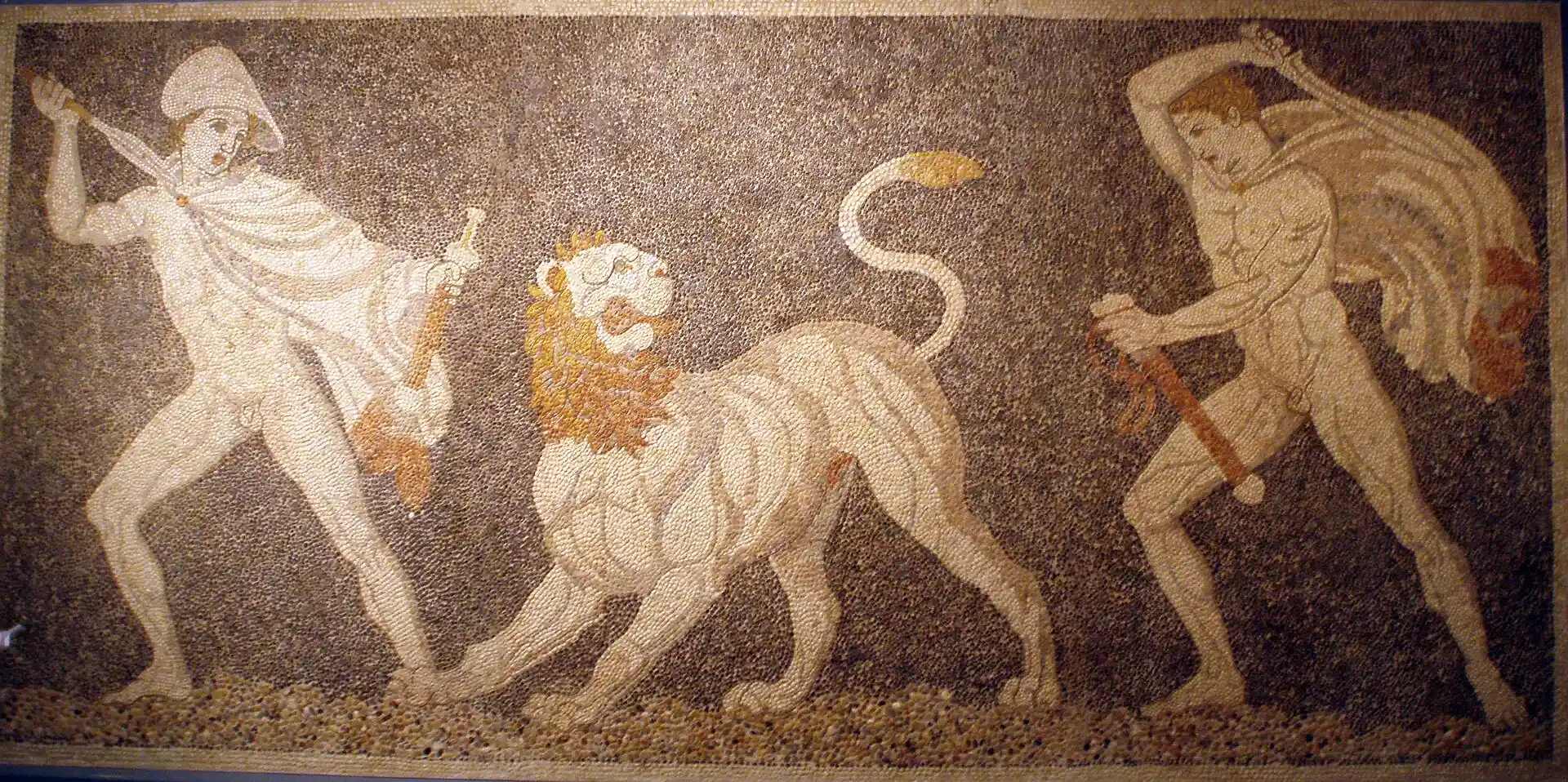
    Pebble mosaic from Pella depicting two hunters confronting a lion.
    A lion-hunt mosaic from Pella. Proposed identifications of the hunters with Alexander and a companion are interpretations, not secure portrait labels. Photograph: miriam.mollerus, via Wikimedia Commons, CC BY 2.0. Converted to WebP for publication. Image source. Licence.

    Placing the two mosaics beside the campaign accounts exposes a useful distinction. Images can help us investigate how courage and elite achievement were presented. They cannot by themselves explain why troops held their positions, why a governor surrendered or how supplies reached a marching army.

    Alexander defeated Persian royal armies by using an experienced force effectively and exploiting opportunities in battle. He extended those gains through movement, resources and political arrangements. The conquest combined violence with administration. Its speed is remarkable, but its mechanisms remain human—and its effects reached far beyond the two kings shown confronting each other in art.
  • Who Built the Egyptian Pyramids—and How Was the Work Organised?

    A pyramid needed a workforce before it needed another stone. Someone had to organise deliveries, prepare food, repair equipment and keep people working together. The monuments at Giza survive on an extraordinary scale; much of the infrastructure that sustained their builders survives as less spectacular traces in the ground.

    Those traces let us give a substantial answer to “Who built the pyramids?” Ancient Egyptian workers did, within projects organised by the crown. The harder—and more interesting—task is understanding how different kinds of work fitted together, and where the evidence still leaves room for disagreement.

    Which pyramids are we talking about?

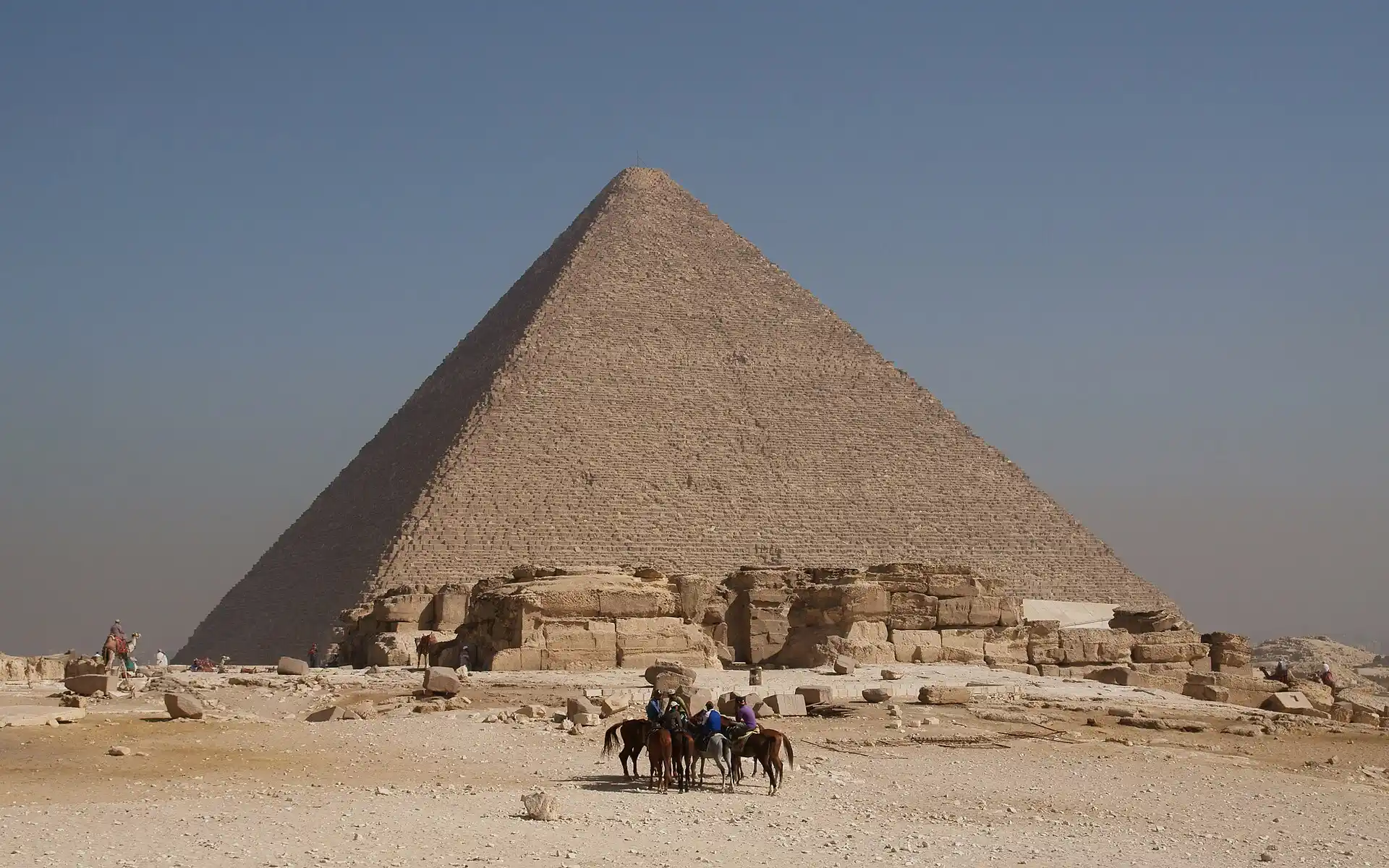
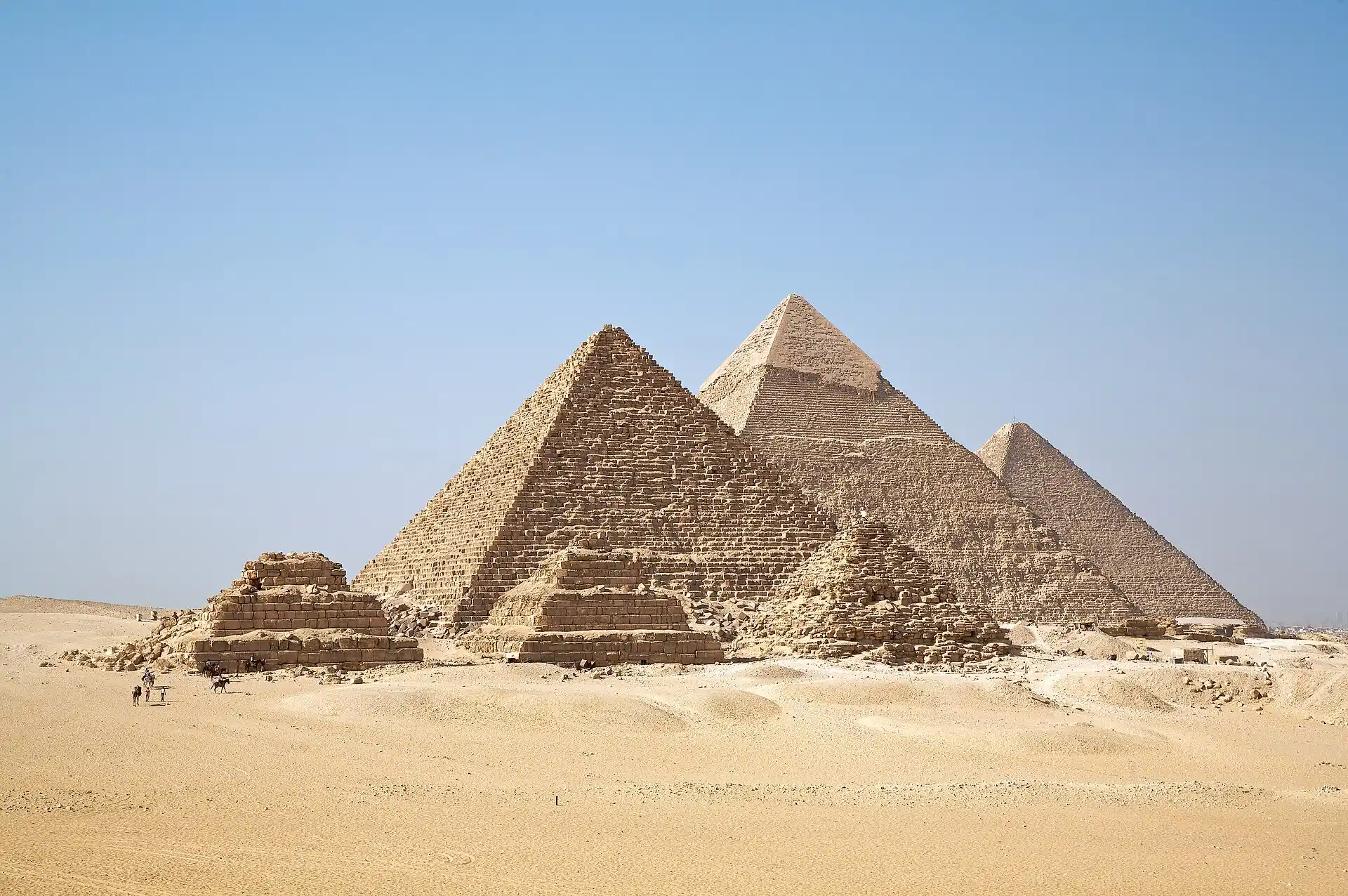
    This article focuses on Giza’s Fourth Dynasty projects, in the third millennium BCE. The three principal pyramids are associated with Khufu, Khafre and Menkaure. Giza belongs to a much wider funerary landscape around ancient Memphis, including Saqqara and Dahshur. Egypt’s pyramids were not all built at once, by one workforce, or according to an unchanged design. UNESCO: Memphis and its Necropolis

    The three main pyramids at Giza with smaller pyramids in the foreground.
    The Giza pyramid complex in a modern photograph. This shows the surviving monuments, not an ancient construction site. Photograph: Ricardo Liberato, via Wikimedia Commons, CC BY-SA 2.0. Commons version includes dust removal and white-balance adjustment; converted to WebP for publication. Image source. Licence.

    A pyramid was also part of a complex. Khufu’s monument had a temple on its eastern side, now largely ruined. Archaeologists documenting that temple have recovered carved and painted relief fragments, alongside evidence of its construction. The building programme therefore required much more than piling up the core of the pyramid: it involved carefully finished surfaces, religious spaces and specialised craftsmanship. AERA: The Great Pyramid Temple

    Finding the people behind the stone

    At Heit el-Ghurab, south of the Sphinx, Ancient Egypt Research Associates has excavated a Fourth Dynasty settlement with workshops, storage areas, kitchens, houses and administrative buildings. Its inhabitants included people who supported construction as well as those directly engaged in it. The excavators connect the settlement with the projects of Menkaure, Khafre and probably Khufu. That final qualification matters: the surviving evidence does not give every building an equally secure connection to every king. AERA: The Lost City of the Pyramids

    Recognising a settlement is only the start. An archaeologist must work out how a space was used, when that use changed and what was removed before abandonment. A long room is not automatically a dormitory. An impressive house is not automatically the residence of the person whose name appears on a nearby object.

    Area C at Giza illustrates the problem. Flinders Petrie identified its long galleries as workers’ barracks. Re-excavation by AERA led to a different interpretation: storage and some craft activity were more likely, probably during Khafre’s project. A familiar label had to be tested against deposits and patterns of use. AERA: Area C

    Were the builders enslaved?

    The familiar image of an entirely enslaved mass driven across the plateau is an inadequate account of the evidence. In his interview with NOVA, archaeologist Mark Lehner describes an Egyptian workforce organised into crews and a wider society mobilised around construction. He also distinguishes estimates and experimental calculations from an actual surviving headcount. NOVA: interview with archaeologist Mark Lehner

    But replacing “slaves” with “free volunteers” would create another oversimplification. Organisation, accommodation and provisioning do not, by themselves, tell us whether an individual could refuse the work. Nor should payment in food be confused with a modern employment contract. The most useful distinction is between what the material evidence establishes about the work and what it leaves uncertain about each worker’s obligations.

    We should therefore resist a single label for every person involved. A skilled mason, an administrator and someone supplying provisions occupied different roles. Identifying an Egyptian workforce is a strong conclusion; reconstructing the legal circumstances and motivations of all its members requires much more evidence.

    Feeding a construction project

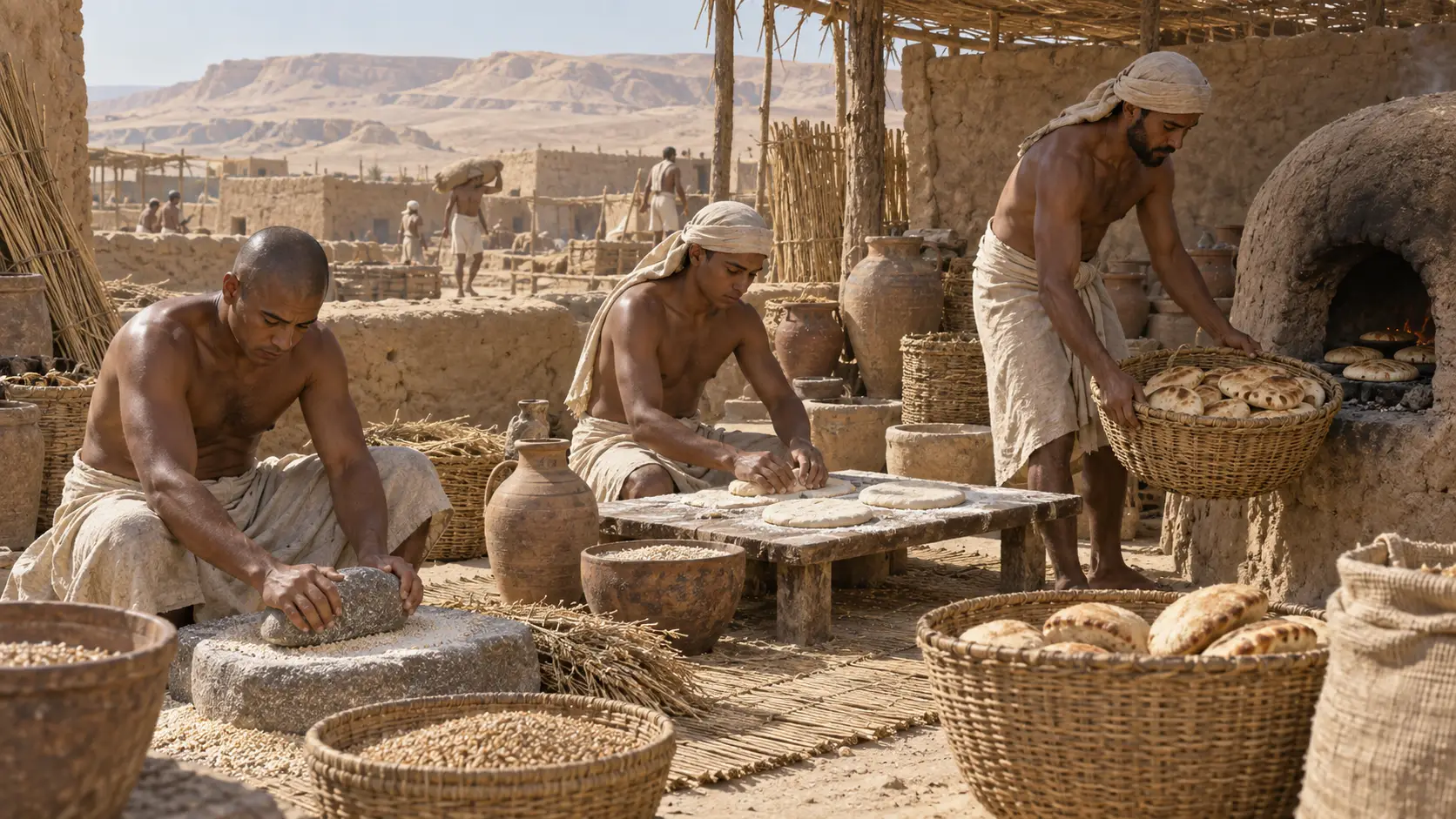
    The settlement’s large grain silos and food-production spaces make provisioning central to the story. AERA identifies the distribution of grain for bread and beer as part of the system sustaining its population. Materials also reached the settlement by waterways during the Nile inundation. These were links between construction and the productive resources of the country. AERA: The Lost City of the Pyramids

    AI illustration of Egyptian workers grinding grain and preparing bread beside mud-brick buildings.
    An imagined provisioning scene inspired by Old Kingdom Egypt. AI-generated interpretative illustration; the bakery layout, oven and individuals are not an exact reconstruction of an excavated site. Libradia.

    The imagined scene gives food preparation a human scale, but its bakery is not an excavated floor plan. To understand the real site, we need the locations of installations, their contents and their dates. A picture of people grinding grain cannot answer those questions on its own.

    Provisioning also changes how we count labour. A calculation limited to people handling stone leaves out those who kept them supplied. The pyramid depended on work taking place away from its rising walls. Thinking through those dependencies is more informative than imagining a huge crowd performing one identical task.

    Rubbish can preserve an administrative history

    At the Kromer dump, discarded material offers another route into that organisation. AERA has studied clay sealings bearing royal names, along with the directions from which baskets of debris were emptied. Sealings naming Khufu and Khafre help connect the waste to successive building phases. The researchers regard the Khufu material as important evidence for an earlier settlement beneath the better-known later one. AERA: Kromer Dump Site

    This is an interpretation assembled from small relationships: an impression, a deposit, a direction of tipping, a possible place of origin. Because rubbish has been moved, it cannot always provide the contextual precision of an object found where it was used. Its value lies in what those surviving relationships allow researchers to reconstruct.

    Moving stones is a different question

    Lehner’s construction experiments for NOVA tested particular operations, including hauling blocks and estimating the labour involved. He explicitly notes that they did not reproduce the whole ancient project: modern equipment was used in parts of the experiment. A successful test can show that a proposed operation is feasible without proving that it was the precise method used at Giza. NOVA: interview with archaeologist Mark Lehner

    Modern view of the Great Pyramid at Giza.
    The Great Pyramid at Giza, photographed in 2010. Its present appearance is distinct from its ancient finished surface. Photograph: kallerna, via Wikimedia Commons, CC BY-SA 3.0. Converted to WebP for publication. Image source. Licence.

    The modern photograph helps us inspect the monument’s scale and surviving masonry. It cannot show a vanished construction ramp or settle which arrangement of ramps was used at different heights. Explaining the workforce and resolving every engineering detail are separate research problems.

    The answer to who built Giza becomes richer when we follow the evidence beyond the stone. Workshops, food supplies, administrative traces and changing interpretations of buildings reveal a coordinated Egyptian undertaking. The remaining uncertainties concern how that undertaking operated in detail. They are questions about human work, and archaeology keeps giving us better ways to ask them.

  • Hammurabi’s Laws: What Did Justice Mean in Ancient Babylon?

    A damaged irrigation bank could turn one farmer’s mistake into a neighbour’s lost harvest. A disputed deposit could set two households against each other. A badly built house could kill the people inside it. These are among the problems addressed in the collection known as Hammurabi’s laws. Its concerns reach well beyond the punishments for which it is famous.

    To read it carefully is to encounter a society arguing about responsibility, property and status. It is also to encounter a king presenting himself as the source of just government. Those two things belong together, but a royal statement about justice is not automatically a record of what happened in every courtroom.

    A monument to law—and to a king

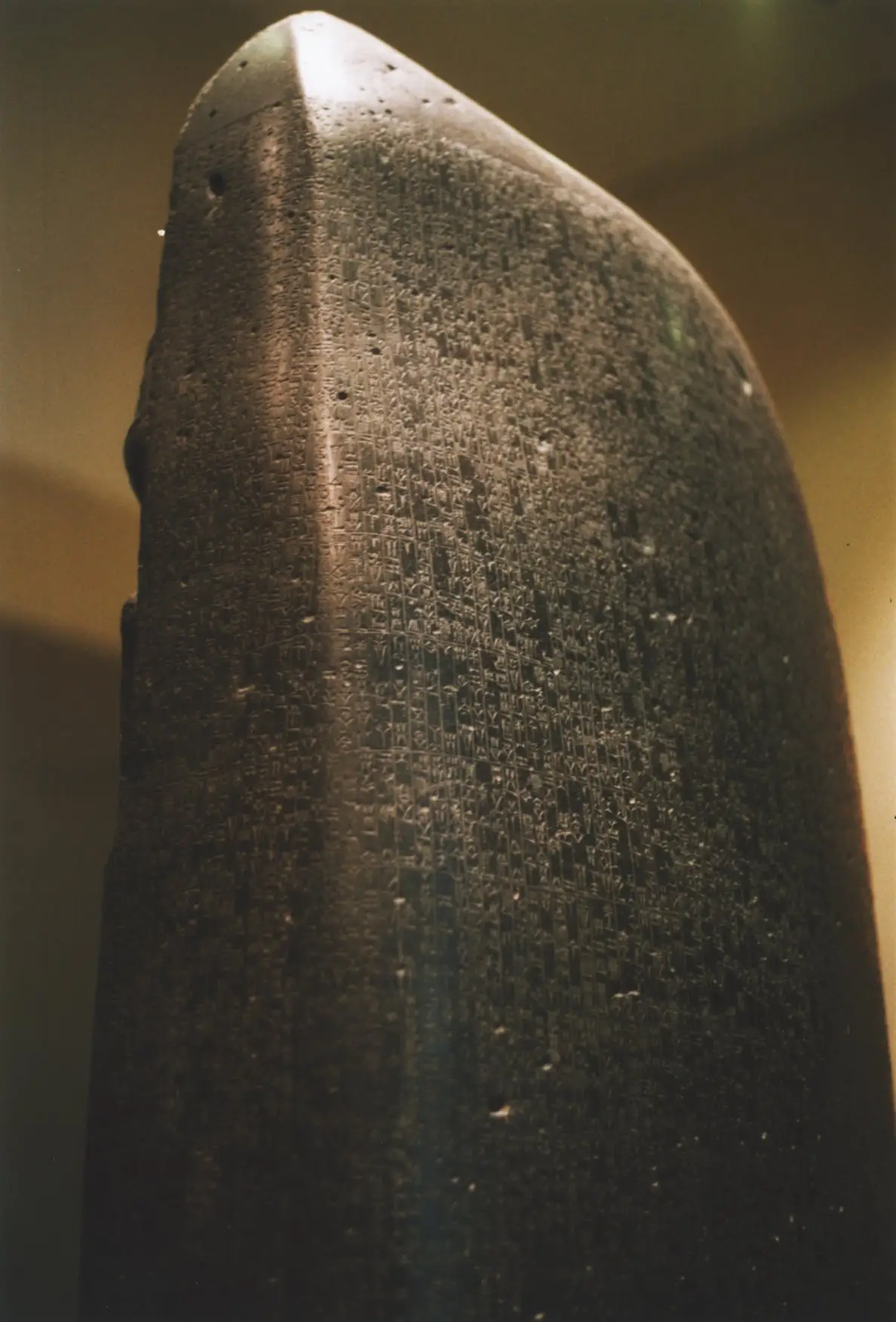
    Hammurabi ruled Babylon in the eighteenth century BCE. The Louvre dates his reign to 1792–1750 BCE, following the chronology commonly used for this period. The most famous surviving version of his laws is inscribed on a basalt stele about 2.25 metres high. French excavators found it at Susa, in present-day Iran, in 1901–1902; it is now in the Louvre. Its findspot should not be mistaken for Hammurabi’s capital. Louvre: stele bearing Hammurabi’s laws (SB 8)

    Side view of the stele bearing Hammurabi’s laws, displayed at the Louvre.
    The stele bearing Hammurabi’s laws, viewed from the side at the Louvre. Photograph: Rama, via Wikimedia Commons, CC BY-SA 3.0 FR. Converted to WebP for publication. Image source. Licence.

    The monument joins a carved image to a long inscription. Its physical form matters: this was an enduring display of royal authority as well as a text. Looking at the stone, we should ask both what its provisions say and what kind of ruler its makers wanted people to see.

    Babylon’s importance also needs a date. The city’s history extended far beyond Hammurabi. The monumental Babylon associated with Nebuchadnezzar II belongs to the first millennium BCE, much later than the Old Babylonian world discussed here. Combining those periods into one timeless scene would obscure how much changed. The Met: Babylon

    What happens when someone causes a loss?

    Many provisions use a case-based structure: a situation is described, followed by a consequence. That makes the collection unusually concrete. Rather than beginning with an abstract definition of negligence, it asks what should happen when an embankment is neglected and water damages other people’s crops.

    In the conventionally numbered provisions 53–54, responsibility for that damage falls on the person who failed to maintain the bank. The text envisages compensation for the grain lost and a severe further consequence if compensation cannot be provided. The issue is not simply that water escaped. It is that one person’s management of a shared agricultural environment could impose costs on others. Hammurabi’s laws: translation at the Avalon Project

    The building provisions pose a related question. Sections 229–233 distinguish deaths, damage to property and deficient construction. Their penalties include consequences that are profoundly unequal and disturbing to a modern reader. Yet the cases also expose a recognisable practical problem: who bears responsibility when paid work fails? We can recognise the problem without treating the proposed solution as our own. Hammurabi’s laws: translation at the Avalon Project

    Why “an eye for an eye” is incomplete

    The bodily-injury provisions are often reduced to a single slogan. Reading the neighbouring cases changes the picture. In sections 196–201, the prescribed response varies with the injured person’s status: bodily retaliation in one case, a payment in another, and compensation connected to an enslaved person’s value in another. This is not equality before the law in its modern sense. Hammurabi’s laws: translation at the Avalon Project

    The distinctions require care in translation. Older English versions use labels such as “freed man” or “gentleman” that should not be read as transparent equivalents of modern social categories. The underlying point is more secure than any easy comparison: legal status affected the protection a person received and the consequences of harming them.

    That changes the question we ask of the collection. Was a penalty predictable? Was it proportionate within the text’s own hierarchy? Was the same protection available to everyone? These are different tests of justice. A system can articulate responsibility clearly while distributing rights unequally.

    Records, witnesses and everyday disputes

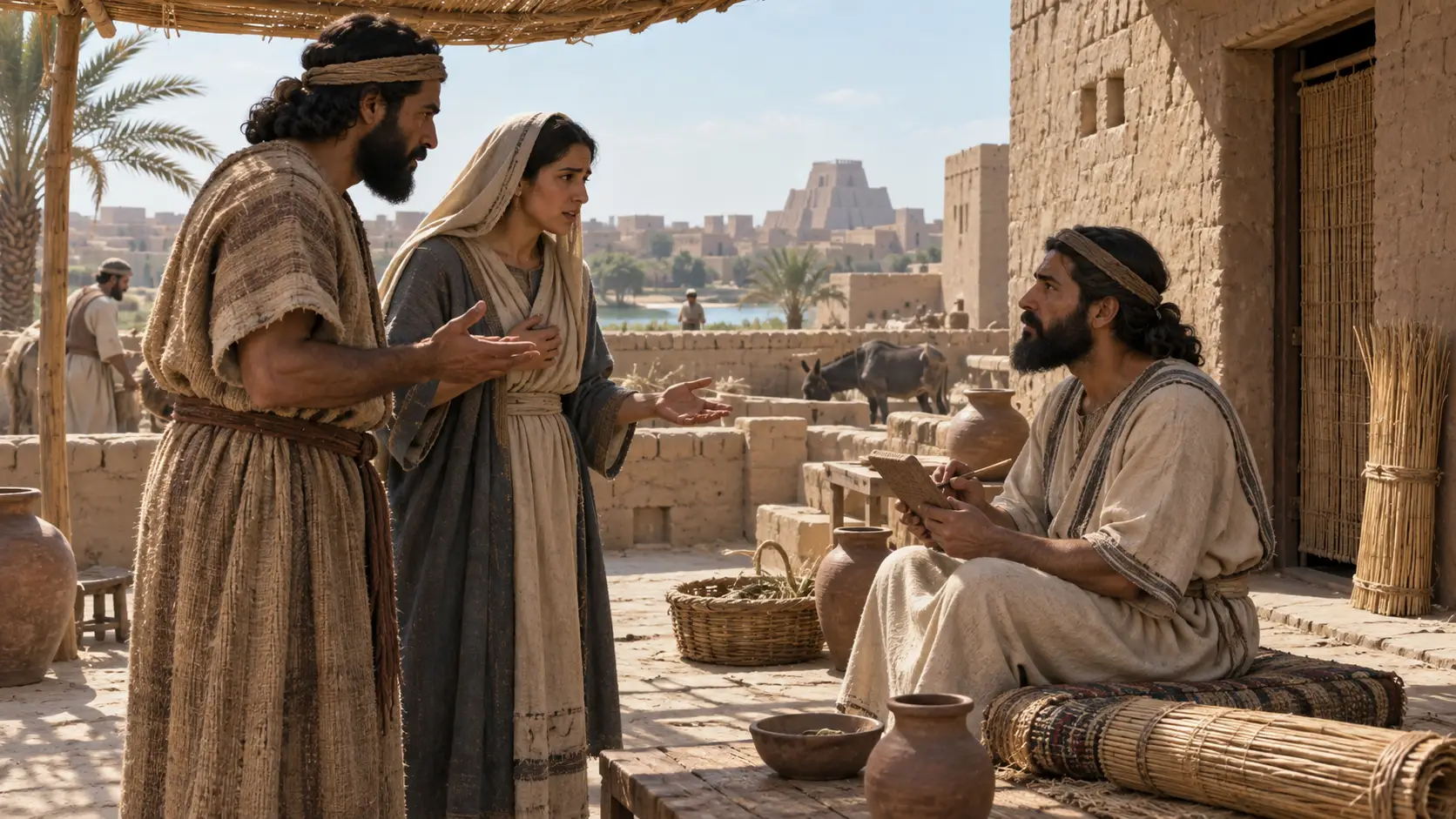
    The text also pays attention to evidence. Provisions 122–124 describe the deposit of valuables, witnesses and an agreement, followed by a dispute in which the recipient denies having received the property. A written or witnessed arrangement could help establish what had been entrusted to whom. Hammurabi’s laws: translation at the Avalon Project

    Here the usefulness of a scribe becomes easier to understand. Recording a transaction gave it a form that could outlast the spoken exchange. That does not mean every inhabitant could read the record, or that every disagreement followed one uniform procedure. It means the collection itself presents documentation and testimony as consequential.

    AI illustration of two townspeople speaking to a seated scribe holding a clay tablet in a mud-brick courtyard.
    An imagined scene of Old Babylonian legal administration. AI-generated interpretative illustration; not a documented trial, an identified historical person or an exact reconstruction of Babylon. Libradia.

    The illustration imagines people bringing a matter to a scribe. The specific courtyard, individuals and encounter are invented. The historical evidence discussed here is the provision about deposits and witnesses, not the scene’s gestures or arrangement of furniture.

    Other provisions bring household relationships into the picture. Section 148, for example, addresses a husband’s continuing support for a wife affected by illness; section 149 considers her departure with her dowry. Such clauses show that the collection cannot be understood solely through its most violent penalties. They do not establish that women and men enjoyed equal power, or tell us how often the stated protection was secured in practice. Hammurabi’s laws: translation at the Avalon Project

    The ruler’s image of justice

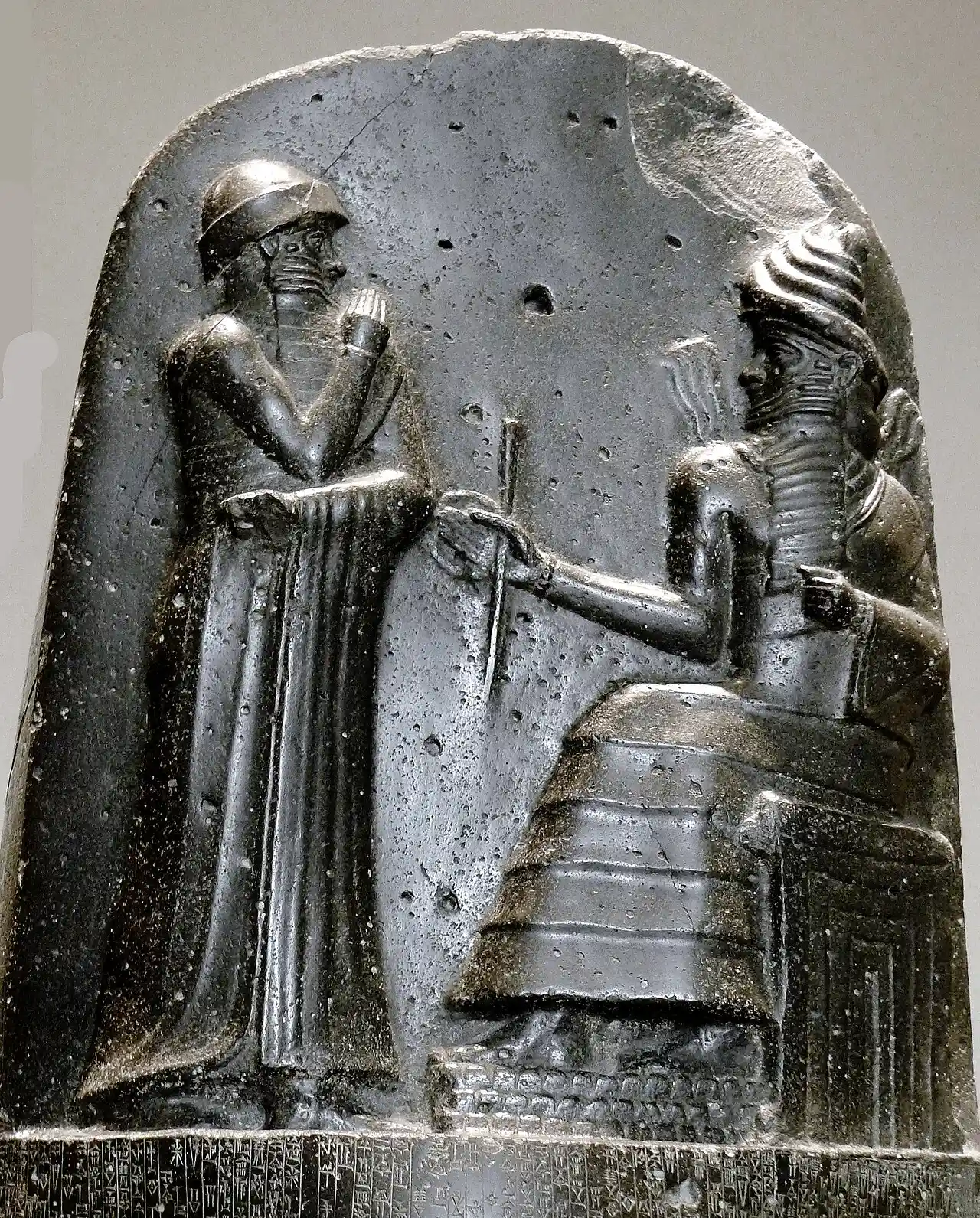
    Above the inscription, Hammurabi stands before the seated god Shamash. The Louvre identifies the scene with the divine legitimation of the king’s authority. The relief is therefore part of the argument made by the monument: royal judgement is presented within a sacred order. Louvre: stele bearing Hammurabi’s laws (SB 8)

    Relief at the top of Hammurabi’s law stele, showing a standing ruler facing a seated deity.
    Detail of the relief above the inscription on Hammurabi’s law stele, Louvre. Photograph: Mbzt, via Wikimedia Commons, CC BY 3.0. Converted to WebP for publication. Image source. Licence.

    The inscription’s concluding passages reinforce that presentation. They invite a wronged person to encounter the king’s words and celebrate Hammurabi’s protection of the vulnerable. This is a claim made by the royal text, not independent proof that every vulnerable person received protection. Hammurabi’s laws: translation at the Avalon Project

    What the laws can—and cannot—tell us

    The safest way to use this source is to keep its cases, its hierarchy and its royal purpose in view at the same time. Its provisions reveal problems considered worthy of formal treatment. Its distinctions reveal unequal valuations of people. Its monumentality reveals the prestige attached to a king’s claim to provide justice.

    To discover the outcome of a particular dispute, we would need evidence of that dispute. To discover what Hammurabi wanted just rule to look like, this monument is exceptional evidence. The tension between those questions is what makes it more revealing than a list of ancient punishments.

  • Why Was Julius Caesar Assassinated?

    Julius Caesar was killed at a meeting of the Roman Senate on 15 March 44 BCE. The assassins were not an invading army or an angry crowd. They were men from Rome’s political elite, including people whose careers Caesar had helped. Their decision exposes a problem that military victory had not resolved: who could exercise power in Rome, and who could place limits on it?

    The conspirators saw Caesar’s dominance as a threat to the Republic. That explanation matters, but it is not the whole story. Personal rivalries, injured status and competing ideas of liberty also belonged to the world in which they acted. To understand the murder, we need to examine both the power Caesar held and the political expectations he had disrupted.

    A republic already under strain

    Rome had acquired extensive territories before Caesar became its dominant figure. The Republic therefore already governed an empire in the geographical sense. Its later transformation into an imperial monarchy was a change in how supreme power operated, not the moment Rome first possessed lands overseas.

    Expansion brought wealth and opportunities, but also unequal gains, military demands and repeated political crises. Caesar’s dictatorship emerged from a long period of conflict rather than a peaceful system suddenly overturned by one ambitious man. The distinction prevents the assassination from becoming an overly simple contest between a healthy Republic and a solitary destroyer. The Met: The Roman Republic

    For a senator, political power involved more than having an official title. It also depended on whether office gave its holder meaningful room to act. Under an overwhelmingly powerful victor, an honour could still be impressive while leaving its recipient dependent on the person who had bestowed it. This tension helps explain why receiving Caesar’s favour did not necessarily produce lasting loyalty.

    When exceptional power became permanent

    By early 44 BCE, Caesar held the dictatorship for life. Plutarch, writing much later, identifies permanence as a decisive feature of this arrangement. He also describes Caesar promising offices and granting honours to leading Romans. In that account, the victor sought willing cooperation, but the choices available to other politicians increasingly rested on his approval. Plutarch: Life of Caesar, 57–62

    A silver denarius in the British Museum makes the concentration of authority unusually tangible. Its inscription identifies Caesar as perpetual dictator. Unlike a later biography, the coin belongs to the political world of 44 BCE itself. It cannot reveal the private thoughts of the assassins, but it provides material evidence for the title around which their fears developed. British Museum: Denarius of Caesar, 1843,0116.170

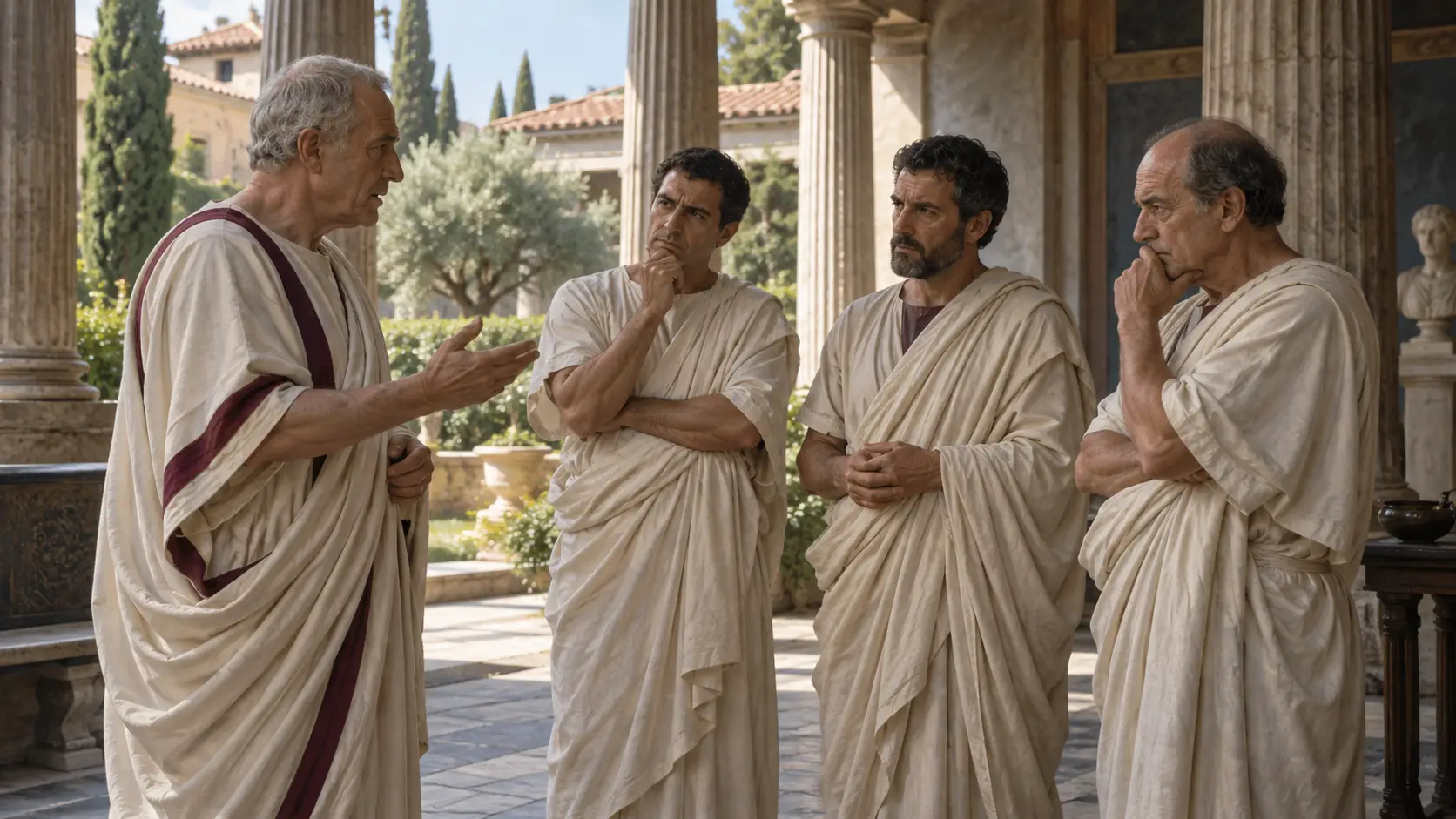
    AI illustration of four Roman senators discussing politics beneath a colonnade.
    An imagined political discussion in late Republican Rome. AI-generated interpretative illustration; the people and setting do not reconstruct a documented meeting or identify Caesar and his assassins. Libradia / AI-generated illustration.

    The illustration evokes political discussion, not a surviving record of one. The actual evidence is less visually complete: an inscription on a coin, an archaeological setting and literary accounts composed under later rulers. Bringing these different kinds of evidence together is more useful than treating an imagined scene as a photograph of the conspiracy.

    Why the possibility of kingship mattered

    Ancient accounts repeatedly connect the growing hostility to suspicions of kingship. Plutarch describes Antony offering Caesar a diadem at the Lupercalia and Caesar refusing it. The refusal did not settle the larger question of how far his power might extend. Plutarch also reports resentment over the treatment of tribunes and over honours that placed Caesar above his fellow citizens. Plutarch: Life of Caesar, 57–62

    Suetonius presents another revealing episode: Caesar received a senatorial delegation without standing. He preserves different explanations of what happened. The disagreement is a reminder that even an apparently small gesture reached later readers through competing stories. For senators concerned about their standing, however, the political issue was substantial: were they participants in government or petitioners before a superior? Suetonius: Life of Julius Caesar, 76–82

    We should distinguish evidence of suspicion from proof of a settled plan. Accounts of rumours about a crown do not establish precisely what Caesar intended to do next. They do show how the language and symbols of monarchy could turn anxieties about power into an urgent political accusation.

    The conspiracy brought different interests together

    Suetonius names Gaius Cassius, Marcus Brutus and Decimus Brutus among the leaders. Marcus and Decimus were different men; reducing the story to Caesar and one Brutus obscures the wider coalition. The plot involved more than a single friendship ending in betrayal. Suetonius: Life of Julius Caesar, 76–82

    Plutarch’s account of Brutus presents the conspirators as expecting other leading Romans to support liberty once Caesar was dead. That expectation helps explain their choice of a Senate meeting: it brought important political figures together and allowed the attackers to gather without immediately attracting suspicion. Yet an expectation of support is not evidence that the whole Senate had agreed to the murder. Plutarch: Life of Brutus, 14

    It would be equally misleading to reduce every participant to a selfish careerist or to assume that all shared an identical constitutional programme. Opposition to one-man rule and concern for personal standing could reinforce each other. The sources let us identify these tensions more confidently than they allow us to rank every conspirator’s motives.

    The Ides of March—and the problem left behind

    The attack took place in Pompey’s Curia, associated with the theatre complex, rather than in the Senate House that visitors commonly associate with the Roman Forum. Rome’s archaeological authority identifies this hall as the location of the meeting on 15 March. The setting was part of the normal business of government, which helped make it an opportunity for assassination. Roma Capitale: La Curia di Pompeo

    The conspirators could remove Caesar more easily than they could settle who would command authority afterwards. Their act did not produce a durable restoration of republican government. Further struggles eventually brought Caesar’s heir Octavian to supremacy; he received the title Augustus in 27 BCE. Caesar’s murder and the establishment of Augustus’s position were separated by years of conflict. The Met: The Roman Republic

    Reading the story without its later script

    Plutarch and Suetonius wrote long after the assassination. Their biographies preserve valuable traditions, but they also arrange incidents around character, ambition and moral judgement. Their accounts should not be read as transcripts. This is especially important when a story supplies a private conversation, a perfectly timed warning or an explanation of someone’s inner feelings.

    The strongest answer to the title’s question is therefore layered. Caesar’s enduring dominance made some senators believe that meaningful republican politics could not survive him. Rivalries and anxieties helped turn opposition into a conspiracy. But the assassins’ confidence that removing the ruler would restore political freedom proved far stronger than their ability to achieve that result.

  • Before Coins: How People Traded in Mesopotamia

    Long before a stamped coin changed hands, people in Mesopotamia could give goods a value in silver. The metal was weighed. That simple distinction opens a much richer history than the familiar picture of two people swapping whatever they happened to have.

    Trade involved materials, measures and relationships. Some objects travelled far beyond the places where their raw materials originated; records could define a transfer or an obligation. The examples here come mainly from the third millennium BCE, followed by one clearly identified look at Assyrian merchants in the early second millennium.

    At a glance

    Focus
    Mesopotamian exchange before coinage.
    Time
    Mainly c. 2900–2000 BCE; a later commercial record from the twentieth–nineteenth centuries BCE.
    Distinction
    A unit of value, a means of payment and a coin are not the same thing.

    Before coins does not mean before money

    William B. Hafford’s account of Mesopotamian commerce describes goods being valued in silver by weight by around 2500 BCE. Coinage was not necessary for that practice. Nor does a silver valuation prove that every transaction involved handing over silver: expressing a value and settling an obligation are different actions. William B. Hafford: Mesopotamian City Life (Penn Museum, 2018)

    Barter means a direct exchange of goods or services without money mediating the transaction. It is one possible arrangement, but it should not be the automatic label for everything that happened before coins. To understand a particular exchange, we need to ask what was being transferred, how its value was expressed and what the parties actually did.

    Three key concepts

    Unit of account
    A standard in which a value or obligation is expressed.
    Payment
    What is transferred to settle that obligation.
    Coin
    A piece of metal made and marked for use as money.

    Materials and goods from farther afield

    A headdress from Ur’s Royal Cemetery, now in the Met, combines gold, lapis lazuli and carnelian. It belonged to a female attendant in the so-called King’s Grave and dates approximately to 2600–2500 BCE. Those materials point beyond the southern river plain to wider networks of supply. The Met: Headdress from Ur, 33.35.3

    The ornament gives us an endpoint: materials brought together in an object deposited at Ur. It does not identify every intermediary or prove that one merchant travelled the entire route. The history of movement must be reconstructed from more than the location of a finished piece.

    Textiles were also significant in Mesopotamian exchange. Hafford describes cloth and finished garments being exchanged for resources from farther afield. These were useful products made through skilled work, rather than simply natural materials waiting to be collected. William B. Hafford: Mesopotamian City Life (Penn Museum, 2018)

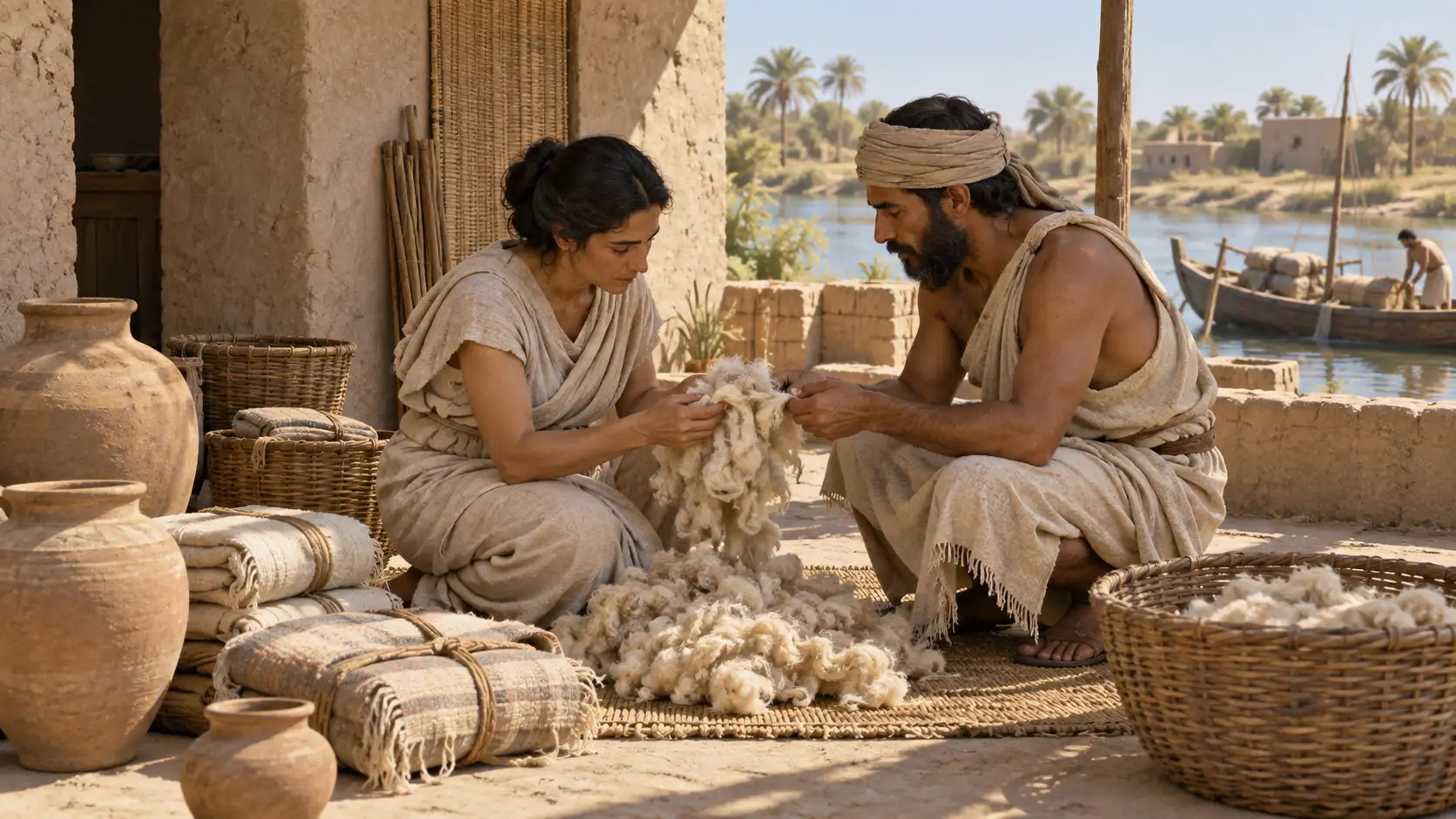
    The imagined encounter below shows people inspecting wool alongside other goods. It illustrates the handling of materials without assigning a price or payment method to the exchange.

    AI illustration of people examining wool and other goods in an imagined Mesopotamian trading encounter.
    AI-generated interpretative illustration for Libradia: an imagined encounter involving wool and other goods. The scene does not document a particular transaction, price or method of payment.

    A shekel was a weight

    The shekel in this setting was a unit of weight, not the name of a stamped Sumerian coin. Hafford’s research gives approximately 8.4 grams for a principal Mesopotamian standard, especially in southern Mesopotamia. “Approximately” matters: ancient measures must be studied in their regional and historical contexts. William B. Hafford: Hanging in the Balance — Precision Weighing in Antiquity (Penn Museum, 2005)

    Weights could be elaborately carved, including animal forms, or look like rather plain shaped stones. Their significance lies in measurement as much as appearance. Comparing their masses and relationships can help identify sets that are not immediately recognisable as commercial equipment. William B. Hafford: Hanging in the Balance — Precision Weighing in Antiquity (Penn Museum, 2005)

    Weighing provided a way to compare an amount of material against an agreed standard. It still left room for practical questions about the weights, the material and the agreement. Measurement made a transaction more explicit; it did not remove the need for trust.

    Records could define transfers of property

    The Stele of Ushumgal and Shara-igizi-Abzu, dated 2900–2700 BCE and probably from Umma, records a transaction involving fields, houses and livestock. Ushumgal and his daughter are central to it. The Met notes that its early script does not make clear whether the properties were being bought, sold or granted. The Met: Stele of Ushumgal and Shara-igizi-Abzu, 58.29

    The stele records concern with property and its transfer, even though the precise arrangement remains uncertain. That distinction matters when deciding whether an ancient document describes a sale, a gift or another kind of transaction.

    It also broadens the subject beyond portable merchandise. Economic relationships could involve land, buildings and continuing rights, not only items exchanged at a meeting place. To read an ancient economy well, we need a vocabulary larger than “barter.”

    A later look at credit and repayment

    For a particularly clear example of a financial obligation, move forward to the early second millennium BCE. Merchants from Ashur in northern Mesopotamia operated in trading settlements in Anatolia, including Kanesh, at modern Kültepe. Their records include business dealings, loans and correspondence. This is a later commercial setting, not a direct description of Early Dynastic Sumer. The Met: Cuneiform tablet — quittance for a loan in silver, 66.245.16a

    A tablet in the Met, dated to the twentieth–nineteenth centuries BCE and probably from Kültepe, acknowledges repayment of a silver loan owed to Ashur-taklaku. It states that further claims are void. Witnesses are named, and their seals were impressed on the tablet’s clay envelope. The Met: Cuneiform tablet — quittance for a loan in silver, 66.245.16a

    The important moment here is the end of a debt. The record was useful because an obligation had existed over time and its discharge needed to be recognised. The tablet preserves the borrower’s release from a claim, as well as the evidence that could be used to demonstrate it.

    Movement is not always trade

    Our evidence includes several different kinds of movement. An Ur III tablet dated approximately 2029 BCE records a shipment of barley, while the earlier Uruk material includes accounts of grain distribution. These document economic activity, but their descriptions alone do not establish an ordinary purchase between independent buyers and sellers. The Met: Tablet recording a shipment of barley, 86.11.243 The Met: Administrative account of barley distribution, 1988.433.1

    This is why an archaeologist’s map of objects and a historian’s account of commerce answer related but different questions. A map may show connections. To explain the relationship behind a connection, we need context: a text, a findspot, an institutional setting or a combination of clues.

    An economy of relationships

    Weighed silver, crafted goods, property records and acknowledged debts reveal an economic world that was already varied before coinage. The surviving evidence does not support one simple exchange system operating identically across Mesopotamia for centuries.

    What made these arrangements work? Sometimes it was a recognised measure, sometimes a record and witnesses, and sometimes a relationship that archaeology only partly preserves. Our article on the beginnings of writing explores why recording goods became so important. Following those records brings the people behind exchange into view, without treating coinage as the starting point of economic history.

  • Daily Life in Early Mesopotamia: Homes, Work and Family

    The remains of a home ask different questions from a royal monument. Where was food prepared? Which spaces connected to the street? What work left tools or waste behind? Looking at those details brings early Mesopotamian cities closer to the people who sustained them.

    There was no single “ordinary Mesopotamian day.” A household’s resources and obligations mattered, and conditions changed between cities and centuries. This article focuses on examples from the third millennium BCE, using excavated domestic remains and records of work to explore homes, family relationships and the activities that are easiest to lose in a history of kings.

    At a glance

    Time
    Primarily c. 2600–2000 BCE, with a later comparison clearly marked.
    Evidence
    House remains, tools, animal bones, craft records and game boards.
    Question
    What can we recover about work and relationships within an early urban community?

    What survives inside a home

    At Abu Salabikh in southern Iraq, a residence known to excavators as House 6H dates to the Early Dynastic III period, approximately 2600–2350 BCE. It was an affluent house with multiple rooms and courtyards. Burials and deposits in neighbouring lanes also form part of its archaeological setting. Its size and wealth make it an example of an affluent residence rather than a typical home. Frontiers in Environmental Archaeology: Sliced meat — animal processing at Early Dynastic Abu Salabikh (2026)

    A floor plan shows routes, divisions and possible uses of space. Objects and deposits add activities. Yet the two do not always produce a simple room label: something discarded in a room need not have been made there, and debris may have moved after a building fell out of use.

    A house is a building; a household is a group of people whose lives and resources were connected. The surviving rooms can help us understand how space was used, but usually reveal much less about kinship and authority.

    The work inside a meal

    Grain processing belongs in a history of everyday work. Written sources discussed by Agnès Garcia-Ventura identify milling as an occupation in the Ur III period, at the end of the third millennium BCE. The evidence includes both women and men, although their representation varies between records and settings. Agnès Garcia-Ventura: Weaving in Ur III Mesopotamia — Women’s Work? (2014)

    The imagined courtyard below shows grain processing alongside basket work. It brings everyday tasks into view without reconstructing House 6H or a documented family.

    AI illustration of two people processing grain and working with basketry in a mud-brick courtyard.
    AI-generated interpretative illustration for Libradia: imagined household activities in a Mesopotamian courtyard. This is not House 6H, a documented family or evidence of a fixed division of work.

    Food preparation takes time, space and equipment. A record of grain supplied tells only part of the story: the grain still had to be processed into food.

    Other food work survives at a microscopic scale. A 2026 study of animal bones from the House 6H complex examined a selected sample of cut marks and interpreted them as consistent with chipped-stone blades. No diagnostic metal-knife marks were identified in that analysed sample. This is a small, specific finding, but it warns against assuming that a Bronze Age household used metal for every cutting task. Frontiers in Environmental Archaeology: Sliced meat — animal processing at Early Dynastic Abu Salabikh (2026)

    Craft work could bind people to institutions

    Making things was not always an independent household business. In her study of Ur III craft production, Rita P. Wright describes substantial differences between workers’ obligations and legal positions. Some worked seasonally; others were attached to institutions for longer periods, including people in conditions of dependence or enslavement. An occupational label such as “weaver” therefore does not explain how much freedom a worker possessed. Rita P. Wright: Crafting Social Identity in Ur III Southern Mesopotamia (1998)

    That matters when we imagine a busy workshop. Skilled work can produce an impressive object without being comfortable, voluntary or well rewarded. The product and the worker’s circumstances are different subjects, and both deserve attention.

    Conversely, not every craft activity visible in a city belonged to the same institutional system. Wright also discusses family-operated pottery workshops outside direct state management. The useful picture contains variation in both the scale of production and the relationships through which it was organised. Rita P. Wright: Crafting Social Identity in Ur III Southern Mesopotamia (1998)

    Family relationships could run through the workplace

    Ur III accounts examined by Wright list women weavers together with sons and daughters, sometimes identifying children through their mother’s name. Such records place family relationships inside the organisation of labour. They should not be turned into a cheerful modern apprenticeship story: the same institutional setting could involve severe constraints on a family’s choices. Rita P. Wright: Crafting Social Identity in Ur III Southern Mesopotamia (1998)

    A child’s appearance in an account gives us a connection and a category. It rarely gives us a description of teaching, affection, play or the child’s own experience. Much of family life fell outside the administrator’s concerns.

    We can nevertheless ask more precise questions because the relationships survive: whose children were listed, what group they belonged to, and how their treatment compared with other workers. Answers to those questions can reveal differences between families that a general description of daily life would miss.

    Who did the work?

    Garcia-Ventura challenges the assumption that all Ur III weavers or millers were female. Some occupational terms do not, by themselves, specify gender; names and surrounding text may be needed. She also discusses records that explicitly include male workers in these occupations. Recognising women’s substantial role does not require turning it into an exceptionless rule. Agnès Garcia-Ventura: Weaving in Ur III Mesopotamia — Women’s Work? (2014)

    The division of work varied between settings. The people shown in our illustration should therefore be understood as one imagined scene, rather than a fixed arrangement shared by Mesopotamian households.

    There was also time for play

    Game boards deposited in Ur’s Royal Graves around 2600 BCE preserve the Sumerian version of Twenty Squares, commonly called the Royal Game of Ur. They put play beside the ornaments and ceremonial objects through which these graves are often remembered. Anne-Elizabeth Dunn-Vaturi: Board Games from Ancient Egypt and the Near East (The Met, 2018)

    The setting still matters. A richly made board in a grave does not describe every home’s possessions or tell us how frequently a particular person played. More broadly, ancient gaming evidence ranges from elaborate objects to simple markings, while boards drawn on the ground or made from perishable materials can disappear. Surviving luxury examples are only part of the history. Anne-Elizabeth Dunn-Vaturi: Board Games from Ancient Egypt and the Near East (The Met, 2018)

    From households to neighbourhoods

    A later comparison comes from Ur around 1900 BCE. William B. Hafford describes a residential area with more than fifty buildings and neighbourhoods associated with local chapels. Texts and seals sometimes preserve inhabitants’ names. This later evidence helps frame questions about urban social life, but its arrangements cannot be copied unchanged into a third-millennium house. William B. Hafford: Mesopotamian City Life (Penn Museum, 2018)

    Everyday history becomes more convincing as its scale becomes more precise: a particular house, a group of workers, a dated object. Together these glimpses show why a city’s history belongs as much to food preparation, craft and relationships as to public buildings. They also leave room for lives that were never written down.

  • Feeding the First Cities: Farming, Storage and Distribution

    Bringing in a harvest was only the beginning of feeding a city. Grain must be gathered, moved, kept usable and eventually prepared. When many people live close together, those tasks connect fields outside a settlement with storerooms, institutions and households within it.

    For the early cities of Mesopotamia, food supply was part of the organisation of urban life. Evidence comes from different periods and places: villages before the cities, early administrative tablets, excavated food remains and more detailed records from later urban societies. Together they show several parts of the process, though never a complete account of every resident’s diet.

    At a glance

    Where
    Primarily southern Mesopotamia; one comparison from Shakhi Kora in north-east Iraq.
    When
    Late fourth and third millennia BCE, with earlier agricultural background.
    Question
    How did food reach people whose work kept a city running?

    Farming was already old when cities grew

    The growth of cities did not introduce agriculture to southern Mesopotamia. During the earlier Ubaid period, communities farmed with irrigation and exploited fish from rivers and the Gulf. The urban world developed out of a landscape already shaped by food production and settlement. The Met: The Ubaid Period

    That background changes the story. The challenge was not simply discovering how to grow more grain. It was organising relationships between producers and the people who depended on them. A potter, builder or administrator might contribute essential work without producing everything needed for their own meals.

    We should therefore picture the city together with its surrounding land and waterways. The built-up area was only one part of the system. Food production continued beyond its streets, and access to that production mattered as much as the height of its public buildings.

    Water required continuing work

    Irrigation supported intensive cultivation in the southern alluvial plain. Getty’s account of early urban growth emphasises the maintenance of canals and the role of major temple estates. Canal work was an ongoing responsibility, not a single engineering achievement completed when a settlement was founded. Getty: Mesopotamia — Civilization Begins

    This helps explain why discussions of agriculture soon become discussions of labour and authority. A channel links more than one patch of ground. Clearing and maintaining it raises practical questions about who works, who coordinates the work and who benefits from the water. The evidence does not justify assuming that every channel, field or harvest belonged to one central institution.

    From field to meal

    Production
    Obtaining food from cultivated land, animals and other resources.
    Storage
    Keeping supplies usable between collection and consumption.
    Distribution
    Moving or allocating supplies to the people who will use them.

    A harvest had to last

    Harvests and daily meals follow different schedules. Storage helps bridge the gap. A reserve of grain can support later meals, but it also creates work. Containers must be filled and handled; the contents must remain accessible and protected. The practical problem is easy to recognise even where the particular arrangements are uncertain.

    Ceramic vessels had been used for preparing, serving and storing food in Mesopotamia long before urbanisation. Their long history should not be confused with a single standard city warehouse. A jar, a room and a large institutional store represent different scales of organisation. Identifying a vessel’s particular contents or a building’s function requires evidence from its archaeological setting. The Met: Mesopotamia, 8000–2000 B.C.

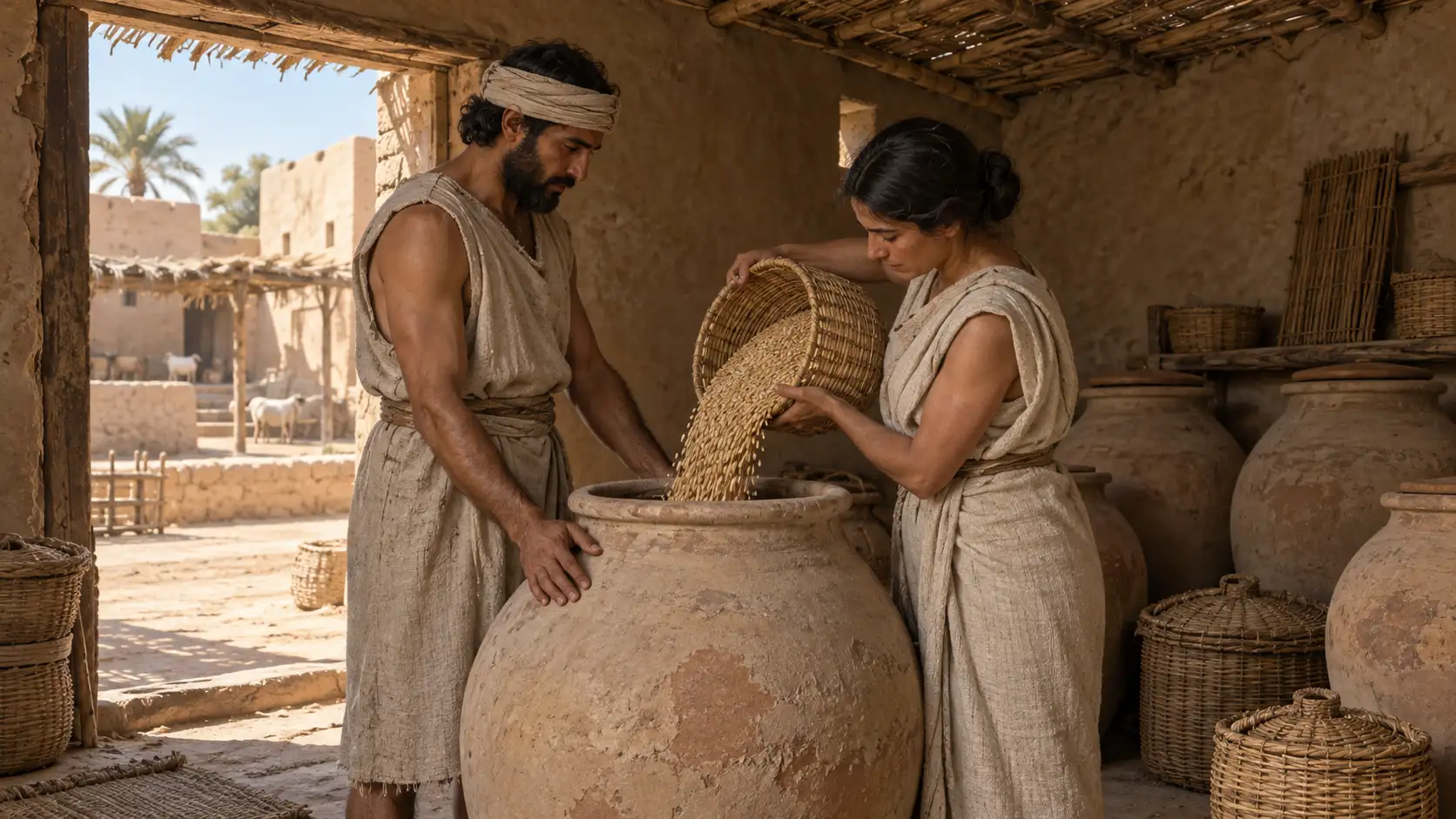
    The imagined storeroom below focuses on the handling of grain. Its containers and workers illustrate the activity; they do not identify a particular temple store or the owner of its supplies.

    AI illustration of people handling grain among containers in a mud-brick storeroom.
    AI-generated interpretative illustration for Libradia: imagined grain handling in a Mesopotamian storeroom. It does not reproduce an excavated building or establish ownership of the supplies.

    What the grain accounts record

    One early tablet in the Metropolitan Museum of Art, dated approximately 3100–2900 BCE and probably from Uruk, records an administrative account of barley distribution. The museum interprets it as most likely connected with a large temple, while noting that early texts can be difficult to understand because they lack verbs. The Met: Administrative account of barley distribution, 1988.433.1

    The tablet shows why durable records mattered to institutions handling grain. Its scope is narrower than a household’s food supply: an administrative account can record an allocation without revealing everything that its recipients ate.

    A much later tablet, approximately 2029 BCE and probably from Umma, records a shipment of barley. It belongs to the Ur III period, nearly a millennium after the earlier example. Here the surviving record draws attention to movement: supplies could be documented as they passed between places or responsible parties. The Met: Tablet recording a shipment of barley, 86.11.243

    Provisions for messengers

    Another tablet from Umma, dated approximately 2028 BCE, records beer, bread, oil and onions intended for messengers. Its named purpose makes it especially useful. Rather than listing foods supposedly eaten by all “Sumerians,” it shows what was allocated to a particular group on a recorded occasion. The Met: Food allocations for messengers, 1985.180.2

    It also reveals why translating an allocation into a modern idea of a wage can be misleading. The document tells us about provisions; it does not settle every question about the recipients’ employment, other resources or household arrangements. Food could sustain work and travel without every distribution having the same social meaning.

    There is a further gap between a written allocation and consumption. Recording supplies does not show whether every portion arrived as intended, how it was shared, or exactly how it was prepared. Even a precise list of provisions leaves some details of the eventual meal unknown.

    Evidence beyond the grain accounts

    At Shakhi Kora in the Sirwan/Upper Diyala region of north-east Iraq, researchers examined food residues in fourth-millennium BCE bevelled-rim bowls. Their results indicate several foods, with many vessels apparently used for broths or stews made with meat or marrow. The study also discusses animal remains and institutional food provision. Antiquity: There and back again — local institutions and an Uruk expansion

    This is a regional comparison, not direct evidence for a meal in southern Uruk. Its value is that it warns against assigning one universal content or purpose to a common-looking bowl. Pottery form, residues and the surrounding deposits need to be considered together. The researchers suggest that some meals may have compensated labour; the food residues alone do not prove that relationship. Antiquity: There and back again — local institutions and an Uruk expansion

    The work behind a city

    Feeding an urban population required more than a productive field. It linked seasonal supplies with daily needs, and physical goods with decisions about access. Institutions are especially visible because they left buildings and records, while much of the work of preparing and sharing food is harder to recover.

    That uneven evidence should shape the picture rather than stop us from looking. Canals, containers, food traces and accounts illuminate different parts of the same practical problem. Behind the monuments stood repeated acts of producing, carrying, keeping and preparing food. To understand Sumer’s cities and institutions, we need to follow those acts as carefully as we follow its rulers.

  • Sumer: A World of Cities, Temples and Trade

    A city needs more than houses. Its people must obtain food, organise work and maintain connections with the surrounding countryside. In Sumer, the cities of southern Mesopotamia brought those demands together with temples, rulers and networks of exchange. Understanding how these parts fitted together is a useful way into their history.

    This article follows that working landscape from irrigated fields to urban institutions and the objects that travelled between distant places. It begins with the foundations of city life, then considers worship, wealth and political change. Sumer was a changing world of communities, not one unified country with an unbroken history under a single ruler.

    At a glance

    Where
    Southern Mesopotamia, in present-day Iraq.
    Focus
    The growth of cities and the Early Dynastic period, with a later political overview.
    The question
    How did food, worship, authority and exchange connect Sumer’s cities?

    Where was Sumer?

    Sumer occupied southern Mesopotamia, in what is now Iraq. It was part of a wider region shaped by the Tigris and Euphrates rivers. Its early urban history stretches across the later fourth and third millennia BCE; this article concentrates on the growth of cities and the Early Dynastic period, approximately 2900–2350 BCE. These dates are a working chronological framework, not sharply defined moments when everyday life changed everywhere. The Met: Mesopotamian chronology.

    During the Early Dynastic period, political power was divided among competing city-states. Each had its own rulers. Sharing a cultural world did not mean obeying the same king, and the history of Sumer cannot be read as the uninterrupted history of one unified country. The Met: city-states before Akkadian rule.

    The cities rested on older foundations

    People had been making a living in the southern landscape well before its great cities emerged. The earlier Ubaid communities cultivated land using irrigation and drew food from rivers and the Persian Gulf. At places such as Eridu, increasingly substantial buildings formed part of a long history of settlement. The Met’s account of the Ubaid period stresses continuity with the urban developments that followed. The Met: the Ubaid period.

    That continuity matters. A city required more than an impressive building. Its inhabitants needed dependable access to food, materials and other people’s labour. Irrigated cultivation was one important foundation of southern Mesopotamian settlement. The fields and waterways therefore belong in the story alongside the monuments: the visible centre was only one part of the community’s working landscape.

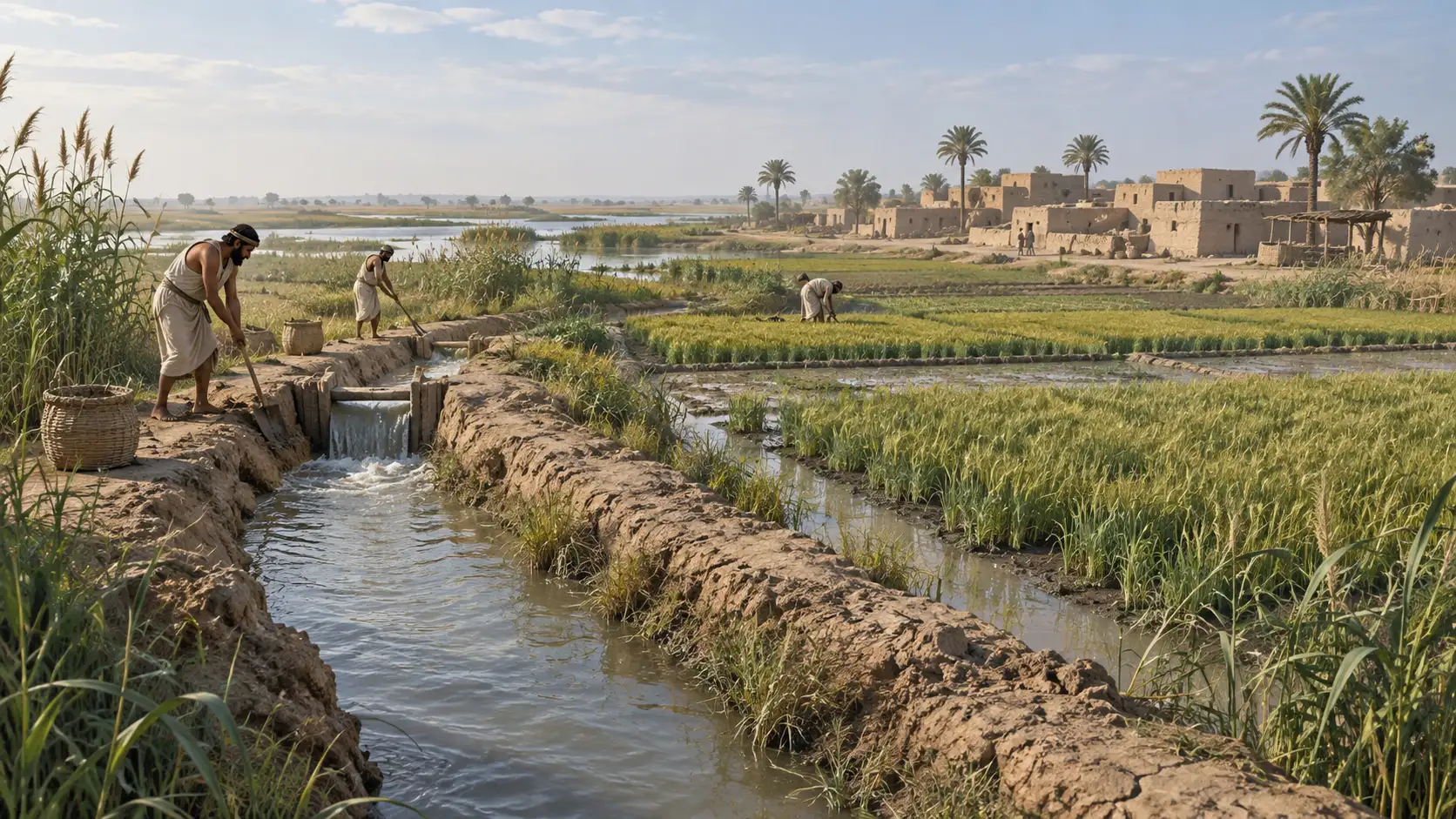
    The illustration below imagines a landscape supporting early urban communities in the late fourth millennium BCE. Its fields, water channel and buildings help connect the discussion of food production with settlement; their exact arrangement is an artistic interpretation.

    Irrigation channels, barley fields and a settlement in an imagined southern Mesopotamian landscape.
    AI-generated interpretative illustration for Libradia, inspired by southern Mesopotamia in the late fourth millennium BCE. The people, buildings and activities are imagined; this is not an exact reconstruction of a documented scene.

    Temples made authority visible

    Early Dynastic temples were understood as places where gods dwelt. Their small inner shrines were probably accessible to a limited group, rather than to crowds gathering for a service in the modern sense. Some people commissioned statues of worshippers, commonly shown with clasped hands, which scholars interpret as representing their donors before a deity. The exact placement and use of many surviving examples remain uncertain. The Met: Early Dynastic sculpture.

    The statues offer an unusually personal point of entry into this world. Some inscriptions identify a donor and profession. Yet even a named statue gives us a formal act of devotion, not a complete biography. The formal pose tells us more about how devotion was represented than about the donor’s private thoughts.

    Rulers also presented their authority through obligations to gods and cities. Temple building, warfare, justice and the maintenance of walls and canals belonged to the responsibilities associated with kingship. Belief and government were closely connected, although their relationship changed over time. Getty: First Kings.

    A city’s wealth could come from far away

    A headdress excavated at Ur gives these distant connections a visible form. Its gold leaves are separated by lapis lazuli and carnelian beads. Dated approximately 2600–2500 BCE, it belonged to one of the female attendants buried in the tomb conventionally called the King’s Grave. The Met: headdress from Ur.

    Gold, lapis lazuli and carnelian were not local products of the Mesopotamian river plain. Bringing them to Ur and turning them into jewellery required connections across distance as well as craft knowledge. The photograph shows the surviving object; it does not reveal the route taken by every material or the lives of all the people who handled it.

    Gold-leaf headdress with lapis lazuli and carnelian beads from a burial at Ur.
    Headdress, Ur, c. 2600–2500 BCE. The Metropolitan Museum of Art, Dodge Fund, 1933, 33.35.3. Public Domain.

    Nor was such splendour typical of everyone buried at Ur. Excavation exposed a large cemetery containing many relatively simple graves, alongside the exceptional tombs called royal. Reading only the richest discoveries would give a distorted picture of the wider population. Their importance lies partly in the contrast they expose. The Met: Ur’s cemetery.

    This is a recurring challenge in early history. An extraordinary object attracts attention because it survives and is beautiful. To understand the society around it, we must also ask how exceptional it was and whose lives are less clearly represented.

    Sumer’s political world did not stand still

    The independence of the city-states was not permanent. In the twenty-fourth century BCE, Sargon of Akkad brought southern Mesopotamian cities under his rule through conquest. The resulting imperial order changed the scale of political power. Its own control later weakened, and local rulers again asserted independence. These changes caution against treating centuries of Sumerian history as a single snapshot. The Met: the Akkadian period.

    Much later than the first urban expansion, the Third Dynasty of Ur, conventionally dated approximately 2112–2004 BCE, again united southern Mesopotamia. The Met’s chronology places major ziggurat construction in this period. These stepped monuments belong to a later chapter than the initial growth of cities. The Met: Third Dynasty of Ur.

    Three points in the changing political landscape
    Approximate date Context
    2900–2350 BCE Early Dynastic city-states.
    24th century BCE Sargon’s conquests expand Akkadian rule.
    2112–2004 BCE The Third Dynasty of Ur.

    Dates follow the Met’s chronology and its account of the Akkadian period; they are approximate.

    What makes Sumer a useful starting point?

    Sumer lets us examine how urban life joined together food production, authority, worship and connections across distance. It also teaches us to distinguish what an object shows from what we would like it to explain. A grave reveals a burial, a statue represents a worshipper, and a monument materialises an investment of labour. None is a transparent window onto an entire population.

    The aim is therefore to understand particular places and changes, rather than award one society a prize for being first. From this regional introduction, Uruk offers a closer view: a city where monumental buildings and early records allow us to investigate how people organised life on a new scale.

  • How Writing Began in Mesopotamia: From Accounts to Language

    How do you preserve information when the person who remembers it is no longer there? A record can keep a quantity available to check again, but a brief account may still depend on knowledge shared by its users. The early writing of Mesopotamia brings both possibilities into view.

    This article begins with the surviving evidence from Uruk and then examines a small account concerning malt and barley groats. From there, it follows changes in the use of signs, sounds and writing tools. These changes expanded what writing could express; they do not point to a single known inventor or a single moment when the whole system was complete.

    At a glance

    Place
    Mesopotamia, beginning with early evidence from Uruk.
    Focus
    From early accounts to a script used for several languages.
    The question
    How could signs preserve quantities, words and sounds?

    When does the evidence appear?

    Proto-cuneiform is documented at Uruk in southern Iraq in the later fourth millennium BCE. A recent study by Kathryn Kelley, Mattia Cartolano and Silvia Ferrara uses approximately 3350–3000 BCE for its early attestation there. This is a date range for surviving evidence and archaeological phases, not a birthday for writing. The same study notes difficulties in comparing chronologies across sites. Kelley, Cartolano and Ferrara: Seals and signs.

    This article follows the Mesopotamian evidence. It does not assume that every writing system elsewhere descended from Uruk. Even within Southwest Asia, researchers investigate how different forms of recording contributed to the surviving script, rather than reconstructing the work of a single known inventor.

    Recording information before full written language

    Writing developed in an environment already rich in ways to mark and identify things. Cylinder seals are one example. A carved cylinder could be rolled over clay to leave a continuous design. Seal impressions served identification or ownership functions and could be applied to clay closing containers or to tablets. The design was repeatable without being drawn again each time. The Met: cylinder seals and impressions.

    A seal impression, a numerical record and a written sentence do different jobs. Recognising that distinction prevents us from treating every old mark as a complete writing system. A design can establish an association; a count can register an amount. Neither necessarily records how a person would say a sentence aloud.

    Kelley and her colleagues have proposed specific connections between earlier seal motifs and some proto-cuneiform signs, including motifs involving textiles and vessels. Their research argues for contributions from existing administrative imagery. It does not demonstrate that every written sign came from a seal, or eliminate other proposed contributions to writing’s development. Kelley, Cartolano and Ferrara.

    What did early records actually say?

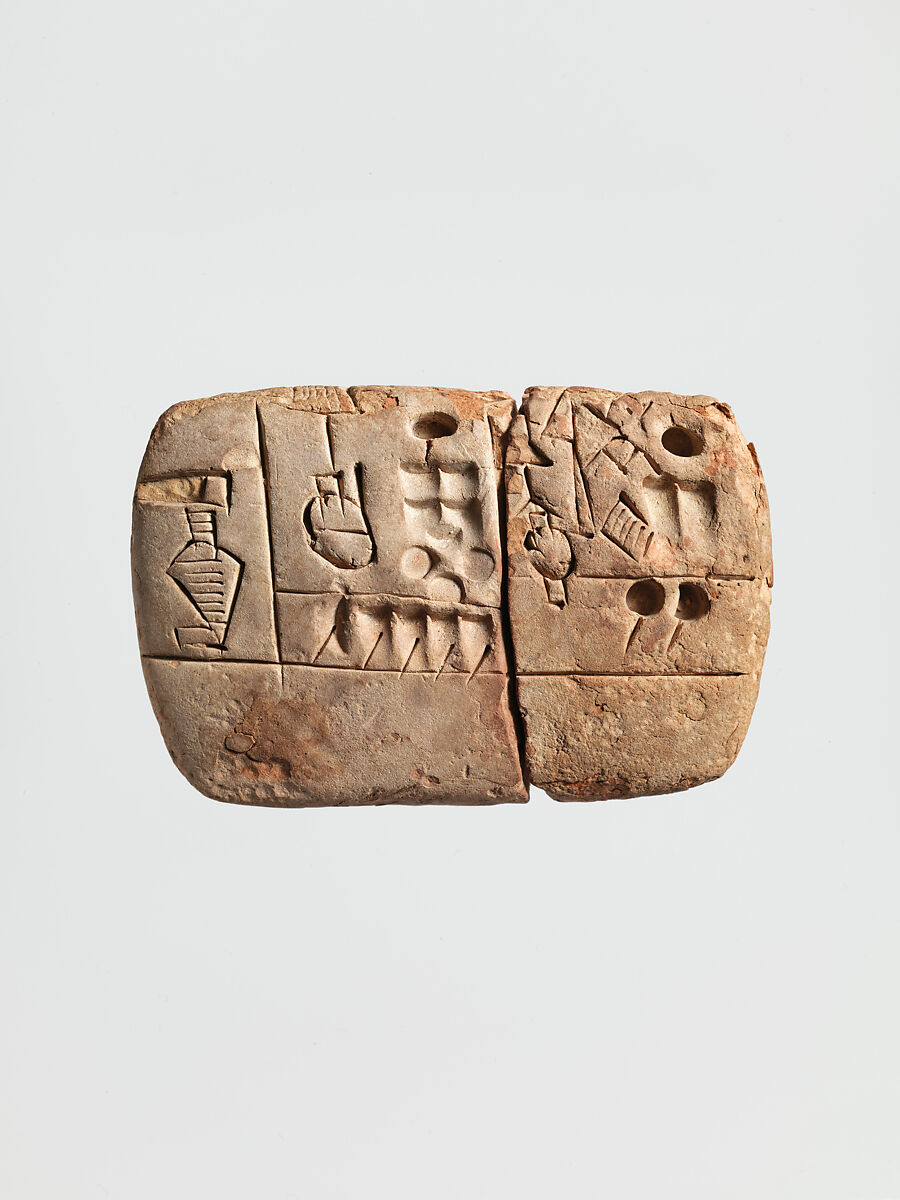
    A tablet in The Met provides a specific example. Dated approximately 3100–2900 BCE and catalogued as probably from Uruk, it contains entries concerning malt and barley groats. The museum interprets it as most likely recording grain distributed by a large temple. The Met: tablet 1988.433.3.

    Early clay tablet with signs recording an account concerning malt and barley groats.
    Administrative tablet, probably Uruk, c. 3100–2900 BCE. The Metropolitan Museum of Art, Purchase, Raymond and Beverly Sackler Gift, 1988, 1988.433.3. Public Domain.

    The marks on this small object preserve an account, rather than a complete description of the activity behind it. The Met explains that early records combined commodity signs and numbers while leaving much grammatical information unstated. People involved in the transaction may have understood details that a modern reader cannot recover. The Met: interpreting an early administrative account.

    A modern example — not a translation

    flour — 12

    Twelve sacks, weights, deliveries or quantities still owed? An outsider would need context that the record’s users might know immediately. This modern comparison illustrates a difficulty in interpreting brief accounts.

    How signs could represent sounds

    A crucial development was the use of signs for sounds, allowing writing to move beyond the direct naming or depiction of things. This is often explained through the rebus principle.

    The rebus principle — a modern English illustration

    sun + day → Sunday

    Pictures suggesting “sun” and “day” can prompt a word through their sounds. This teaching example is not an ancient Sumerian spelling.

    In his account of writing’s origins, Ira Spar distinguishes early, limited phonetic uses from their more consistent appearance after approximately 2600 BCE. That development made it easier to represent language with combinations of word-signs and sound-signs. It was an extended change, rather than one moment when all pictorial signs vanished. Ira Spar: The Origins of Writing.

    Why does cuneiform look wedge-shaped?

    Writing technique also changed. Early signs could be drawn into moist clay; later writers impressed a stylus to produce characteristic wedge-shaped marks. “Cuneiform” refers to that wedge-shaped appearance. The changing shapes and the growing ability to represent language are related parts of the story, but they are not the same development. Ira Spar: signs and writing technique.

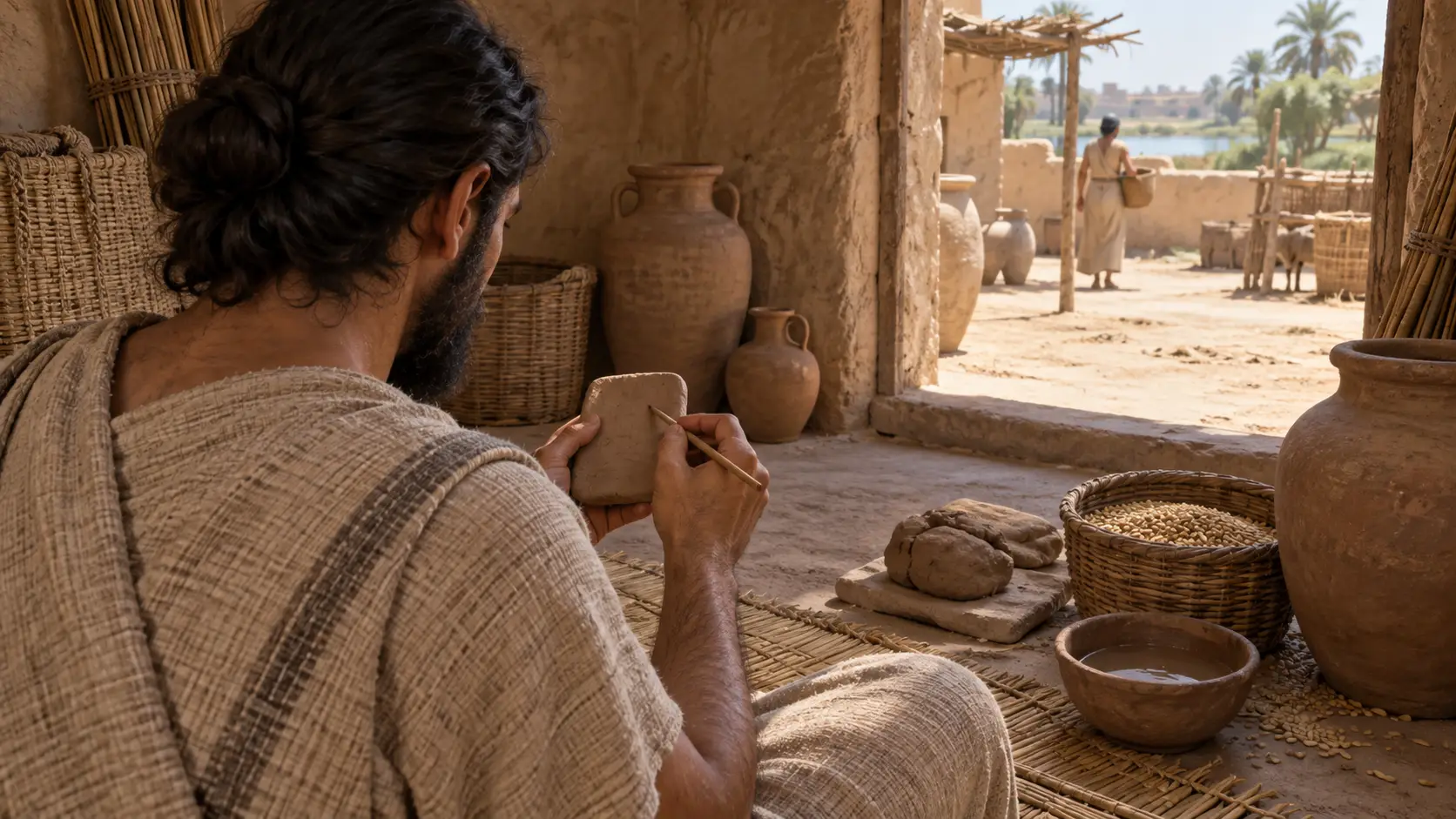
    The illustration below imagines the act of working with clay and a reed stylus. The person, room and arrangement of objects are invented for the illustration. The museum photograph earlier in the article shows an actual surviving tablet; this scene helps picture a possible activity without reproducing or translating its signs.

    An imagined administrative worker holding a clay tablet and reed stylus beside a basket of grain.
    AI-generated interpretative illustration for Libradia, inspired by southern Mesopotamia in the late fourth millennium BCE. The people, buildings and activities are imagined; this is not an exact reconstruction of a documented scene.

    The distinction remains useful when looking at a museum display. A tablet with recognisable pictures is not necessarily a simple illustrated story, and one covered with wedges is not necessarily written in the same language as the next tablet.

    Cuneiform was used for more than one language

    Sumerian and Akkadian are languages; cuneiform is a writing system used to record both. Yale’s descriptions of the two languages illustrate how broad their written traditions became. Sumerian texts include administrative records, letters, royal inscriptions, lamentations and other literary compositions. Akkadian texts likewise range from private correspondence to treaties and scholarly works. These collections span long periods and should not all be projected back into Uruk’s earliest records. Yale: Sumerian; Yale: Akkadian.

    In other words, the label on the writing system does not tell us everything about a text. We still need its language, date, purpose and setting. A letter and an account can share a script while asking very different things of their readers.

    Accounts did not disappear when literature became possible

    More than a millennium after the earliest Uruk tablets, people were still recording grain. A tablet in The Met, dated approximately 2029 BCE and probably from Umma, records a shipment of barley and carries a cylinder-seal impression. It provides a later example of administration continuing alongside writing’s other uses. The Met: barley-shipment tablet 86.11.243.

    The history of writing is therefore not a journey in which poetry simply replaces bookkeeping. Its range expanded. Systems developed for particular tasks became capable of preserving many other kinds of information, while the practical need to record goods and obligations remained. A small account can be as revealing about that history as a celebrated literary text.

  • Uruk: How an Early City Worked

    What did it take to keep an early city working? Houses and monumental buildings were only part of the answer. A large community also needed food, materials, labour and ways to keep track of what moved between people and institutions.

    Uruk, at the site now known as Warka in southern Iraq, offers an early view of these connections. This article follows its watery surroundings, large buildings and administrative records. The evidence lets us investigate the organisation of the city while leaving many details of individual lives uncertain.

    At a glance

    Place
    Uruk, at Warka in southern Iraq.
    Focus
    The late fourth millennium BCE, with later evidence clearly distinguished.
    The question
    What did it take to keep an early city working?

    A city in a changing waterscape

    The dry setting of the ruins can be misleading. UNESCO describes Uruk, Ur and Eridu as cities that developed close to freshwater marshes in the changing deltaic landscape of southern Mesopotamia. Rivers, wetlands and shifting waterways were part of the environment in which urban life took shape. The modern view is not a photograph of the ancient landscape. UNESCO: the Ahwar and the Mesopotamian cities.

    That setting changes how we picture the relationship between a city and its surroundings. Water was part of its productive landscape, not simply something beyond the buildings. UNESCO’s assessment brings hydraulic works, storage areas, production spaces and residential neighbourhoods into the same account of these urban centres. Feeding and maintaining a city depended on the connections among such places.

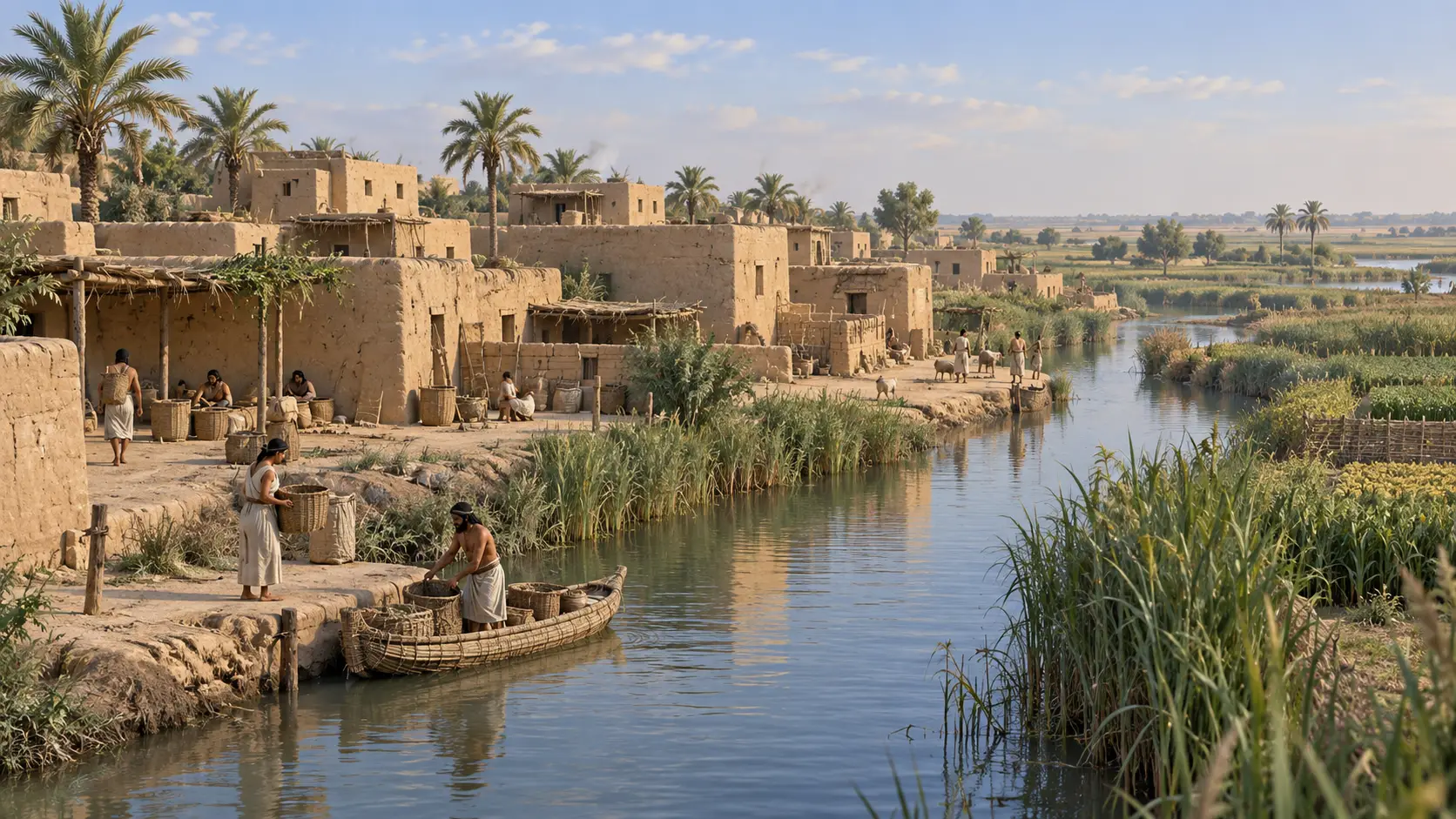
    The accompanying illustration offers one imagined view of that relationship: buildings beside water, with reeds, a boat and baskets connecting the settlement to its surroundings. It is not a plan of an excavated neighbourhood or evidence for a particular boat journey.

    An imagined urban waterside scene inspired by early Uruk, with mud-brick buildings and a boat carrying baskets.
    AI-generated interpretative illustration for Libradia, inspired by southern Mesopotamia in the late fourth millennium BCE. The people, buildings and activities are imagined; this is not an exact reconstruction of a documented scene.

    It is therefore useful to think beyond a boundary drawn around the houses. A city could concentrate people and authority while remaining closely dependent on resources outside its built centre.

    Building at a scale larger than a household

    Some of Uruk’s monumental buildings carried patterns made from coloured cones embedded in their walls. The decoration belonged to a city whose scale, by around 3200 BCE, set it apart in southern Mesopotamia. Its builders were working with mud brick, yet the result was architecture intended to command attention. The Met: Uruk.

    The remains of the White Temple and its elevated setting are among Uruk’s most distinctive early monuments. The conservation specialists working there describe structures made largely from earth blocks, including surviving traces of plaster, paint and floors. Those fragile materials can preserve evidence of ambitious construction, even where little of the original height remains. ZRS: conservation of the White Temple.

    Reading a monument

    Evidence
    Large structures, earth blocks and surviving finishes.
    Inference
    Construction required materials and labour to be coordinated beyond a single household.
    Open questions
    Who recruited the workforce, how people were supported and how willingly they participated.

    Nor should all of Uruk’s sacred architecture be combined into one imaginary skyline. The conservation account distinguishes the early White Temple complex from the substantially later Eanna ziggurat. A reconstructed scene needs a date as well as a place.

    Keeping track of grain

    A small clay tablet in The Met makes the administrative side of this world more concrete. Dated approximately 3100–2900 BCE, it is catalogued as probably from Uruk. Its numerical marks and other signs are interpreted as an account of barley distribution, most likely associated with a large temple. The findspot and precise transaction remain uncertain. The Met: tablet 1988.433.1.

    The tablet also carries impressions from a cylinder seal. Marks used to record quantities thus shared a surface with imagery. The surviving impression shows a male figure with dogs and boars in a marsh setting. The object lets us see accounting and representations of authority together, although it does not preserve the full conversation or procedure behind the account.

    Clay administrative tablet with early signs, numerical marks and seal impressions, probably from Uruk.
    Administrative tablet, probably Uruk, c. 3100–2900 BCE. The Metropolitan Museum of Art, Purchase, Raymond and Beverly Sackler Gift, 1988, 1988.433.1. Public Domain.

    Records like this made some information available beyond a person’s immediate memory. Their usefulness lay in enabling quantities and categories to be checked again. Early administrative writing offers a view into that work; it is much less direct evidence for how an individual household experienced the city.

    Objects reveal another kind of expertise

    A stone bowl fragment from southern Mesopotamia, dated approximately 3300–2900 BCE, preserves a bull whose body is carved in shallow relief while its head projects towards the viewer. The fragment belongs to the artistic world of the Late Uruk and Jemdet Nasr periods; its museum record does not identify Uruk itself as its findspot. The Met: bowl fragment with bulls.

    The contrast with an administrative tablet is instructive. One object records an account; the other required a sculptor to work an animal’s body around a vessel’s surface. Urban society involved multiple forms of knowledge. The Met notes that vessels of this kind occur in important religious or palace settings, suggesting special uses. That does not allow us to reconstruct a particular ceremony for this fragment.

    Much of the city remains beneath the surface

    Excavated monuments are only part of what archaeologists can study. Geophysicist Jörg W. E. Fassbinder describes magnetic surveys at Uruk that trace buried settlement areas, waterways and features associated with the city wall. Such work helps researchers investigate large areas without exposing every building through excavation. Fassbinder: magnetic traces of Uruk-Warka.

    The method also has limits. A buried outline may suggest a canal or structure, but its date and function may require excavation. Fassbinder explicitly identifies features for which that remains necessary. Because Uruk was occupied across many periods, a survey map cannot automatically be treated as a complete plan of the city in 3200 BCE.

    This is how the picture becomes more detailed: broad surveys identify relationships across the site, while excavations and associated finds help establish what those relationships mean and when they existed.

    Where does Gilgamesh fit?

    Later tradition associated Uruk’s wall with Gilgamesh. The Met describes him as possibly a historical ruler around 2700 BCE who became the hero of later stories. The distinction separates a literary tradition from a securely documented construction record. It also places the familiar hero after the city’s major fourth-millennium expansion. The Met: Gilgamesh and Uruk.

    Uruk’s importance does not depend on proving every later story about it. Monuments, objects, records and traces of waterways already reveal a community working at an extraordinary scale. Its early tablets lead to another question: how did a system for recording things and quantities develop into writing capable of expressing language?