
How do you preserve information when the person who remembers it is no longer there? A record can keep a quantity available to check again, but a brief account may still depend on knowledge shared by its users. The early writing of Mesopotamia brings both possibilities into view.
This article begins with the surviving evidence from Uruk and then examines a small account concerning malt and barley groats. From there, it follows changes in the use of signs, sounds and writing tools. These changes expanded what writing could express; they do not point to a single known inventor or a single moment when the whole system was complete.
At a glance
- Place
- Mesopotamia, beginning with early evidence from Uruk.
- Focus
- From early accounts to a script used for several languages.
- The question
- How could signs preserve quantities, words and sounds?
When does the evidence appear?
Proto-cuneiform is documented at Uruk in southern Iraq in the later fourth millennium BCE. A recent study by Kathryn Kelley, Mattia Cartolano and Silvia Ferrara uses approximately 3350–3000 BCE for its early attestation there. This is a date range for surviving evidence and archaeological phases, not a birthday for writing. The same study notes difficulties in comparing chronologies across sites. Kelley, Cartolano and Ferrara: Seals and signs.
This article follows the Mesopotamian evidence. It does not assume that every writing system elsewhere descended from Uruk. Even within Southwest Asia, researchers investigate how different forms of recording contributed to the surviving script, rather than reconstructing the work of a single known inventor.
Recording information before full written language
Writing developed in an environment already rich in ways to mark and identify things. Cylinder seals are one example. A carved cylinder could be rolled over clay to leave a continuous design. Seal impressions served identification or ownership functions and could be applied to clay closing containers or to tablets. The design was repeatable without being drawn again each time. The Met: cylinder seals and impressions.
A seal impression, a numerical record and a written sentence do different jobs. Recognising that distinction prevents us from treating every old mark as a complete writing system. A design can establish an association; a count can register an amount. Neither necessarily records how a person would say a sentence aloud.
Kelley and her colleagues have proposed specific connections between earlier seal motifs and some proto-cuneiform signs, including motifs involving textiles and vessels. Their research argues for contributions from existing administrative imagery. It does not demonstrate that every written sign came from a seal, or eliminate other proposed contributions to writing’s development. Kelley, Cartolano and Ferrara.
What did early records actually say?
A tablet in The Met provides a specific example. Dated approximately 3100–2900 BCE and catalogued as probably from Uruk, it contains entries concerning malt and barley groats. The museum interprets it as most likely recording grain distributed by a large temple. The Met: tablet 1988.433.3.
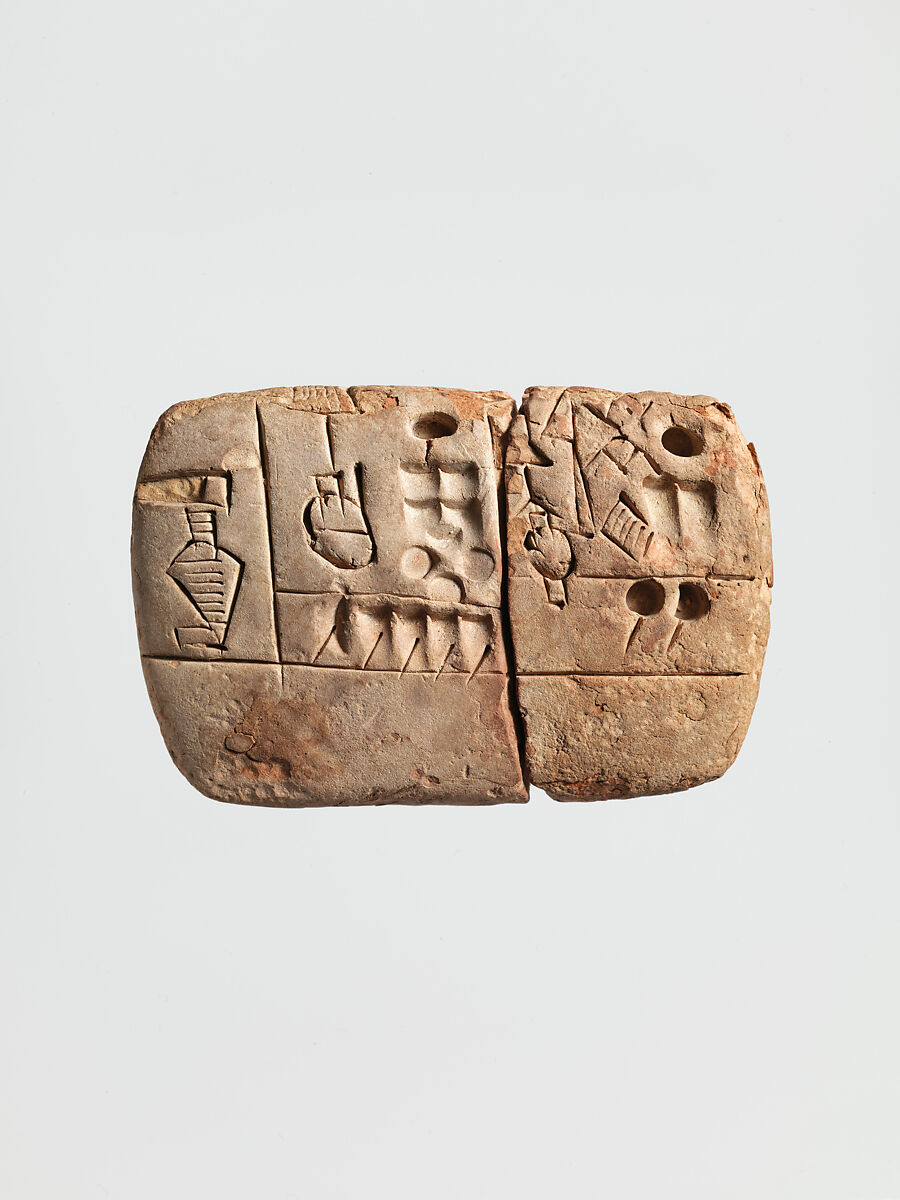
The marks on this small object preserve an account, rather than a complete description of the activity behind it. The Met explains that early records combined commodity signs and numbers while leaving much grammatical information unstated. People involved in the transaction may have understood details that a modern reader cannot recover. The Met: interpreting an early administrative account.
A modern example — not a translation
flour — 12
Twelve sacks, weights, deliveries or quantities still owed? An outsider would need context that the record’s users might know immediately. This modern comparison illustrates a difficulty in interpreting brief accounts.
How signs could represent sounds
A crucial development was the use of signs for sounds, allowing writing to move beyond the direct naming or depiction of things. This is often explained through the rebus principle.
The rebus principle — a modern English illustration
sun + day → Sunday
Pictures suggesting “sun” and “day” can prompt a word through their sounds. This teaching example is not an ancient Sumerian spelling.
In his account of writing’s origins, Ira Spar distinguishes early, limited phonetic uses from their more consistent appearance after approximately 2600 BCE. That development made it easier to represent language with combinations of word-signs and sound-signs. It was an extended change, rather than one moment when all pictorial signs vanished. Ira Spar: The Origins of Writing.
Why does cuneiform look wedge-shaped?
Writing technique also changed. Early signs could be drawn into moist clay; later writers impressed a stylus to produce characteristic wedge-shaped marks. “Cuneiform” refers to that wedge-shaped appearance. The changing shapes and the growing ability to represent language are related parts of the story, but they are not the same development. Ira Spar: signs and writing technique.
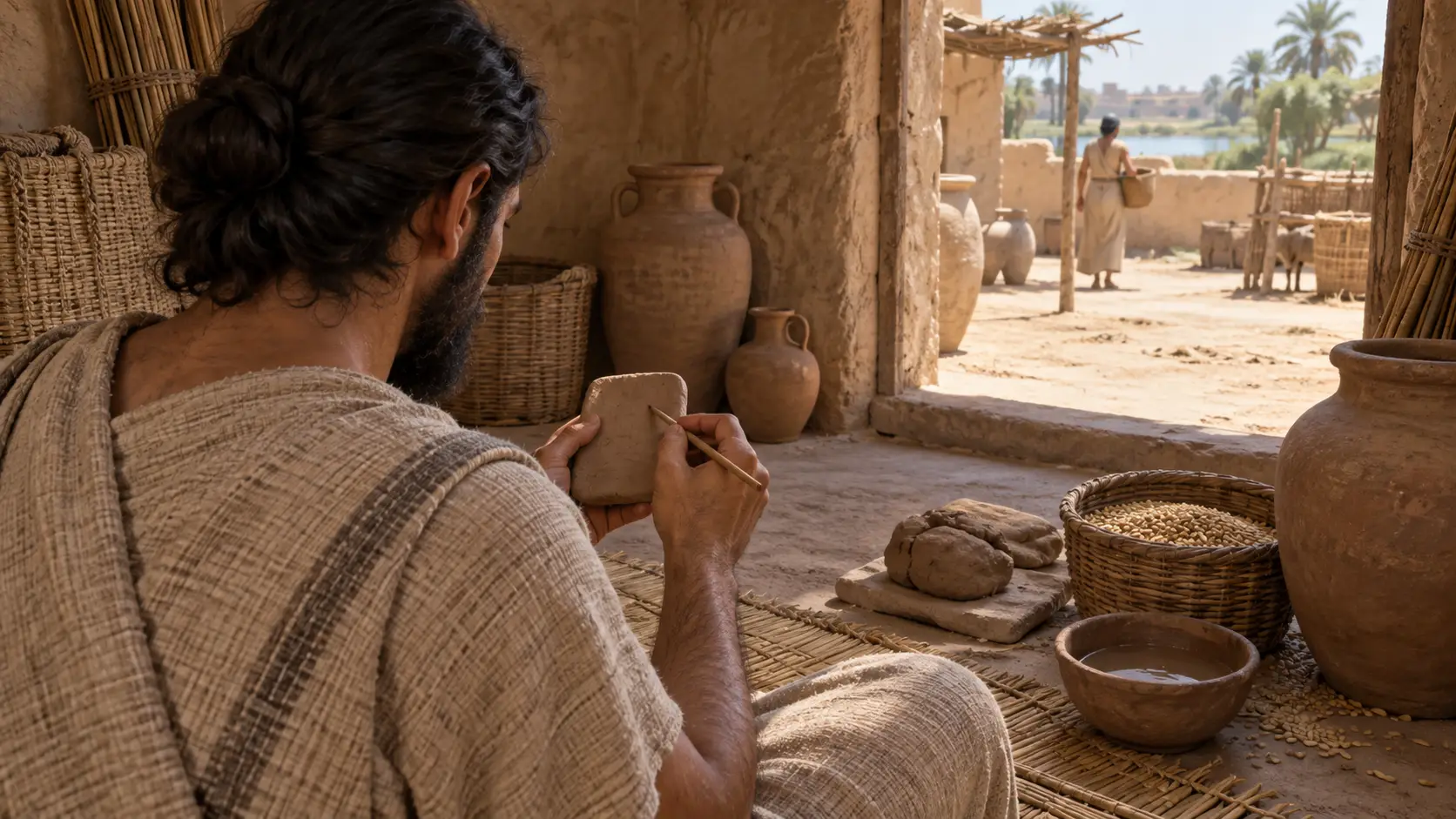
The illustration below imagines the act of working with clay and a reed stylus. The person, room and arrangement of objects are invented for the illustration. The museum photograph earlier in the article shows an actual surviving tablet; this scene helps picture a possible activity without reproducing or translating its signs.
The distinction remains useful when looking at a museum display. A tablet with recognisable pictures is not necessarily a simple illustrated story, and one covered with wedges is not necessarily written in the same language as the next tablet.
Cuneiform was used for more than one language
Sumerian and Akkadian are languages; cuneiform is a writing system used to record both. Yale’s descriptions of the two languages illustrate how broad their written traditions became. Sumerian texts include administrative records, letters, royal inscriptions, lamentations and other literary compositions. Akkadian texts likewise range from private correspondence to treaties and scholarly works. These collections span long periods and should not all be projected back into Uruk’s earliest records. Yale: Sumerian; Yale: Akkadian.
In other words, the label on the writing system does not tell us everything about a text. We still need its language, date, purpose and setting. A letter and an account can share a script while asking very different things of their readers.
Accounts did not disappear when literature became possible
More than a millennium after the earliest Uruk tablets, people were still recording grain. A tablet in The Met, dated approximately 2029 BCE and probably from Umma, records a shipment of barley and carries a cylinder-seal impression. It provides a later example of administration continuing alongside writing’s other uses. The Met: barley-shipment tablet 86.11.243.
The history of writing is therefore not a journey in which poetry simply replaces bookkeeping. Its range expanded. Systems developed for particular tasks became capable of preserving many other kinds of information, while the practical need to record goods and obligations remained. A small account can be as revealing about that history as a celebrated literary text.