
Bringing in a harvest was only the beginning of feeding a city. Grain must be gathered, moved, kept usable and eventually prepared. When many people live close together, those tasks connect fields outside a settlement with storerooms, institutions and households within it.
For the early cities of Mesopotamia, food supply was part of the organisation of urban life. Evidence comes from different periods and places: villages before the cities, early administrative tablets, excavated food remains and more detailed records from later urban societies. Together they show several parts of the process, though never a complete account of every resident’s diet.
At a glance
- Where
- Primarily southern Mesopotamia; one comparison from Shakhi Kora in north-east Iraq.
- When
- Late fourth and third millennia BCE, with earlier agricultural background.
- Question
- How did food reach people whose work kept a city running?
Farming was already old when cities grew
The growth of cities did not introduce agriculture to southern Mesopotamia. During the earlier Ubaid period, communities farmed with irrigation and exploited fish from rivers and the Gulf. The urban world developed out of a landscape already shaped by food production and settlement. The Met: The Ubaid Period
That background changes the story. The challenge was not simply discovering how to grow more grain. It was organising relationships between producers and the people who depended on them. A potter, builder or administrator might contribute essential work without producing everything needed for their own meals.
We should therefore picture the city together with its surrounding land and waterways. The built-up area was only one part of the system. Food production continued beyond its streets, and access to that production mattered as much as the height of its public buildings.
Water required continuing work
Irrigation supported intensive cultivation in the southern alluvial plain. Getty’s account of early urban growth emphasises the maintenance of canals and the role of major temple estates. Canal work was an ongoing responsibility, not a single engineering achievement completed when a settlement was founded. Getty: Mesopotamia — Civilization Begins
This helps explain why discussions of agriculture soon become discussions of labour and authority. A channel links more than one patch of ground. Clearing and maintaining it raises practical questions about who works, who coordinates the work and who benefits from the water. The evidence does not justify assuming that every channel, field or harvest belonged to one central institution.
From field to meal
- Production
- Obtaining food from cultivated land, animals and other resources.
- Storage
- Keeping supplies usable between collection and consumption.
- Distribution
- Moving or allocating supplies to the people who will use them.
A harvest had to last
Harvests and daily meals follow different schedules. Storage helps bridge the gap. A reserve of grain can support later meals, but it also creates work. Containers must be filled and handled; the contents must remain accessible and protected. The practical problem is easy to recognise even where the particular arrangements are uncertain.
Ceramic vessels had been used for preparing, serving and storing food in Mesopotamia long before urbanisation. Their long history should not be confused with a single standard city warehouse. A jar, a room and a large institutional store represent different scales of organisation. Identifying a vessel’s particular contents or a building’s function requires evidence from its archaeological setting. The Met: Mesopotamia, 8000–2000 B.C.
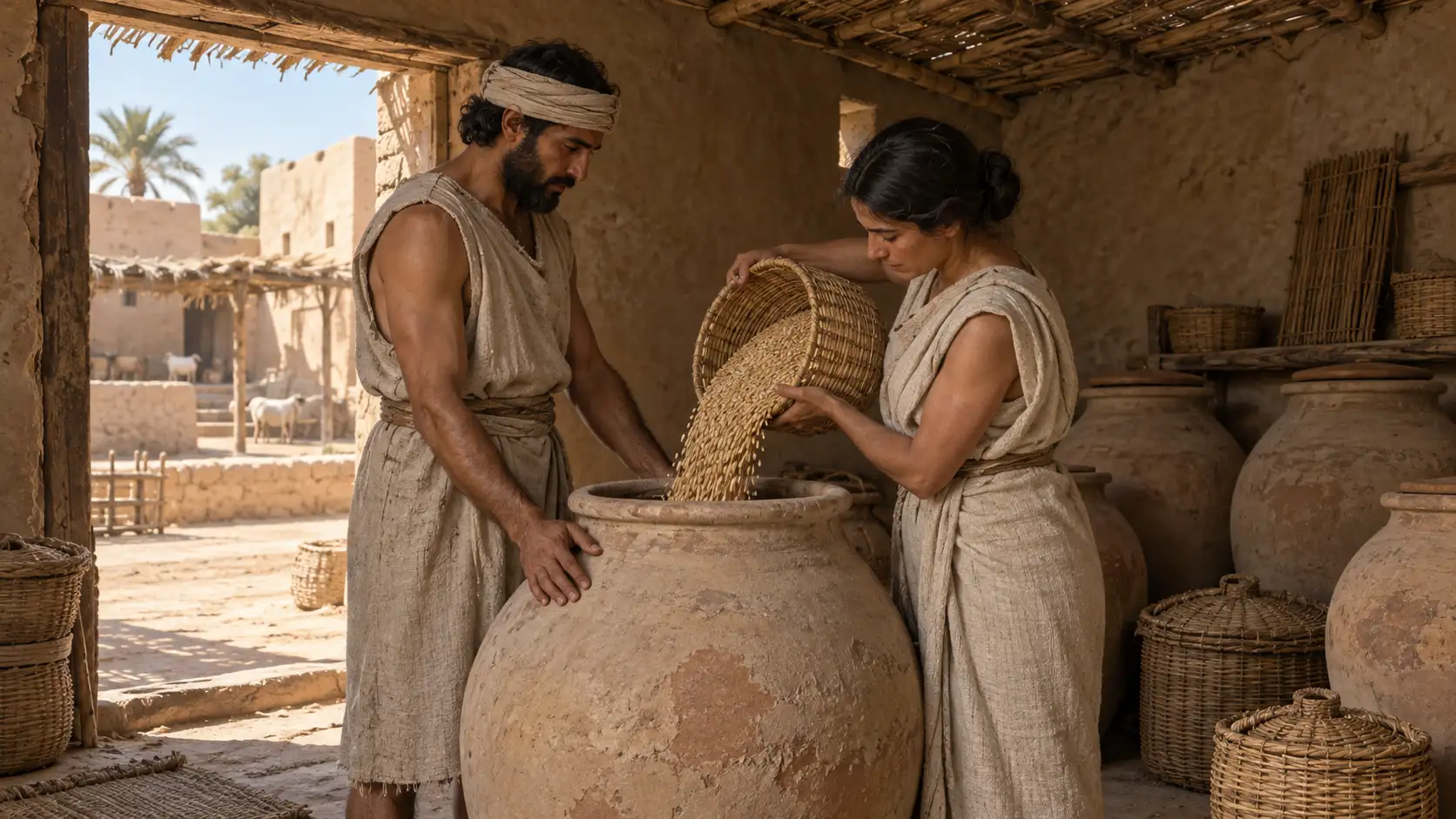
The imagined storeroom below focuses on the handling of grain. Its containers and workers illustrate the activity; they do not identify a particular temple store or the owner of its supplies.
What the grain accounts record
One early tablet in the Metropolitan Museum of Art, dated approximately 3100–2900 BCE and probably from Uruk, records an administrative account of barley distribution. The museum interprets it as most likely connected with a large temple, while noting that early texts can be difficult to understand because they lack verbs. The Met: Administrative account of barley distribution, 1988.433.1
The tablet shows why durable records mattered to institutions handling grain. Its scope is narrower than a household’s food supply: an administrative account can record an allocation without revealing everything that its recipients ate.
A much later tablet, approximately 2029 BCE and probably from Umma, records a shipment of barley. It belongs to the Ur III period, nearly a millennium after the earlier example. Here the surviving record draws attention to movement: supplies could be documented as they passed between places or responsible parties. The Met: Tablet recording a shipment of barley, 86.11.243
Provisions for messengers
Another tablet from Umma, dated approximately 2028 BCE, records beer, bread, oil and onions intended for messengers. Its named purpose makes it especially useful. Rather than listing foods supposedly eaten by all “Sumerians,” it shows what was allocated to a particular group on a recorded occasion. The Met: Food allocations for messengers, 1985.180.2
It also reveals why translating an allocation into a modern idea of a wage can be misleading. The document tells us about provisions; it does not settle every question about the recipients’ employment, other resources or household arrangements. Food could sustain work and travel without every distribution having the same social meaning.
There is a further gap between a written allocation and consumption. Recording supplies does not show whether every portion arrived as intended, how it was shared, or exactly how it was prepared. Even a precise list of provisions leaves some details of the eventual meal unknown.
Evidence beyond the grain accounts
At Shakhi Kora in the Sirwan/Upper Diyala region of north-east Iraq, researchers examined food residues in fourth-millennium BCE bevelled-rim bowls. Their results indicate several foods, with many vessels apparently used for broths or stews made with meat or marrow. The study also discusses animal remains and institutional food provision. Antiquity: There and back again — local institutions and an Uruk expansion
This is a regional comparison, not direct evidence for a meal in southern Uruk. Its value is that it warns against assigning one universal content or purpose to a common-looking bowl. Pottery form, residues and the surrounding deposits need to be considered together. The researchers suggest that some meals may have compensated labour; the food residues alone do not prove that relationship. Antiquity: There and back again — local institutions and an Uruk expansion
The work behind a city
Feeding an urban population required more than a productive field. It linked seasonal supplies with daily needs, and physical goods with decisions about access. Institutions are especially visible because they left buildings and records, while much of the work of preparing and sharing food is harder to recover.
That uneven evidence should shape the picture rather than stop us from looking. Canals, containers, food traces and accounts illuminate different parts of the same practical problem. Behind the monuments stood repeated acts of producing, carrying, keeping and preparing food. To understand Sumer’s cities and institutions, we need to follow those acts as carefully as we follow its rulers.