
A damaged irrigation bank could turn one farmer’s mistake into a neighbour’s lost harvest. A disputed deposit could set two households against each other. A badly built house could kill the people inside it. These are among the problems addressed in the collection known as Hammurabi’s laws. Its concerns reach well beyond the punishments for which it is famous.
To read it carefully is to encounter a society arguing about responsibility, property and status. It is also to encounter a king presenting himself as the source of just government. Those two things belong together, but a royal statement about justice is not automatically a record of what happened in every courtroom.
A monument to law—and to a king
Hammurabi ruled Babylon in the eighteenth century BCE. The Louvre dates his reign to 1792–1750 BCE, following the chronology commonly used for this period. The most famous surviving version of his laws is inscribed on a basalt stele about 2.25 metres high. French excavators found it at Susa, in present-day Iran, in 1901–1902; it is now in the Louvre. Its findspot should not be mistaken for Hammurabi’s capital. Louvre: stele bearing Hammurabi’s laws (SB 8)
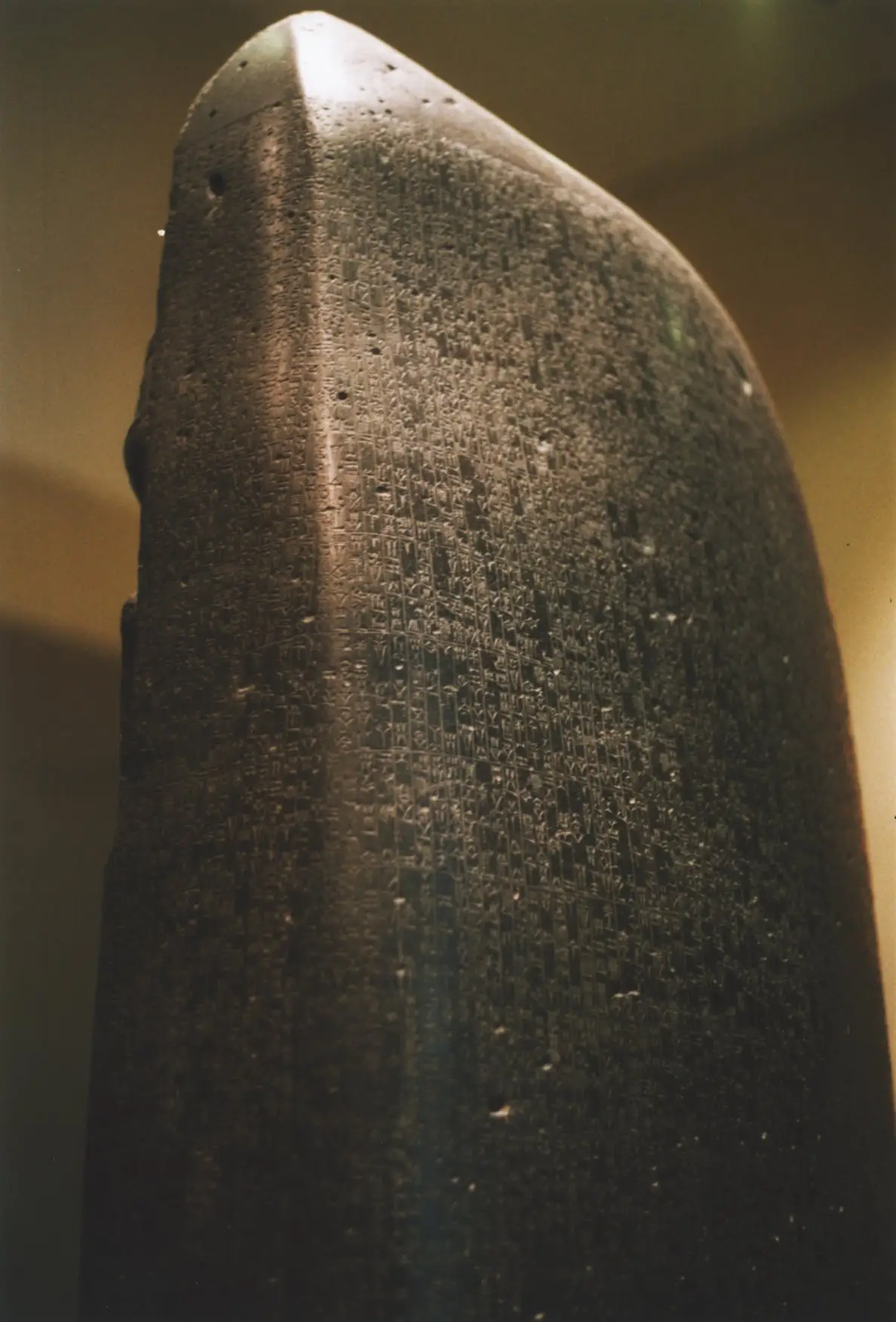

The monument joins a carved image to a long inscription. Its physical form matters: this was an enduring display of royal authority as well as a text. Looking at the stone, we should ask both what its provisions say and what kind of ruler its makers wanted people to see.
Babylon’s importance also needs a date. The city’s history extended far beyond Hammurabi. The monumental Babylon associated with Nebuchadnezzar II belongs to the first millennium BCE, much later than the Old Babylonian world discussed here. Combining those periods into one timeless scene would obscure how much changed. The Met: Babylon
What happens when someone causes a loss?
Many provisions use a case-based structure: a situation is described, followed by a consequence. That makes the collection unusually concrete. Rather than beginning with an abstract definition of negligence, it asks what should happen when an embankment is neglected and water damages other people’s crops.
In the conventionally numbered provisions 53–54, responsibility for that damage falls on the person who failed to maintain the bank. The text envisages compensation for the grain lost and a severe further consequence if compensation cannot be provided. The issue is not simply that water escaped. It is that one person’s management of a shared agricultural environment could impose costs on others. Hammurabi’s laws: translation at the Avalon Project
The building provisions pose a related question. Sections 229–233 distinguish deaths, damage to property and deficient construction. Their penalties include consequences that are profoundly unequal and disturbing to a modern reader. Yet the cases also expose a recognisable practical problem: who bears responsibility when paid work fails? We can recognise the problem without treating the proposed solution as our own. Hammurabi’s laws: translation at the Avalon Project
Why “an eye for an eye” is incomplete
The bodily-injury provisions are often reduced to a single slogan. Reading the neighbouring cases changes the picture. In sections 196–201, the prescribed response varies with the injured person’s status: bodily retaliation in one case, a payment in another, and compensation connected to an enslaved person’s value in another. This is not equality before the law in its modern sense. Hammurabi’s laws: translation at the Avalon Project
The distinctions require care in translation. Older English versions use labels such as “freed man” or “gentleman” that should not be read as transparent equivalents of modern social categories. The underlying point is more secure than any easy comparison: legal status affected the protection a person received and the consequences of harming them.
That changes the question we ask of the collection. Was a penalty predictable? Was it proportionate within the text’s own hierarchy? Was the same protection available to everyone? These are different tests of justice. A system can articulate responsibility clearly while distributing rights unequally.
Records, witnesses and everyday disputes
The text also pays attention to evidence. Provisions 122–124 describe the deposit of valuables, witnesses and an agreement, followed by a dispute in which the recipient denies having received the property. A written or witnessed arrangement could help establish what had been entrusted to whom. Hammurabi’s laws: translation at the Avalon Project
Here the usefulness of a scribe becomes easier to understand. Recording a transaction gave it a form that could outlast the spoken exchange. That does not mean every inhabitant could read the record, or that every disagreement followed one uniform procedure. It means the collection itself presents documentation and testimony as consequential.
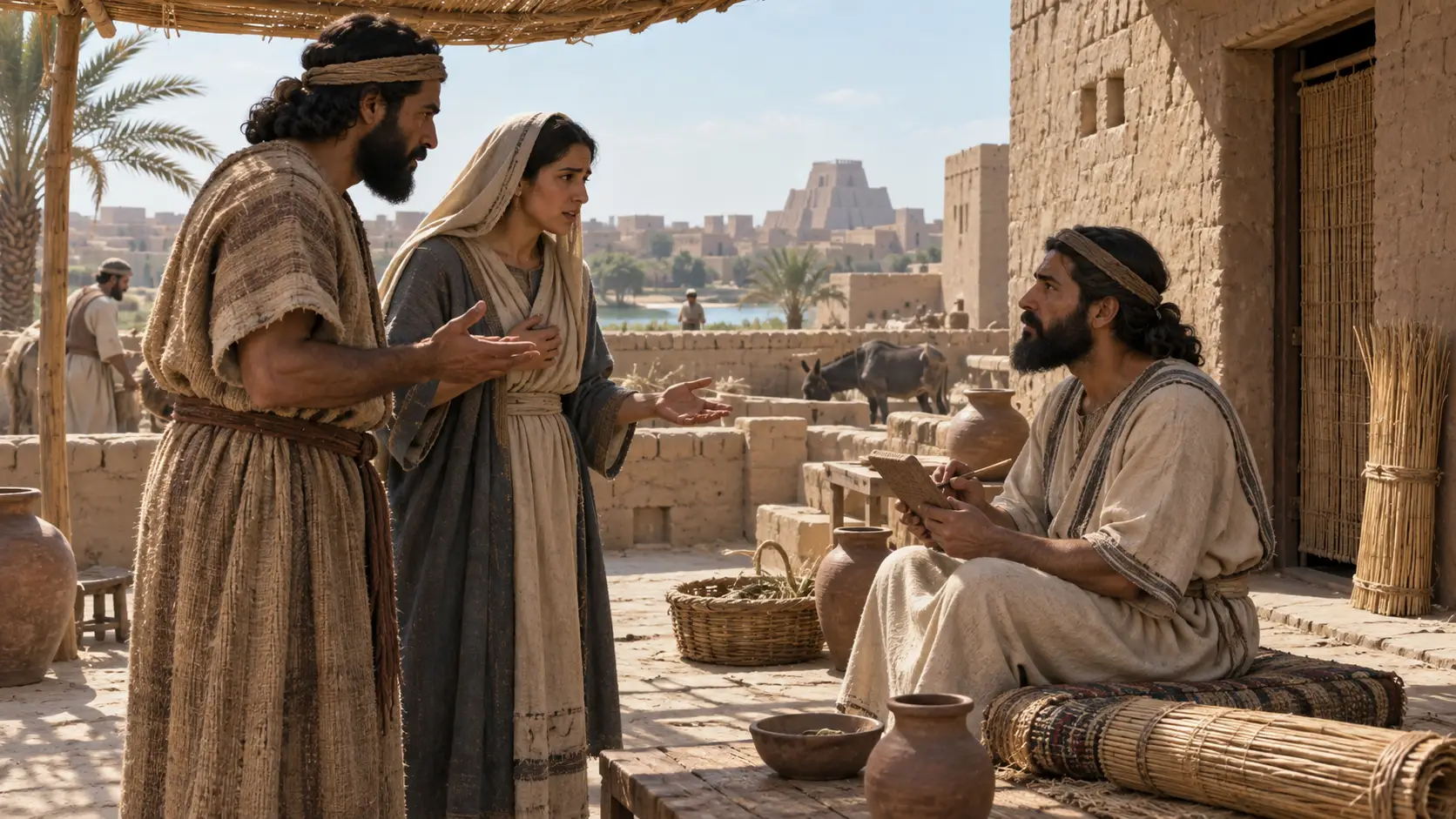
The illustration imagines people bringing a matter to a scribe. The specific courtyard, individuals and encounter are invented. The historical evidence discussed here is the provision about deposits and witnesses, not the scene’s gestures or arrangement of furniture.
Other provisions bring household relationships into the picture. Section 148, for example, addresses a husband’s continuing support for a wife affected by illness; section 149 considers her departure with her dowry. Such clauses show that the collection cannot be understood solely through its most violent penalties. They do not establish that women and men enjoyed equal power, or tell us how often the stated protection was secured in practice. Hammurabi’s laws: translation at the Avalon Project
The ruler’s image of justice
Above the inscription, Hammurabi stands before the seated god Shamash. The Louvre identifies the scene with the divine legitimation of the king’s authority. The relief is therefore part of the argument made by the monument: royal judgement is presented within a sacred order. Louvre: stele bearing Hammurabi’s laws (SB 8)
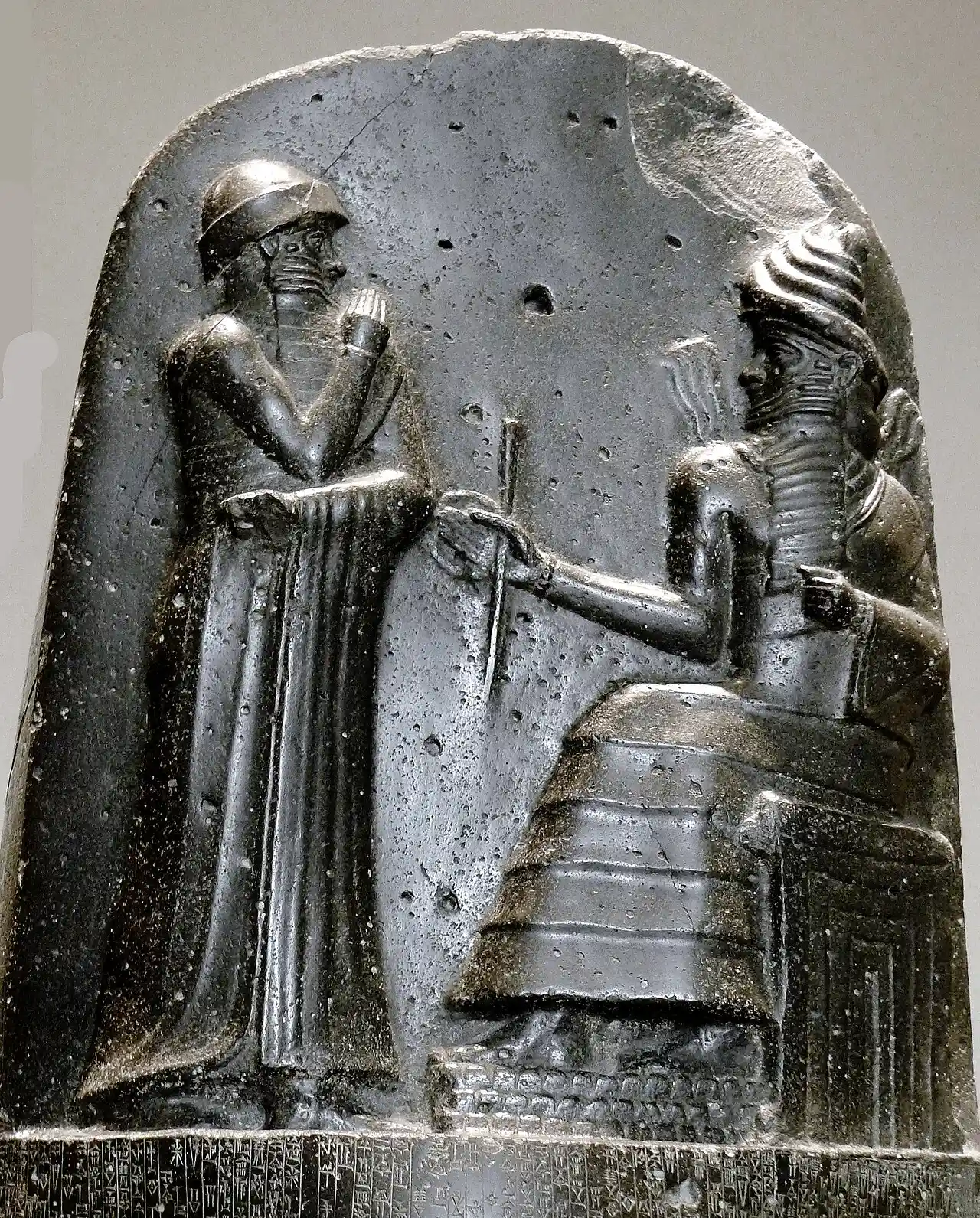

The inscription’s concluding passages reinforce that presentation. They invite a wronged person to encounter the king’s words and celebrate Hammurabi’s protection of the vulnerable. This is a claim made by the royal text, not independent proof that every vulnerable person received protection. Hammurabi’s laws: translation at the Avalon Project
What the laws can—and cannot—tell us
The safest way to use this source is to keep its cases, its hierarchy and its royal purpose in view at the same time. Its provisions reveal problems considered worthy of formal treatment. Its distinctions reveal unequal valuations of people. Its monumentality reveals the prestige attached to a king’s claim to provide justice.
To discover the outcome of a particular dispute, we would need evidence of that dispute. To discover what Hammurabi wanted just rule to look like, this monument is exceptional evidence. The tension between those questions is what makes it more revealing than a list of ancient punishments.