
Julius Caesar was killed at a meeting of the Roman Senate on 15 March 44 BCE. The assassins were not an invading army or an angry crowd. They were men from Rome’s political elite, including people whose careers Caesar had helped. Their decision exposes a problem that military victory had not resolved: who could exercise power in Rome, and who could place limits on it?
The conspirators saw Caesar’s dominance as a threat to the Republic. That explanation matters, but it is not the whole story. Personal rivalries, injured status and competing ideas of liberty also belonged to the world in which they acted. To understand the murder, we need to examine both the power Caesar held and the political expectations he had disrupted.
A republic already under strain
Rome had acquired extensive territories before Caesar became its dominant figure. The Republic therefore already governed an empire in the geographical sense. Its later transformation into an imperial monarchy was a change in how supreme power operated, not the moment Rome first possessed lands overseas.
Expansion brought wealth and opportunities, but also unequal gains, military demands and repeated political crises. Caesar’s dictatorship emerged from a long period of conflict rather than a peaceful system suddenly overturned by one ambitious man. The distinction prevents the assassination from becoming an overly simple contest between a healthy Republic and a solitary destroyer. The Met: The Roman Republic
For a senator, political power involved more than having an official title. It also depended on whether office gave its holder meaningful room to act. Under an overwhelmingly powerful victor, an honour could still be impressive while leaving its recipient dependent on the person who had bestowed it. This tension helps explain why receiving Caesar’s favour did not necessarily produce lasting loyalty.
When exceptional power became permanent
By early 44 BCE, Caesar held the dictatorship for life. Plutarch, writing much later, identifies permanence as a decisive feature of this arrangement. He also describes Caesar promising offices and granting honours to leading Romans. In that account, the victor sought willing cooperation, but the choices available to other politicians increasingly rested on his approval. Plutarch: Life of Caesar, 57–62
A silver denarius in the British Museum makes the concentration of authority unusually tangible. Its inscription identifies Caesar as perpetual dictator. Unlike a later biography, the coin belongs to the political world of 44 BCE itself. It cannot reveal the private thoughts of the assassins, but it provides material evidence for the title around which their fears developed. British Museum: Denarius of Caesar, 1843,0116.170
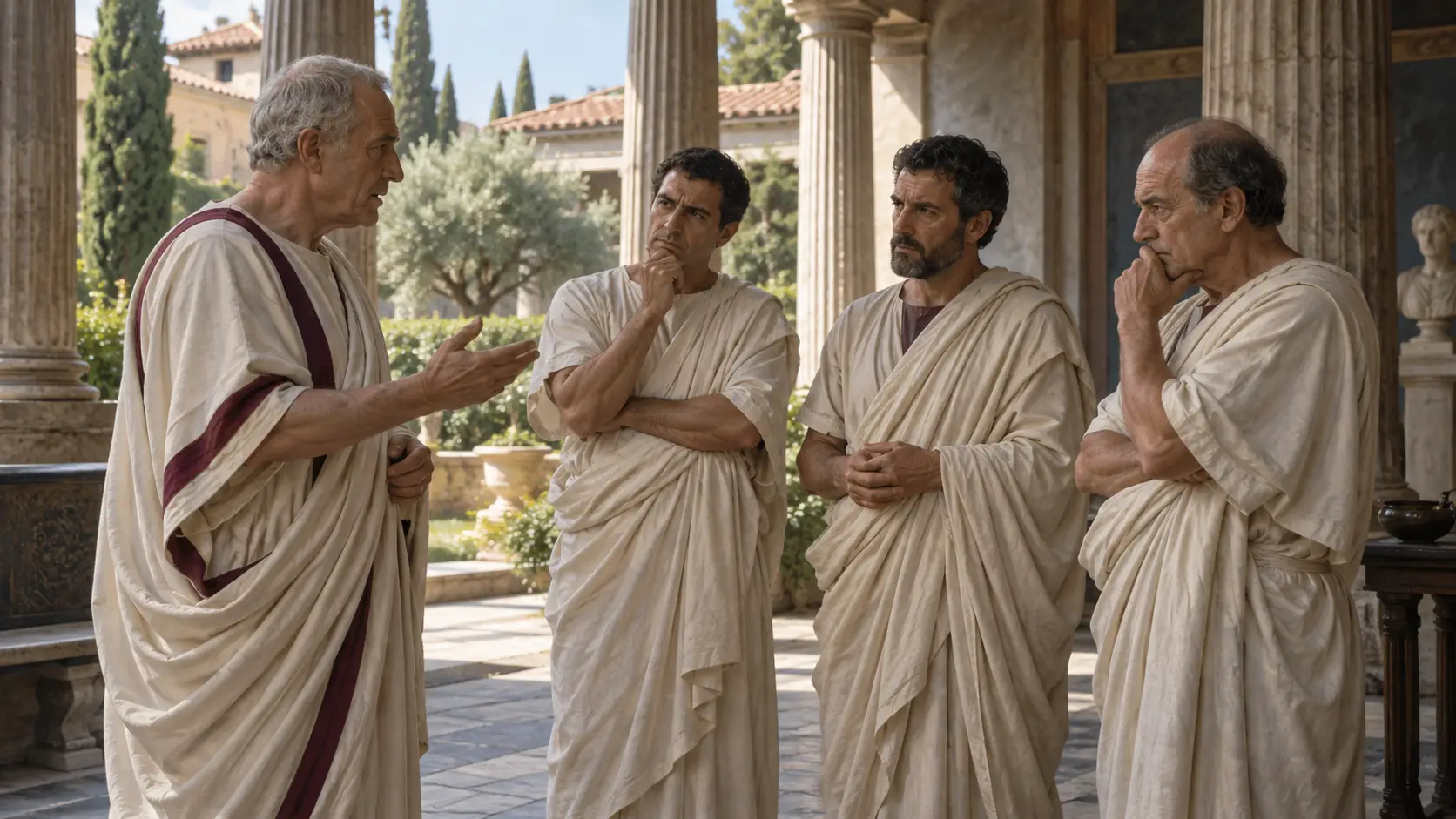
The illustration evokes political discussion, not a surviving record of one. The actual evidence is less visually complete: an inscription on a coin, an archaeological setting and literary accounts composed under later rulers. Bringing these different kinds of evidence together is more useful than treating an imagined scene as a photograph of the conspiracy.
Why the possibility of kingship mattered
Ancient accounts repeatedly connect the growing hostility to suspicions of kingship. Plutarch describes Antony offering Caesar a diadem at the Lupercalia and Caesar refusing it. The refusal did not settle the larger question of how far his power might extend. Plutarch also reports resentment over the treatment of tribunes and over honours that placed Caesar above his fellow citizens. Plutarch: Life of Caesar, 57–62
Suetonius presents another revealing episode: Caesar received a senatorial delegation without standing. He preserves different explanations of what happened. The disagreement is a reminder that even an apparently small gesture reached later readers through competing stories. For senators concerned about their standing, however, the political issue was substantial: were they participants in government or petitioners before a superior? Suetonius: Life of Julius Caesar, 76–82
We should distinguish evidence of suspicion from proof of a settled plan. Accounts of rumours about a crown do not establish precisely what Caesar intended to do next. They do show how the language and symbols of monarchy could turn anxieties about power into an urgent political accusation.
The conspiracy brought different interests together
Suetonius names Gaius Cassius, Marcus Brutus and Decimus Brutus among the leaders. Marcus and Decimus were different men; reducing the story to Caesar and one Brutus obscures the wider coalition. The plot involved more than a single friendship ending in betrayal. Suetonius: Life of Julius Caesar, 76–82
Plutarch’s account of Brutus presents the conspirators as expecting other leading Romans to support liberty once Caesar was dead. That expectation helps explain their choice of a Senate meeting: it brought important political figures together and allowed the attackers to gather without immediately attracting suspicion. Yet an expectation of support is not evidence that the whole Senate had agreed to the murder. Plutarch: Life of Brutus, 14
It would be equally misleading to reduce every participant to a selfish careerist or to assume that all shared an identical constitutional programme. Opposition to one-man rule and concern for personal standing could reinforce each other. The sources let us identify these tensions more confidently than they allow us to rank every conspirator’s motives.
The Ides of March—and the problem left behind
The attack took place in Pompey’s Curia, associated with the theatre complex, rather than in the Senate House that visitors commonly associate with the Roman Forum. Rome’s archaeological authority identifies this hall as the location of the meeting on 15 March. The setting was part of the normal business of government, which helped make it an opportunity for assassination. Roma Capitale: La Curia di Pompeo
The conspirators could remove Caesar more easily than they could settle who would command authority afterwards. Their act did not produce a durable restoration of republican government. Further struggles eventually brought Caesar’s heir Octavian to supremacy; he received the title Augustus in 27 BCE. Caesar’s murder and the establishment of Augustus’s position were separated by years of conflict. The Met: The Roman Republic
Reading the story without its later script
Plutarch and Suetonius wrote long after the assassination. Their biographies preserve valuable traditions, but they also arrange incidents around character, ambition and moral judgement. Their accounts should not be read as transcripts. This is especially important when a story supplies a private conversation, a perfectly timed warning or an explanation of someone’s inner feelings.
The strongest answer to the title’s question is therefore layered. Caesar’s enduring dominance made some senators believe that meaningful republican politics could not survive him. Rivalries and anxieties helped turn opposition into a conspiracy. But the assassins’ confidence that removing the ruler would restore political freedom proved far stronger than their ability to achieve that result.