
A winning army still has to eat the next morning. Before Alexander reached the battlefield of Gaugamela, his route through Mesopotamia had to account for provisions, water and fodder. Arrian’s account explicitly connects the route chosen with supplies and conditions for marching. It is a useful starting point for a conquest so often explained through one man’s personality. Arrian, Anabasis III.7: the approach through Mesopotamia
Alexander’s leadership mattered. So did the army he inherited, the decisions of Persian commanders, control of cities and resources, and the difficult business of turning victory into government. His success becomes more understandable when those parts of the story are brought together.
The army Alexander inherited
Alexander became king of Macedon after Philip II’s assassination in 336 BCE. Philip had already strengthened the kingdom and reorganised its military forces. Infantry carrying the long pike known as the sarissa formed part of that system, alongside cavalry and siege capabilities. Alexander crossed into Asia in 334 BCE with an established military instrument, not an army created from nothing. The Met: Macedon and Alexander’s conquests
The advantage lay in coordination. A formation that could hold an opponent in place had different uses from cavalry able to move rapidly against an opening. Neither worked independently of terrain, discipline and the actions of the enemy. It would be misleading to treat the sarissa as a single invention that made every battle inevitable.
The opponent was the Achaemenid Persian Empire: a vast realm with provincial governors, important cities and long-distance communications. Its territories and populations were diverse. Darius III’s difficulties should not be turned into a claim that the whole empire lacked administrative sophistication or military resources. The Met: The Achaemenid Persian Empire
Victory was not one uninterrupted charge
At Issus in 333 BCE, Alexander defeated an army commanded by Darius himself. In Arrian’s telling, fighting continued in different parts of the field as the Persian position broke down. Darius escaped; his family and camp fell into Macedonian hands. The king’s survival meant that a battlefield defeat had not yet eliminated the rival centre of authority. Arrian, Anabasis II.11: Issus and Darius’s retreat
The famous mosaic from Pompeii compresses a clash between Alexander and Darius into a dramatic encounter. It belongs to a later ancient setting and is conventionally associated with Issus. We should read it as evidence of how the confrontation was represented, rather than as a photograph of the manoeuvres. Alexander Mosaic from Pompeii: photograph and source record

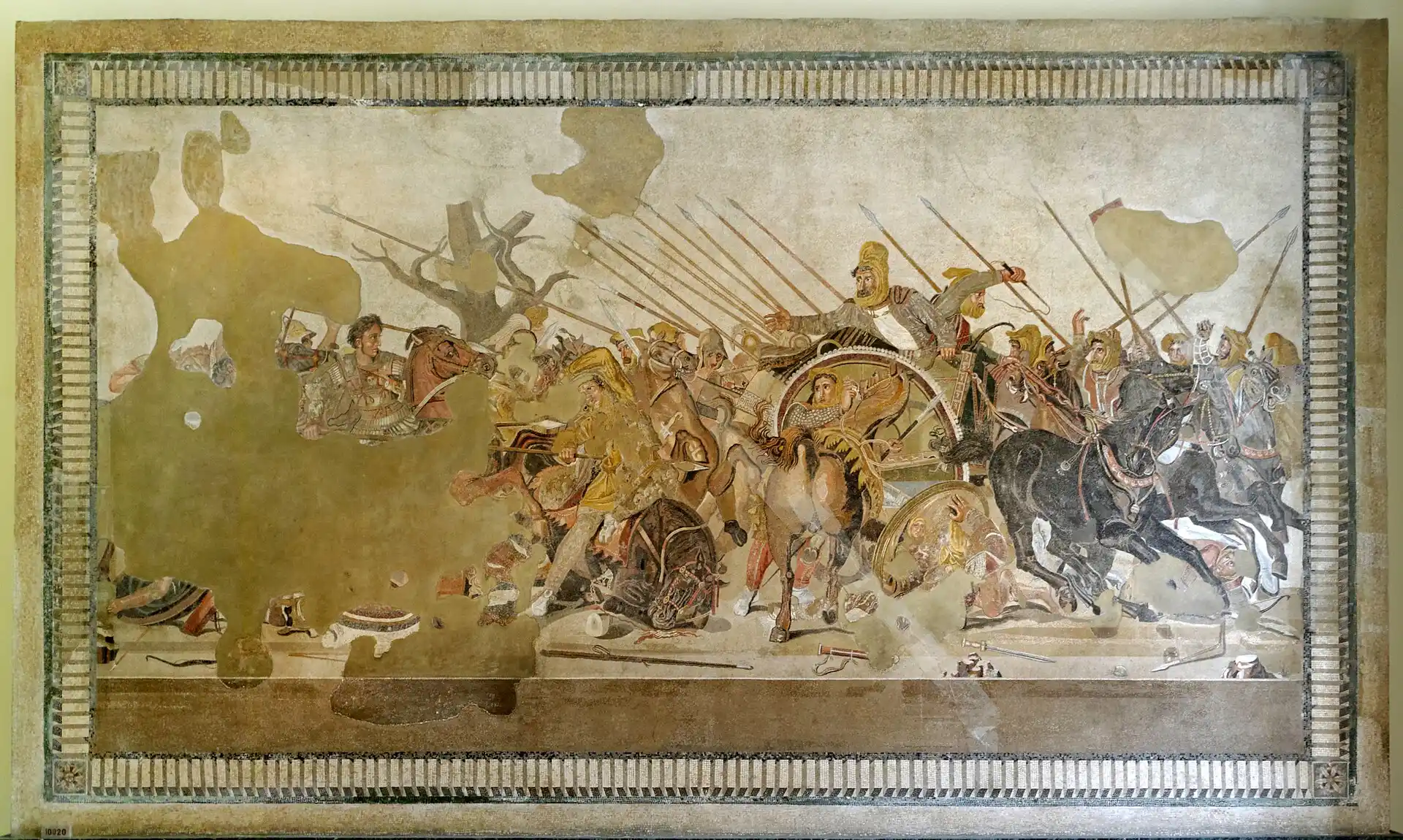
The picture encourages the eye to follow the two rulers. A military explanation has to widen the frame: which troops remained engaged, where lines were disrupted, and whether pursuit left other formations exposed. Even a commanding royal image cannot substitute for those questions.
Gaugamela: exploiting an opening
At Gaugamela in 331 BCE, Arrian describes Alexander turning towards a gap in the Persian front and attacking with Companion cavalry and nearby infantry. That is a specific explanation of how a local opportunity could affect the centre of the opposing army. It is also an account written long after the campaign, not a surviving field report. Arrian, Anabasis III.14: fighting at Gaugamela
Arrian’s own narrative complicates a simple picture of effortless victory. The Macedonian left was under pressure; some opposing cavalry reached the baggage area. Different parts of the battle were unfolding at once. Alexander’s attack towards Darius was decisive in the account, but the soldiers resisting elsewhere also belonged to the explanation.
Ancient battle narratives often provide extremely large army and casualty figures. Those numbers should not be reproduced as if they came from audited muster rolls. Nor can a historian directly verify a defeated king’s private feelings simply because a later author describes them. Here the emphasis is on the reported actions and the problems of command, rather than an exact numerical ratio or a diagnosis of Darius’s character.
Getting the army to the battlefield
Arrian’s description of the approach to Gaugamela brings the countryside back into view. He explains that Alexander did not take the most direct route towards Babylon because another route offered easier access to food and horse fodder and less punishing heat. Crossing the Tigris still proved difficult because of its current, even without enemy troops defending the crossing. Arrian, Anabasis III.7: the approach through Mesopotamia
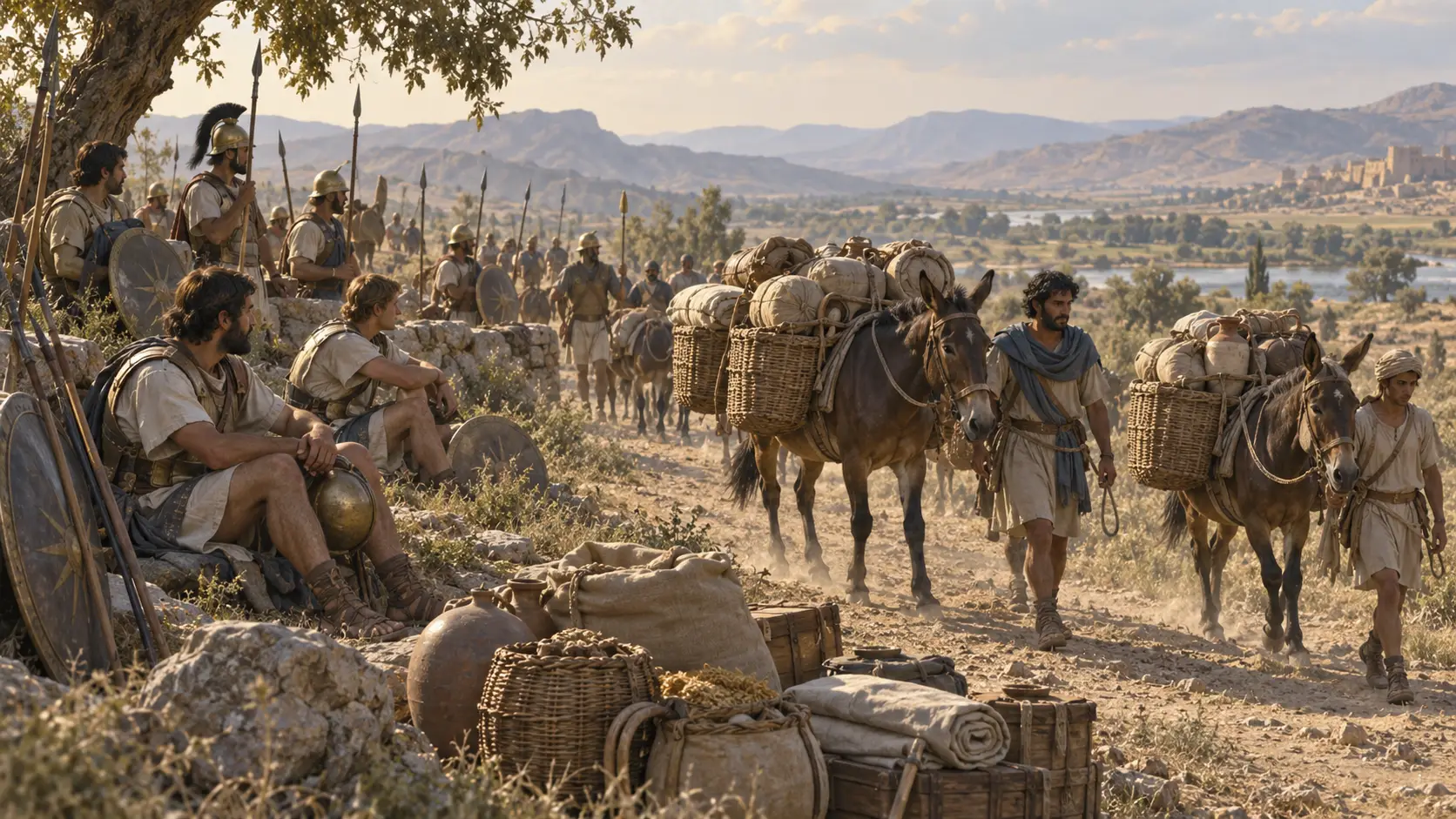
A commander could win a tactical opportunity only if the army arrived capable of using it. Pack animals needed feeding as well as loading. River crossings constrained movement. Rest affected whether soldiers could fight. The illustration is an imagined campaign scene; the evidence for the route and the crossing comes from the written account.
Thinking about supplies also brings local people into the story. Obtaining provisions from a region transferred resources to the invading army. Arrian’s short passage does not describe every transaction or every household’s experience. It nevertheless makes clear why the march cannot be understood solely as movement across an empty map.
How victory became a change of government
After Gaugamela, the contest involved cities, treasuries and officeholders as well as the pursuit of Darius. Arrian records the surrender of Babylon and Alexander’s appointment of Mazaeus as its governor, alongside separate military and revenue officials. At Susa, he describes another surrender and the takeover of royal resources. Arrian, Anabasis III.16: Babylon and Susa
Those arrangements reveal a practical pattern: a conqueror could retain local or Persian officeholders while placing armed force and revenue under new supervision. Taking an empire required access to its existing institutions. It did not require replacing every administrator or inventing a new governing system in each city.
Darius subsequently fell into the hands of men from his own side. Arrian describes his seizure and killing during Alexander’s pursuit. His death did not mean that every region accepted Macedonian rule or that resistance had ended. The campaign continued beyond the defeat of the Achaemenid king. Arrian, Anabasis III.21: the fate of Darius
The culture behind the conqueror’s image
A different mosaic, from Pella in Macedon, depicts two hunters confronting a lion. Unlike the Pompeii battle scene, it presents prowess through a hunt. Identifications of the hunters with Alexander and a companion are interpretations; they are not secure name labels supplied by the image. Lion-hunt mosaic from Pella: photograph and source record

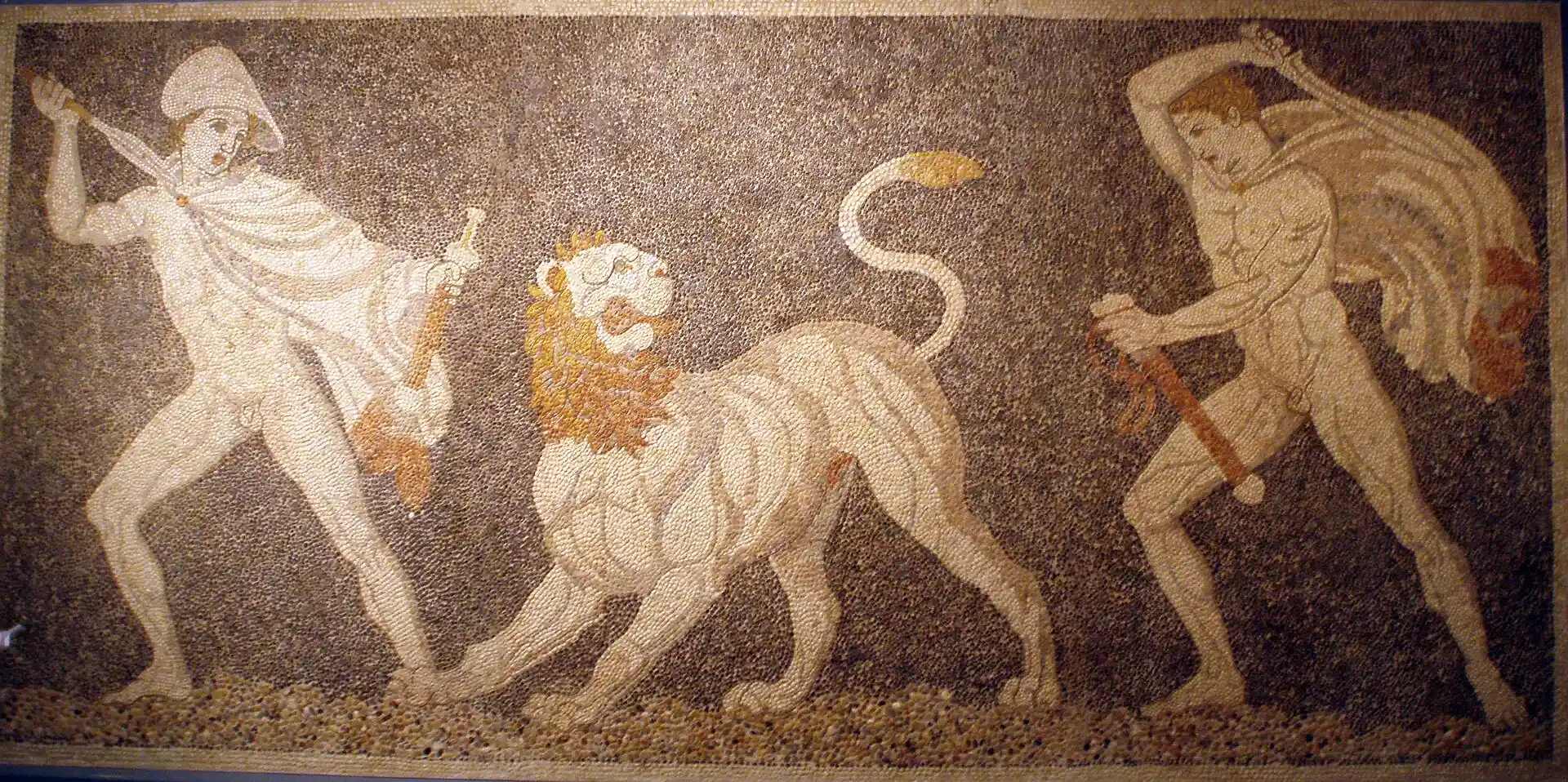
Placing the two mosaics beside the campaign accounts exposes a useful distinction. Images can help us investigate how courage and elite achievement were presented. They cannot by themselves explain why troops held their positions, why a governor surrendered or how supplies reached a marching army.
Alexander defeated Persian royal armies by using an experienced force effectively and exploiting opportunities in battle. He extended those gains through movement, resources and political arrangements. The conquest combined violence with administration. Its speed is remarkable, but its mechanisms remain human—and its effects reached far beyond the two kings shown confronting each other in art.