
A city needs more than houses. Its people must obtain food, organise work and maintain connections with the surrounding countryside. In Sumer, the cities of southern Mesopotamia brought those demands together with temples, rulers and networks of exchange. Understanding how these parts fitted together is a useful way into their history.
This article follows that working landscape from irrigated fields to urban institutions and the objects that travelled between distant places. It begins with the foundations of city life, then considers worship, wealth and political change. Sumer was a changing world of communities, not one unified country with an unbroken history under a single ruler.
At a glance
- Where
- Southern Mesopotamia, in present-day Iraq.
- Focus
- The growth of cities and the Early Dynastic period, with a later political overview.
- The question
- How did food, worship, authority and exchange connect Sumer’s cities?
Where was Sumer?
Sumer occupied southern Mesopotamia, in what is now Iraq. It was part of a wider region shaped by the Tigris and Euphrates rivers. Its early urban history stretches across the later fourth and third millennia BCE; this article concentrates on the growth of cities and the Early Dynastic period, approximately 2900–2350 BCE. These dates are a working chronological framework, not sharply defined moments when everyday life changed everywhere. The Met: Mesopotamian chronology.
During the Early Dynastic period, political power was divided among competing city-states. Each had its own rulers. Sharing a cultural world did not mean obeying the same king, and the history of Sumer cannot be read as the uninterrupted history of one unified country. The Met: city-states before Akkadian rule.
The cities rested on older foundations
People had been making a living in the southern landscape well before its great cities emerged. The earlier Ubaid communities cultivated land using irrigation and drew food from rivers and the Persian Gulf. At places such as Eridu, increasingly substantial buildings formed part of a long history of settlement. The Met’s account of the Ubaid period stresses continuity with the urban developments that followed. The Met: the Ubaid period.
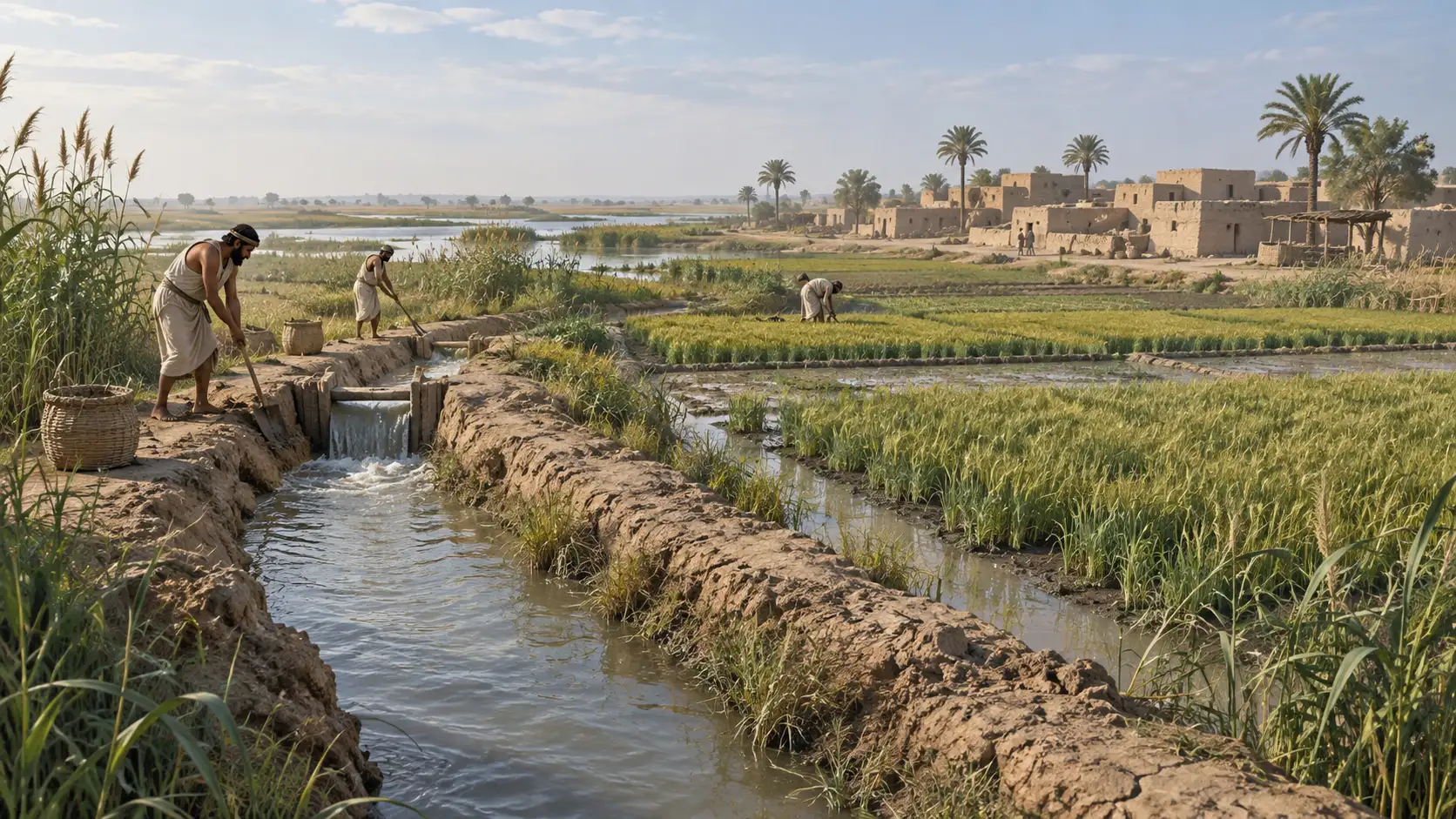
That continuity matters. A city required more than an impressive building. Its inhabitants needed dependable access to food, materials and other people’s labour. Irrigated cultivation was one important foundation of southern Mesopotamian settlement. The fields and waterways therefore belong in the story alongside the monuments: the visible centre was only one part of the community’s working landscape.
The illustration below imagines a landscape supporting early urban communities in the late fourth millennium BCE. Its fields, water channel and buildings help connect the discussion of food production with settlement; their exact arrangement is an artistic interpretation.
Temples made authority visible
Early Dynastic temples were understood as places where gods dwelt. Their small inner shrines were probably accessible to a limited group, rather than to crowds gathering for a service in the modern sense. Some people commissioned statues of worshippers, commonly shown with clasped hands, which scholars interpret as representing their donors before a deity. The exact placement and use of many surviving examples remain uncertain. The Met: Early Dynastic sculpture.
The statues offer an unusually personal point of entry into this world. Some inscriptions identify a donor and profession. Yet even a named statue gives us a formal act of devotion, not a complete biography. The formal pose tells us more about how devotion was represented than about the donor’s private thoughts.
Rulers also presented their authority through obligations to gods and cities. Temple building, warfare, justice and the maintenance of walls and canals belonged to the responsibilities associated with kingship. Belief and government were closely connected, although their relationship changed over time. Getty: First Kings.
A city’s wealth could come from far away
A headdress excavated at Ur gives these distant connections a visible form. Its gold leaves are separated by lapis lazuli and carnelian beads. Dated approximately 2600–2500 BCE, it belonged to one of the female attendants buried in the tomb conventionally called the King’s Grave. The Met: headdress from Ur.
Gold, lapis lazuli and carnelian were not local products of the Mesopotamian river plain. Bringing them to Ur and turning them into jewellery required connections across distance as well as craft knowledge. The photograph shows the surviving object; it does not reveal the route taken by every material or the lives of all the people who handled it.

Nor was such splendour typical of everyone buried at Ur. Excavation exposed a large cemetery containing many relatively simple graves, alongside the exceptional tombs called royal. Reading only the richest discoveries would give a distorted picture of the wider population. Their importance lies partly in the contrast they expose. The Met: Ur’s cemetery.
This is a recurring challenge in early history. An extraordinary object attracts attention because it survives and is beautiful. To understand the society around it, we must also ask how exceptional it was and whose lives are less clearly represented.
Sumer’s political world did not stand still
The independence of the city-states was not permanent. In the twenty-fourth century BCE, Sargon of Akkad brought southern Mesopotamian cities under his rule through conquest. The resulting imperial order changed the scale of political power. Its own control later weakened, and local rulers again asserted independence. These changes caution against treating centuries of Sumerian history as a single snapshot. The Met: the Akkadian period.
Much later than the first urban expansion, the Third Dynasty of Ur, conventionally dated approximately 2112–2004 BCE, again united southern Mesopotamia. The Met’s chronology places major ziggurat construction in this period. These stepped monuments belong to a later chapter than the initial growth of cities. The Met: Third Dynasty of Ur.
| Approximate date | Context |
|---|---|
| 2900–2350 BCE | Early Dynastic city-states. |
| 24th century BCE | Sargon’s conquests expand Akkadian rule. |
| 2112–2004 BCE | The Third Dynasty of Ur. |
Dates follow the Met’s chronology and its account of the Akkadian period; they are approximate.
What makes Sumer a useful starting point?
Sumer lets us examine how urban life joined together food production, authority, worship and connections across distance. It also teaches us to distinguish what an object shows from what we would like it to explain. A grave reveals a burial, a statue represents a worshipper, and a monument materialises an investment of labour. None is a transparent window onto an entire population.
The aim is therefore to understand particular places and changes, rather than award one society a prize for being first. From this regional introduction, Uruk offers a closer view: a city where monumental buildings and early records allow us to investigate how people organised life on a new scale.