
Long before a stamped coin changed hands, people in Mesopotamia could give goods a value in silver. The metal was weighed. That simple distinction opens a much richer history than the familiar picture of two people swapping whatever they happened to have.
Trade involved materials, measures and relationships. Some objects travelled far beyond the places where their raw materials originated; records could define a transfer or an obligation. The examples here come mainly from the third millennium BCE, followed by one clearly identified look at Assyrian merchants in the early second millennium.
At a glance
- Focus
- Mesopotamian exchange before coinage.
- Time
- Mainly c. 2900–2000 BCE; a later commercial record from the twentieth–nineteenth centuries BCE.
- Distinction
- A unit of value, a means of payment and a coin are not the same thing.
Before coins does not mean before money
William B. Hafford’s account of Mesopotamian commerce describes goods being valued in silver by weight by around 2500 BCE. Coinage was not necessary for that practice. Nor does a silver valuation prove that every transaction involved handing over silver: expressing a value and settling an obligation are different actions. William B. Hafford: Mesopotamian City Life (Penn Museum, 2018)
Barter means a direct exchange of goods or services without money mediating the transaction. It is one possible arrangement, but it should not be the automatic label for everything that happened before coins. To understand a particular exchange, we need to ask what was being transferred, how its value was expressed and what the parties actually did.
Three key concepts
- Unit of account
- A standard in which a value or obligation is expressed.
- Payment
- What is transferred to settle that obligation.
- Coin
- A piece of metal made and marked for use as money.
Materials and goods from farther afield
A headdress from Ur’s Royal Cemetery, now in the Met, combines gold, lapis lazuli and carnelian. It belonged to a female attendant in the so-called King’s Grave and dates approximately to 2600–2500 BCE. Those materials point beyond the southern river plain to wider networks of supply. The Met: Headdress from Ur, 33.35.3
The ornament gives us an endpoint: materials brought together in an object deposited at Ur. It does not identify every intermediary or prove that one merchant travelled the entire route. The history of movement must be reconstructed from more than the location of a finished piece.
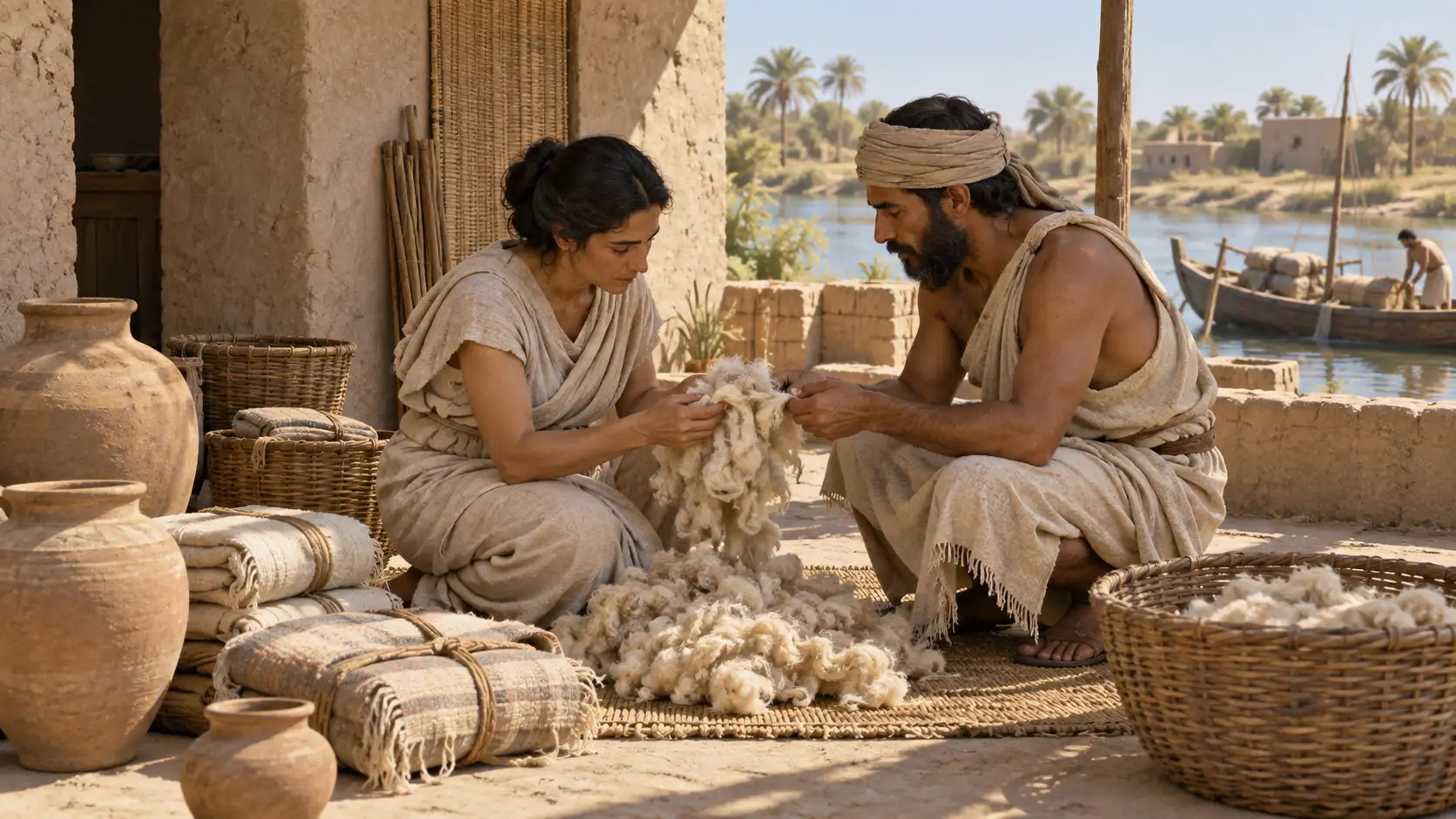
Textiles were also significant in Mesopotamian exchange. Hafford describes cloth and finished garments being exchanged for resources from farther afield. These were useful products made through skilled work, rather than simply natural materials waiting to be collected. William B. Hafford: Mesopotamian City Life (Penn Museum, 2018)
The imagined encounter below shows people inspecting wool alongside other goods. It illustrates the handling of materials without assigning a price or payment method to the exchange.
A shekel was a weight
The shekel in this setting was a unit of weight, not the name of a stamped Sumerian coin. Hafford’s research gives approximately 8.4 grams for a principal Mesopotamian standard, especially in southern Mesopotamia. “Approximately” matters: ancient measures must be studied in their regional and historical contexts. William B. Hafford: Hanging in the Balance — Precision Weighing in Antiquity (Penn Museum, 2005)
Weights could be elaborately carved, including animal forms, or look like rather plain shaped stones. Their significance lies in measurement as much as appearance. Comparing their masses and relationships can help identify sets that are not immediately recognisable as commercial equipment. William B. Hafford: Hanging in the Balance — Precision Weighing in Antiquity (Penn Museum, 2005)
Weighing provided a way to compare an amount of material against an agreed standard. It still left room for practical questions about the weights, the material and the agreement. Measurement made a transaction more explicit; it did not remove the need for trust.
Records could define transfers of property
The Stele of Ushumgal and Shara-igizi-Abzu, dated 2900–2700 BCE and probably from Umma, records a transaction involving fields, houses and livestock. Ushumgal and his daughter are central to it. The Met notes that its early script does not make clear whether the properties were being bought, sold or granted. The Met: Stele of Ushumgal and Shara-igizi-Abzu, 58.29
The stele records concern with property and its transfer, even though the precise arrangement remains uncertain. That distinction matters when deciding whether an ancient document describes a sale, a gift or another kind of transaction.
It also broadens the subject beyond portable merchandise. Economic relationships could involve land, buildings and continuing rights, not only items exchanged at a meeting place. To read an ancient economy well, we need a vocabulary larger than “barter.”
A later look at credit and repayment
For a particularly clear example of a financial obligation, move forward to the early second millennium BCE. Merchants from Ashur in northern Mesopotamia operated in trading settlements in Anatolia, including Kanesh, at modern Kültepe. Their records include business dealings, loans and correspondence. This is a later commercial setting, not a direct description of Early Dynastic Sumer. The Met: Cuneiform tablet — quittance for a loan in silver, 66.245.16a
A tablet in the Met, dated to the twentieth–nineteenth centuries BCE and probably from Kültepe, acknowledges repayment of a silver loan owed to Ashur-taklaku. It states that further claims are void. Witnesses are named, and their seals were impressed on the tablet’s clay envelope. The Met: Cuneiform tablet — quittance for a loan in silver, 66.245.16a
The important moment here is the end of a debt. The record was useful because an obligation had existed over time and its discharge needed to be recognised. The tablet preserves the borrower’s release from a claim, as well as the evidence that could be used to demonstrate it.
Movement is not always trade
Our evidence includes several different kinds of movement. An Ur III tablet dated approximately 2029 BCE records a shipment of barley, while the earlier Uruk material includes accounts of grain distribution. These document economic activity, but their descriptions alone do not establish an ordinary purchase between independent buyers and sellers. The Met: Tablet recording a shipment of barley, 86.11.243 The Met: Administrative account of barley distribution, 1988.433.1
This is why an archaeologist’s map of objects and a historian’s account of commerce answer related but different questions. A map may show connections. To explain the relationship behind a connection, we need context: a text, a findspot, an institutional setting or a combination of clues.
An economy of relationships
Weighed silver, crafted goods, property records and acknowledged debts reveal an economic world that was already varied before coinage. The surviving evidence does not support one simple exchange system operating identically across Mesopotamia for centuries.
What made these arrangements work? Sometimes it was a recognised measure, sometimes a record and witnesses, and sometimes a relationship that archaeology only partly preserves. Our article on the beginnings of writing explores why recording goods became so important. Following those records brings the people behind exchange into view, without treating coinage as the starting point of economic history.