
Choose 3500 BCE on a timeline, then look across a map. The date stays the same, but the human landscape changes. In southern Mesopotamia, settlements were growing towards the urban world explored in our opening articles. Elsewhere, communities organised food, work and gathering places in different ways.
A world history needs those differences. It also needs care with dates: famous monuments can make distant societies feel contemporary even when centuries separate them. This tour uses the centuries around 3500 BCE as its starting point, with later developments explicitly marked. It is a selection of places, not a complete inventory of the inhabited world.
At a glance
- Time
- The fourth millennium BCE, centred on c. 3500 BCE; later comparisons are identified.
- Places
- Mesopotamia, Egypt, South and East Asia, southern Britain and coastal Peru.
- Question
- What changes when we look beyond the first Mesopotamian cities?
One date does not mean one stage of history
Terms such as Neolithic, Chalcolithic and Bronze Age describe regional archaeological sequences. Their dates and meanings vary from region to region. Nor does the presence of pottery, farming or a large monument automatically identify a city.
For this comparison, three questions are more useful: how did people obtain food, how did they organise shared activity, and what evidence survives? Asking the same questions helps us compare communities without assuming they were all trying to become Uruk.
Mesopotamia: cities take shape
Southern Mesopotamia provides our starting point because the later fourth millennium brought an especially visible concentration of large settlements, substantial public buildings and economic administration. Getty places this combination around 3400–3000 BCE. The date range helps distinguish the cities of the late fourth millennium from settlements several centuries earlier. Getty: Mesopotamia — Civilization Begins
By around 3200 BCE, Uruk had monumental mud-brick architecture and administrative records on clay. Its growth raises questions about supplying people and coordinating labour, but does not tell us how every other large community worked. Our article on Uruk explores that local setting in more detail. The Met: Uruk — The First City
Egypt: communities along the Nile before the pyramids
Around 3500 BCE, Egypt was in its Predynastic period. Farming and herding had long been part of village economies, alongside resources such as fish. During the Naqada II period, differences in tomb size and contents suggest that access to wealth was becoming more unequal. Pottery decorated with boats and other motifs offers another view of this changing society. The Met: Egypt, 8000–2000 B.C.
The imagined Nile settlement below brings cultivated ground, homes and water into one view. It illustrates the setting of village life rather than a particular excavated site.
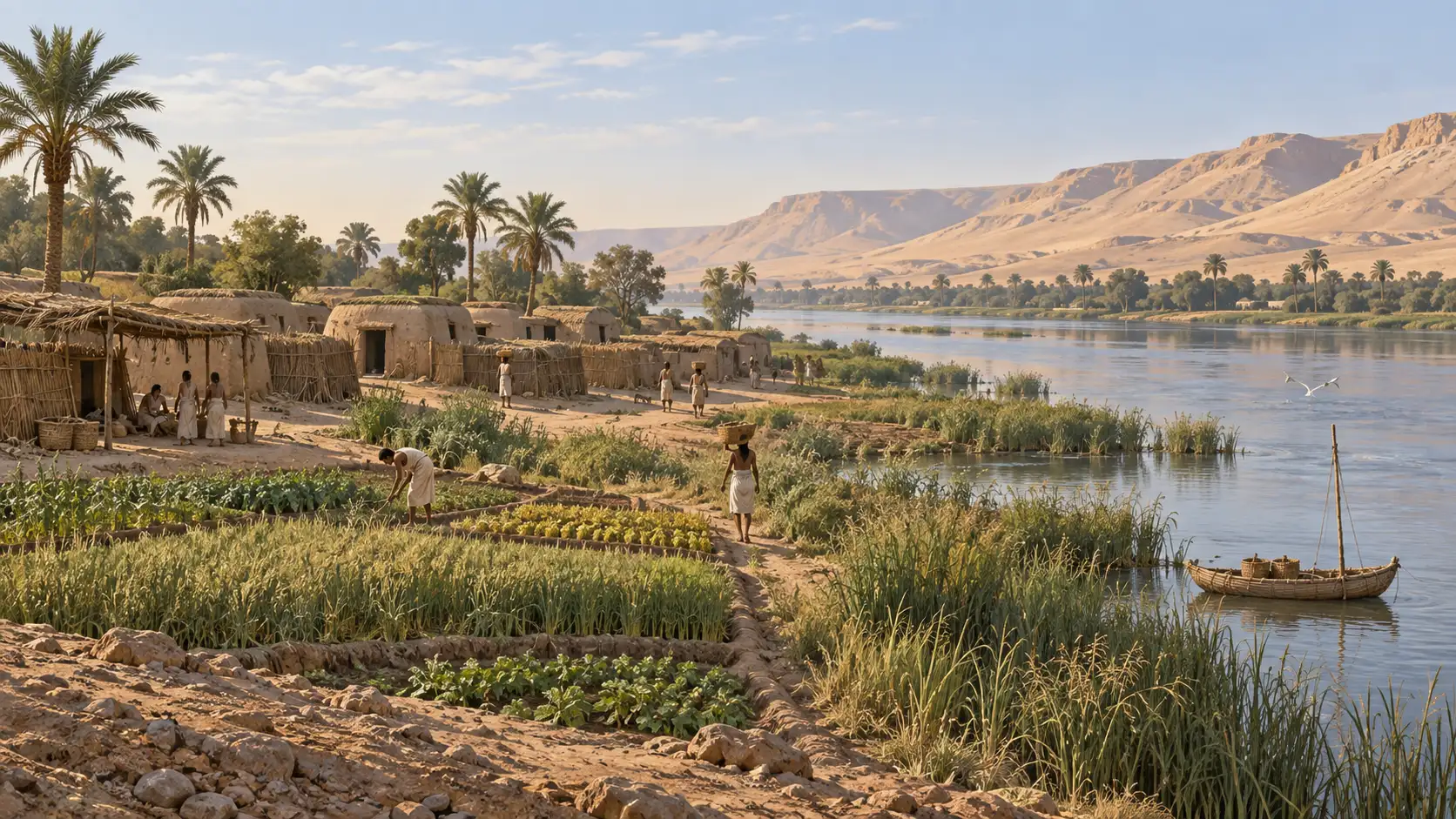
This was not yet the Egypt of the Giza pyramids. The Met places the Early Dynastic period from approximately 3100 BCE, with the great pyramid-building age later still, in the Old Kingdom. Looking at Egypt around 3500 BCE means taking its earlier communities seriously, rather than filling the landscape with monuments familiar from a different millennium. The Met: Egypt, 8000–2000 B.C.
South Asia: the settlements before Harappa’s great city
At Harappa, in present-day Pakistan, excavation separates early occupation from the much later urban settlement. Jonathan Mark Kenoyer and Richard Meadow identify a Ravi phase conventionally dated approximately 3300–2800 BCE in their published chronology, preceding the Harappan urban phase from around 2600 BCE. The Ravi evidence therefore takes us slightly beyond our starting date; Harappa’s mature urban settlement lay farther in the future. Kenoyer and Meadow: The Ravi Phase — A New Cultural Manifestation at Harappa (2000)
The early finds include bone tools interpreted as equipment for activities such as basketry and textile work. Small objects deserve a place beside impressive city plans: they reveal skills and work that would be easy to overlook if we began only with a settlement at its greatest size. Some proposed tool functions remain interpretations rather than directly observed uses. Kenoyer and Meadow: The Ravi Phase — A New Cultural Manifestation at Harappa (2000)
East Asia: different relationships with food and place
Across the Japanese archipelago, Jōmon communities combined fishing, hunting and gathering with substantial traditions of pottery and other crafts. Pit dwellings and the remains of food processing show that a settled community need not be defined by the same cereal agriculture that supported Mesopotamian cities. Jōmon is itself a broad label covering considerable regional and chronological variety. The Met: Jōmon Culture
On the Chinese mainland, Liangzhu provides a later comparison within the fourth millennium. UNESCO dates the site complex approximately 3300–2300 BCE and describes a regional society supported by rice cultivation, with major earthworks, water management and marked differences in burial treatment. The remains accumulated over time; the whole complex should not be imagined as already complete in 3300 BCE, still less in 3500 BCE. UNESCO: Archaeological Ruins of Liangzhu City
These examples change the comparison. The useful question becomes how particular communities used local resources and organised collective projects, rather than which one was furthest along a single path.
Southern Britain: a monumental landscape before Stonehenge
In the landscape around the future Stonehenge, people built long barrows, cursus earthworks and a causewayed enclosure in the centuries around 3500 BCE. Such monuments show investment in places beyond individual homes. English Heritage dates Stonehenge’s major circular earthwork to about 3000 BCE and its famous stone settings to about 2500 BCE. English Heritage: History of Stonehenge
Large construction projects therefore do not belong exclusively to cities. A monument can reveal collective effort without establishing that its builders lived under a Mesopotamian-style urban administration. Its form and setting need their own explanation.
Coastal Peru: Caral in a later period
Caral, in Peru’s Supe Valley, is often included in discussions of early urban societies. It belongs in Libradia’s wider story, but not as a fully developed contemporary of our 3500 BCE starting point. UNESCO places the development of the site approximately between 3000 and 1800 BCE. Its monumental platforms and sunken courts offer a valuable comparison for a later period. UNESCO: Sacred City of Caral-Supe
The later date of Caral does not imply an absence of earlier communities in the Americas. It tells us where this particular site belongs in a comparison of monumental settlements.
What comparison reveals
The places in this tour are not entries in a competition. Some preserve conspicuous buildings, others rich burials or traces of ordinary work. Those differences affect what we can say about them, as well as what modern visitors notice first.
Reading across regions also means resisting a familiar visual shortcut: pyramids for Egypt, stone circles for Britain, planned streets for the Indus. Each belongs to a sequence of change. Once we put dates back into those pictures, the past becomes less like a row of finished civilisations and more like communities making choices under particular conditions.
The opening series has followed settled life into the world of early Mesopotamian cities. From here, we can look more closely at the activities that sustained them: feeding people, organising households and moving goods between places.