
A community that stays in one place faces a different set of practical questions from one that moves frequently. How will food be kept until it is needed? Where will households build, work and store their belongings? What happens when neighbours share the same place over many generations?
The settlements of the Levant and Anatolia offer varied answers. This article follows selected examples across thousands of years, from Natufian communities to Neolithic Çatalhöyük, before turning to the early cities of southern Mesopotamia. Settled life, cultivation and urban life did not begin together, and the evidence does not reveal a single sequence followed by every community.
At a glance
- Where
- The Levant and Anatolia, with a final look at southern Mesopotamia.
- When
- Approximately 13,000–3000 BCE; selected examples across a long period.
- The question
- How did food, houses and local connections support more settled communities?
Settling down could come before farming
It is tempting to picture a neat sequence: wandering hunters discovered farming, built villages and eventually founded cities. Archaeological evidence complicates that story.
The Natufian period in the Levant began around 13,000 BCE, thousands of years before Çatalhöyük’s densely packed houses were built. Groman-Yaroslavski and colleagues: Natufian chronology.
Among the hunter-gatherers associated with the Natufian period in the Levant, some communities adopted a more settled way of life. Small settlements with stone-built dwellings appeared in parts of the region while people still made use of wild food resources. But there was considerable variation. Researchers working in Jordan’s Wadi al-Hasa found Natufian occupations that did not appear to be villages, including one in a rock shelter. Olszewski and Coinman, An Ice Age Oasis in Jordan.
“Hunter-gatherer” describes how people obtained food; it does not tell us exactly how often they moved. A community could use a place repeatedly or stay for extended periods without depending on domesticated crops. Archaeologists have to investigate each settlement rather than assume that everyone followed the same pattern.
Growing plants and domesticating them were different changes
Two different changes
- Cultivation
- Tending plants: for example, sowing and harvesting them.
- Domestication
- Inherited changes in plant populations under conditions shaped by people.
For cereals, one useful clue is whether ripe grain breaks away naturally or remains attached until harvested.
The distinction matters because growing plants did not immediately produce fully domesticated crops, and possessing domesticated crops did not necessarily mean that a community depended heavily on farming.
In a 2025 study, archaeobotanists Dorian Q Fuller and Leilani Lucas compared plant evidence from across Southwest Asia. Their results emphasise the long persistence of communities combining cultivation with other food sources. The balance differed between places, challenging the idea of a single, rapid transition from foraging to agriculture. Fuller and Lucas, Contrasting pathways to domestication and agriculture around Southwest Asia.
Keeping food changed what a settlement could do
Obtaining food was one challenge; keeping it usable was another. A stock of grain is only useful if it survives moisture, pests and the time until it is needed.
At Dhra’, near the Dead Sea in present-day Jordan, excavators identified purpose-built granaries from a context preceding fully domesticated plants. Their suspended floors were designed to allow air circulation and help protect the contents from rodents. The structures stood between residential buildings. Kuijt and Finlayson, research on predomestication granaries.
Storage therefore belongs inside the explanation of changing settlement patterns. It gave people another way to manage food supplies over time. The granaries do not reveal every rule governing who could use their contents, but they show deliberate investment in making food last.
Houses brought neighbours into lasting proximity
Çatalhöyük offers a much later example of what a large settled community could look like. UNESCO places the Neolithic occupation of its eastern mound at approximately 7400–6200 BCE. Closely packed houses, entered from above, formed a settlement quite unlike a modern town organised around streets. Paintings, reliefs and other finds preserve traces of its inhabitants’ symbolic world. UNESCO, Neolithic Site of Çatalhöyük.
At Çatalhöyük, in what is now Türkiye, the way into a house was often through its roof. A wooden ladder led down into rooms where people cooked, slept and stored supplies. Houses stood close together, and movement across their roofs was part of the settlement’s layout. The entrance, the shared roofscape and the rooms below raise a practical question: what made it possible for people to live so closely together? Çatalhöyük Research Project, Architecture.
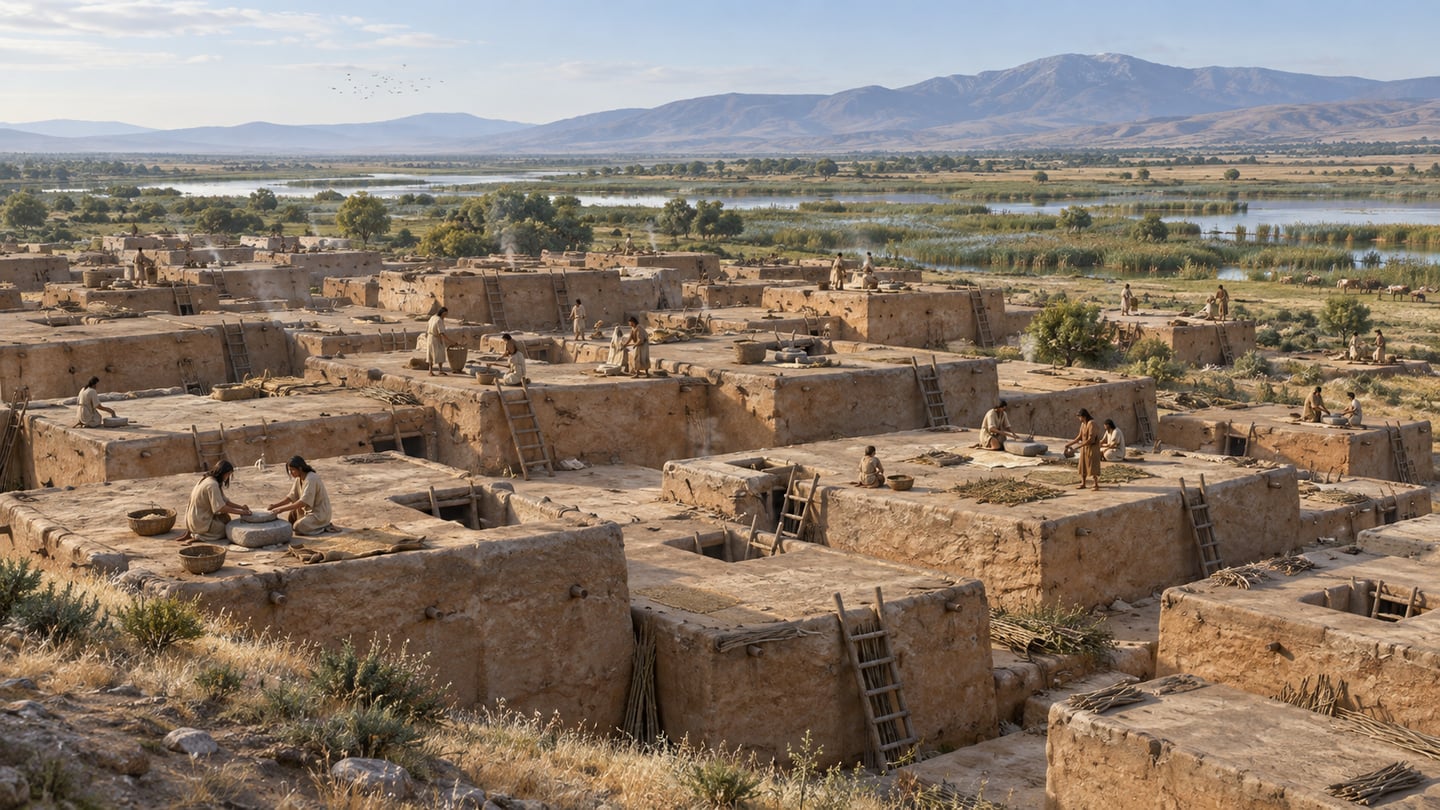
Inside the houses, raised platforms supported domestic activities, while side rooms provided storage. Some of the dead were buried beneath floors and platforms. Buildings were repeatedly filled in and rebuilt, gradually contributing to the mound archaeologists excavate today. Çatalhöyük Research Project, Architecture.
A house could thus connect daily work with remembrance and repeated rebuilding. The surviving structures let us ask how households used space, even when the residents’ own explanations have been lost.
Life extended beyond the houses
A densely built settlement was still part of a wider landscape. The Çatalhöyük Research Project describes the early community as living beside wetland resources, with agricultural land on drier ground nearby. Its setting offered possibilities for fishing, gathering and hunting alongside cultivation. Çatalhöyük Research Project, The Rise and Fall of a Neolithic Town.
Connections also reached beyond that immediate setting. Obsidian used at Çatalhöyük came from sources elsewhere in Anatolia. This volcanic glass could be worked into cutting tools. Its presence points to the movement of materials between places, although an object’s origin alone cannot tell us every stage of its journey or who carried it. Çatalhöyük Research Project, Life at Çatalhöyük.
Remaining attached to a settlement did not mean living in isolation. The practical life of a household could depend on resources and relationships extending well beyond its walls.
How much can the evidence tell us?
The evidence is uneven. At Wadi al-Hasa, some sites preserved a combination of animal bones, charcoal, plant traces and stone tools; elsewhere, preservation was poorer. Different materials answer different questions, and a missing trace is not always evidence that an activity never happened. Olszewski and Coinman.
There is a similar limit to reading a floor plan. It may reveal a storage room or the position of an oven much more clearly than it reveals a household’s authority, beliefs or relationships. Interpreting a settlement means combining such clues while keeping room for what remains uncertain.
What changed with the early cities?
In southern Mesopotamia, the late fourth millennium BCE brought a concentration of features that make places such as Uruk central to discussions of early urban life. Large settlements were connected with monumental construction, administrative institutions and increasingly elaborate systems for managing economic activity. Early writing formed part of this setting. Getty, Mesopotamia: Civilization Begins.
Calling a settlement a city involves more than counting houses. Researchers also consider its organisation and wider functions. Labels such as “village,” “town” and “city” are useful, but their boundaries need explanation, especially when comparing societies separated by thousands of years.
Çatalhöyük was not an early version of Uruk, and this sequence is not evidence that one settlement directly gave rise to the other. The earlier settlements matter in their own right. They preserve varied solutions to enduring questions: where to live, how to keep food and how to share space with other people. Understanding those choices gives us a firmer starting point for exploring the cities that followed.