Category: Medieval History

  • Were the “Dark Ages” Really Dark?

    A richly decorated manuscript and an elaborate helmet are awkward objects for an age supposedly defined by the disappearance of skill. They do not prove that everyone prospered. They do make it difficult to describe several centuries of history as a single cultural blank.

    The phrase “Dark Ages” mixes questions that deserve separate answers. Do we mean that fewer written accounts survive for a particular place? That political institutions changed? That living conditions deteriorated? Or that nothing worth studying happened? The first three can be investigated. The last is a judgement that closes off inquiry before it begins.

    Put a place and a date on the question

    For this article, the main focus is western Europe between roughly 500 and 1000 CE, with comparisons beyond it. “Early Middle Ages” is a more useful working label because it identifies a period without deciding in advance how we should value everything within it.

    There were real disruptions. The Roman West experienced political fragmentation, invasions and the decline of important urban centres. But the empire governed from Constantinople continued. Its inhabitants understood themselves as Romans; “Byzantine” is the name later historians use. Treating the end of western imperial government as the disappearance of the entire Roman world would erase that continuity. The Met: Byzantium

    The distinction matters even within Europe. A question about authority in Britain is not automatically answered by evidence from Italy. A manuscript produced around 800 does not describe conditions in every community three centuries earlier. The broad period becomes intelligible through dated, local examples.

    A manuscript that refuses the label

    The Book of Kells, made around 800, is a striking example of early medieval manuscript art. On folio 32v, Christ appears enthroned within an intricate decorated frame. The surviving page belongs to Trinity College Dublin’s manuscript MS 58. Its design offers direct evidence of planned, highly skilled visual work. Book of Kells, folio 32v: reproduction and collection reference
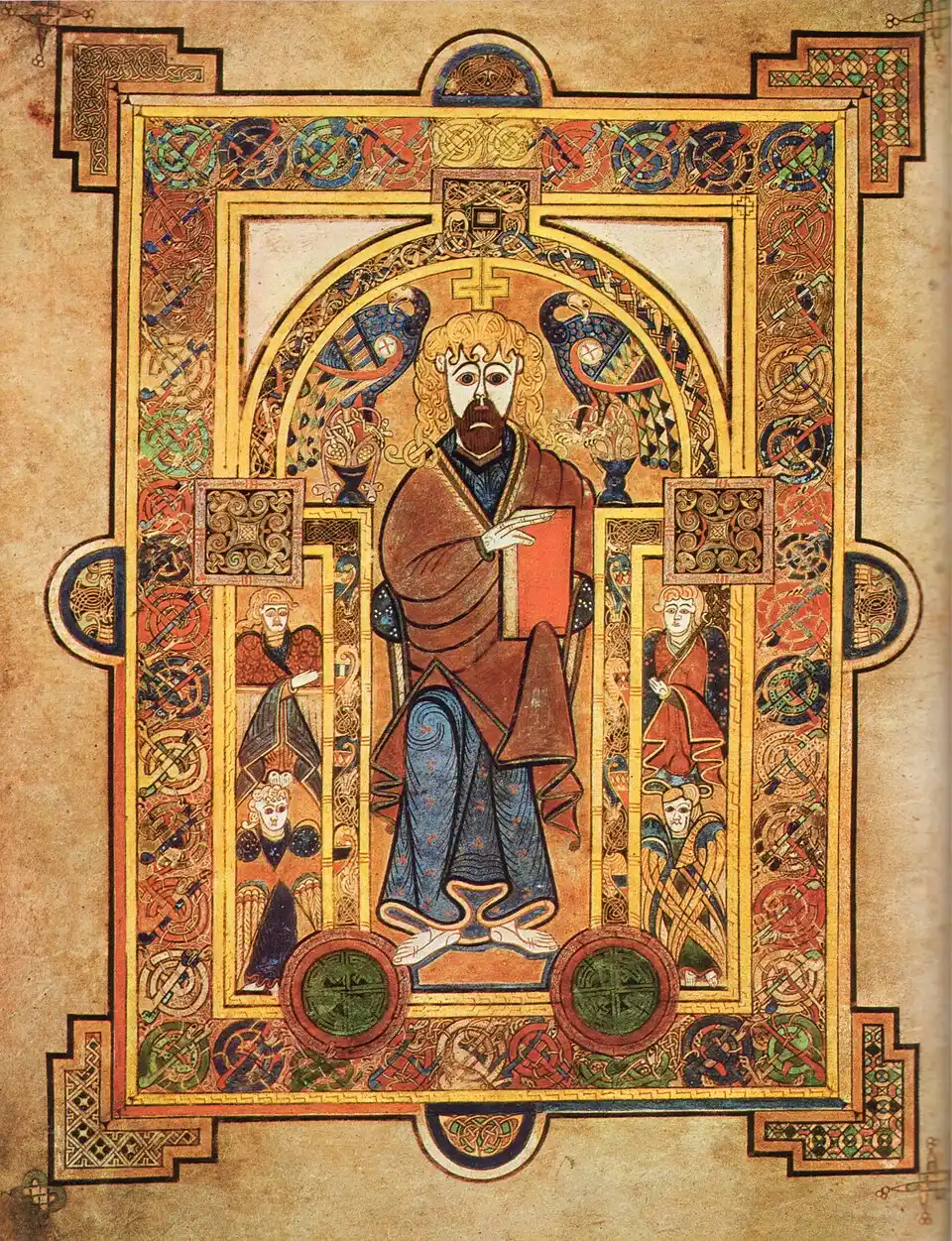
    Illuminated manuscript page showing Christ enthroned within an elaborate decorated frame.
    Christ enthroned, Book of Kells, folio 32v, around 800 CE. Trinity College Dublin, MS 58; reproduction via Wikimedia Commons, public domain. Converted to WebP for publication. Image source.

    Look at the relation between the central figure and the framing ornament. The page directs attention through scale, symmetry and repeated forms. Its makers did not simply preserve a blank space for words: they shaped how a sacred book would be encountered. Those are observations about the object in front of us, rather than a claim about the literacy of the population around it.

    That limitation is essential. An exceptional book tells us that such work could be supported. It does not establish that books were cheap, that education was universal or that most people lived comfortably. Using the manuscript to declare an uncomplicated golden age would repeat the same mistake as using political disorder to declare universal darkness.

    Copying was work, not passive storage

    In the Carolingian world, rulers and religious institutions invested in learning and the production of books. The cultural programme associated with Charlemagne included efforts to improve education and the accuracy and legibility of texts. Carolingian minuscule, a comparatively clear handwriting, formed part of that development. The Met: Carolingian Art
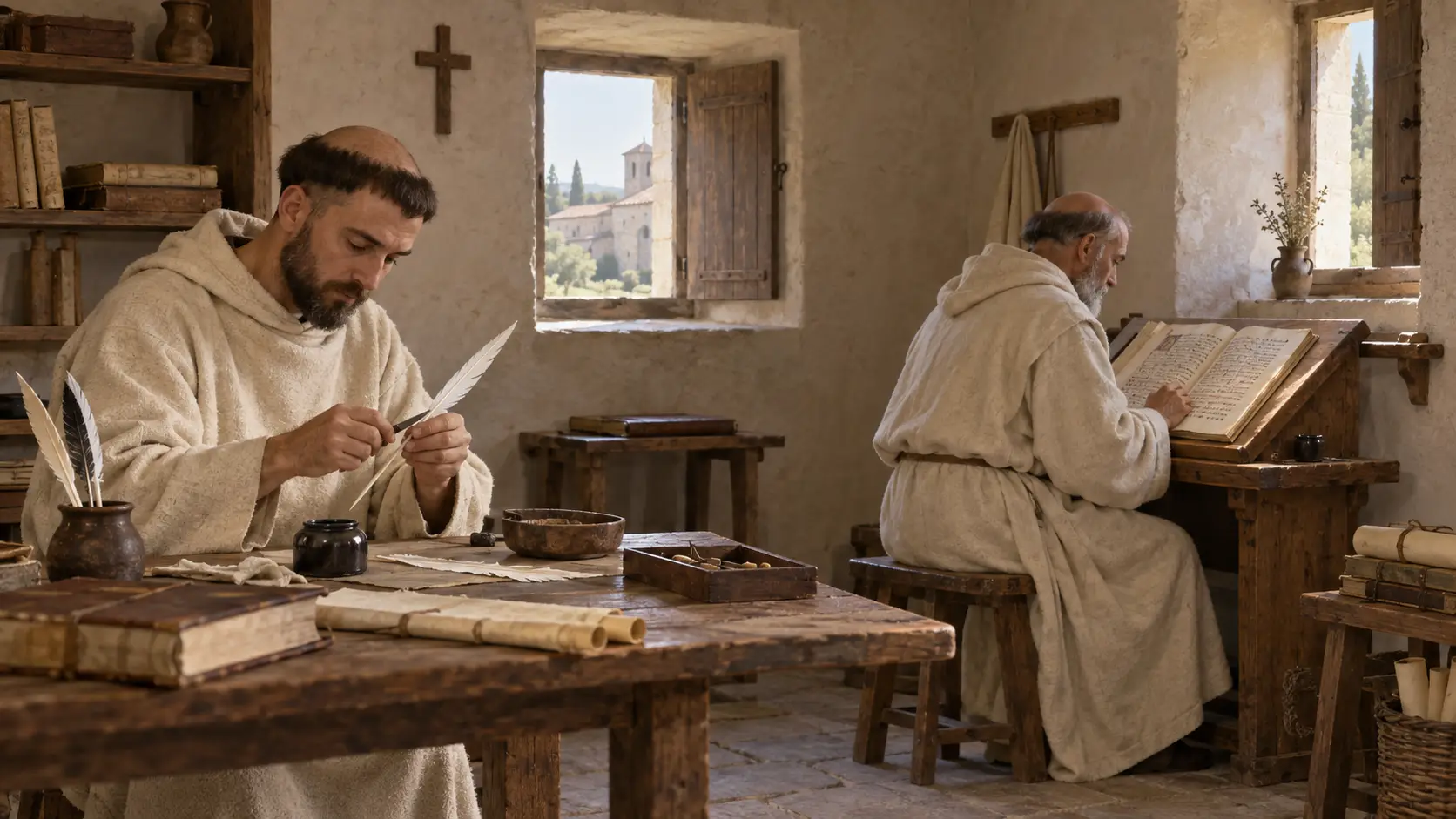
    AI illustration of two monastic scribes working with quills and parchment books in a sunlit room.
    An imagined monastic manuscript workshop inspired by early medieval western Europe. AI-generated interpretative illustration; not a documented scriptorium or a reconstruction of the making of the Book of Kells. Libradia.

    The illustration imagines a manuscript workshop in early medieval western Europe. It is not a reconstruction of the making of the Book of Kells. The distinction preserves two different contexts: an Insular manuscript tradition and the continental setting associated with Carolingian reform.

    A copied text had to pass through material decisions: how to arrange a page, form letters and maintain consistency. Clearer handwriting could help a later reader distinguish words and follow a text. Yet copying also involved selection. The survival of a book depends on people choosing to reproduce and preserve it; the surviving collection is not a complete record of everything once known.

    Charlemagne’s patronage also extended to art and architecture. Antique models were adapted for new Christian and imperial purposes. The result was creative reuse of the past, shaped by the ambitions of a particular court and its religious institutions. It should not be mistaken for either an untouched continuation of Rome or a sudden recovery from total cultural silence. The Met: Carolingian Art

    What a helmet can tell us

    The Sutton Hoo helmet offers a different kind of evidence. The image below shows a modern replica, rather than the excavated original. Its reconstructed appearance makes the decorated face mask and metalwork easier to read, but the act of reconstruction must remain visible in the description. Sutton Hoo helmet replica: photograph and source record
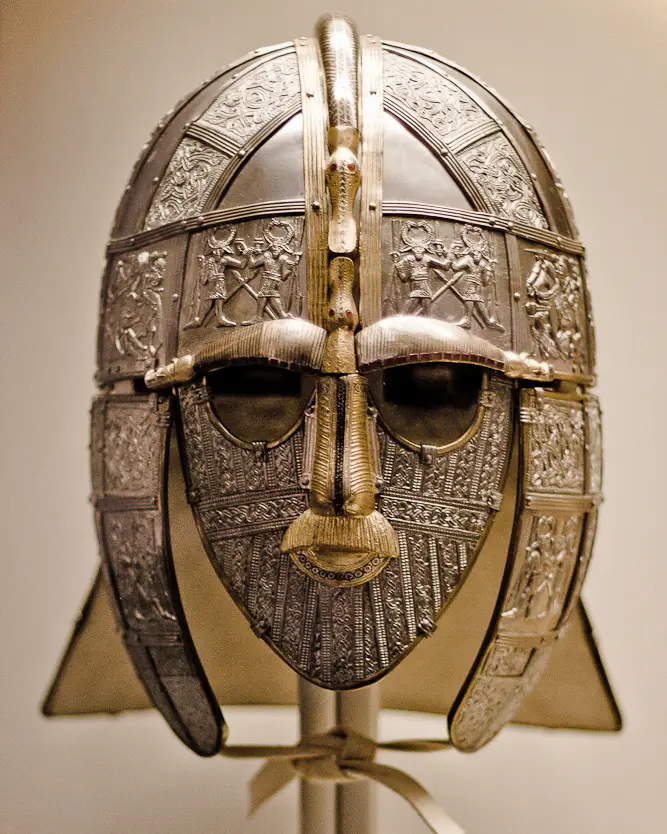
    Modern replica of the Sutton Hoo helmet, showing its decorated face mask and metalwork.
    A modern replica of the Sutton Hoo helmet displayed at the British Museum. This is a reconstruction of its appearance, not the excavated original. Photograph: Mark Ramsay, via Wikimedia Commons, CC BY 2.0. The Commons version was cropped and its vignette reduced; converted to WebP for publication. Image source. Licence.

    A replica invites questions that a photograph alone cannot settle. Which features follow surviving fragments? Which relationships were established during reconstruction? What can the finished object tell us about display, protection and status? These questions let an object become evidence rather than a decorative symbol for an entire era.

    The same caution applies to splendid objects more generally. They can reveal elite access to materials and skilled work while leaving ordinary households much less visible. The existence of technical accomplishment and the existence of social inequality are entirely compatible.

    Connections continued across the sea

    Hedeby gives us a less court-centred view of early medieval activity. UNESCO identifies this Viking Age trading settlement as a connection between Scandinavia and continental Europe and between the North Sea and Baltic networks. Archaeological remains include buildings, streets and harbour structures. These are traces of exchange and settlement, not merely stories of isolated raids. UNESCO: Hedeby and the Danevirke

    That does not make the period peaceful. Trade, political power and violence could coexist. It does mean that a picture of communities cut off from one another is inadequate. For more on the people behind these connections, see Who Were the Vikings?

    A European label is not a world chronology

    Beyond western Europe, the label becomes still less useful. Constantinople sustained Roman institutions and artistic production, even while its empire faced severe military and territorial pressures. Across the Islamic world, new centres were taking shape. Baghdad was founded as the Abbasid capital in 762; Baghdad and Samarra became major centres of cultural and commercial life. The Met: Byzantium The Met: Art of the Abbasid Period

    These societies had their own conflicts and inequalities. Their significance here is not that they supply a simple opposite to a declining Europe. They show why one regional judgement cannot describe the condition of humanity at a given date.

    “Were the Dark Ages really dark?” becomes a better question when we ask what changed, where, and for whom. A manuscript, a reconstructed helmet and a trading settlement answer different parts of it. Together they reveal a period whose losses were real, whose achievements were substantial, and whose variety a single adjective cannot adequately express.
  • Who Were the Vikings? Raiding, Trading and Everyday Life

    A harbour offers a different starting point for Viking history from a battlefield. Boats need places to unload, goods need buyers, and travellers need food, repairs and somewhere to stay. Behind the famous voyages lay communities capable of sustaining them: farms, workshops, households and trading settlements.

    Raiding was an important part of this history. It was not the only part. Looking at trade and everyday life does not excuse the violence; it helps explain the societies that made both overseas exchange and organised attacks possible. The same history must include the people who gained wealth and the people who lost their freedom.

    A period, not a single unchanging people

    “Vikings” is often used as a convenient name for the Scandinavian people associated with this period. It should not lead us to imagine that every inhabitant was a seaborne raider or that all communities followed one leader. An expedition and the society from which it departed are different subjects.

    The National Museum of Denmark places the Danish Viking Age approximately between 800 and 1050 CE. Its overview describes changing kingship, overseas expeditions and the spread of Christianity. These were generations of transformation, not a single frozen moment. Dates used to organise Viking history elsewhere can differ, so a chronological boundary is best treated as a guide rather than an event experienced everywhere at once. National Museum of Denmark: The Viking Age

    Why raiding occupies so much of the story

    The attack on the monastery at Lindisfarne in 793 became an especially powerful landmark in accounts of the period. Written descriptions preserve the horror felt by the attacked community and its religious world. That prominence helps explain why a raid can dominate our picture of an age that also contained ordinary work and exchange. National Museum of Denmark: Robbery of churches and monasteries

    The wider military pattern changed over time. The National Museum describes small surprise attacks alongside the larger forces operating during the ninth century. It also notes service as mercenaries in foreign conflicts. Local rulers could negotiate with armed newcomers, employ them or reward them with land; encounters were not always a simple division between Scandinavian attackers and united foreign defenders. National Museum of Denmark: Different types of expeditions

    Mobility was crucial. Ships with shallow draught could reach beaches and penetrate rivers, extending the places that an armed force could threaten. But sailing technology was also useful to people transporting goods. Evidence for cargo vessels reminds us that a ship’s role cannot be assumed from the word “Viking” alone. National Museum of Denmark: Different types of expeditions

    Hedeby: where routes met

    Hedeby, in present-day northern Germany, shows what a trading centre added to these connections. Its location linked Scandinavia with continental Europe and connected routes between the North Sea and the Baltic. UNESCO identifies surviving evidence of streets, buildings, cemeteries and a harbour. These remains allow questions about settlement and exchange that a chronicle of attacks cannot answer on its own. UNESCO: Hedeby and the Danevirke

    Trade also required protection and authority. At Hedeby, merchants and craftspeople operated within a setting shaped by rulers. A protected trading place could attract valuable traffic, while duties and taxes made that traffic profitable for those exercising power. The relationship between commerce and kingship was therefore practical as well as political. National Museum of Denmark: Trade in the Viking period

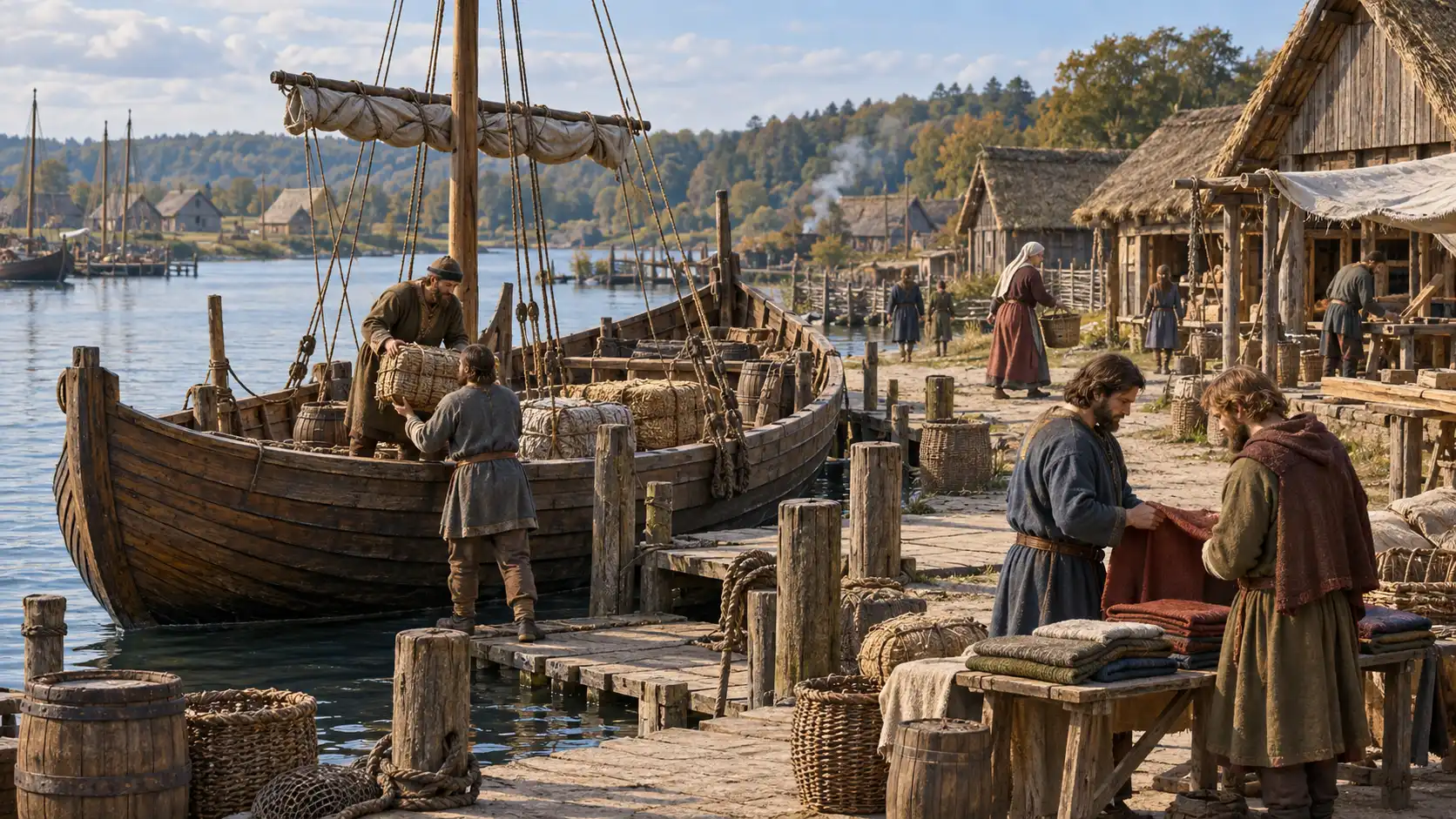
    AI illustration of a Viking Age harbour with a wooden cargo boat, merchants and waterfront workshops.
    An imagined Scandinavian trading harbour around 900 CE. AI-generated interpretative illustration, inspired by Viking Age maritime trade; not an exact reconstruction of Hedeby or a documented event. Libradia / AI-generated illustration.

    This imagined harbour conveys the relationship between water transport and work ashore. It does not reproduce Hedeby’s exact layout. Its usefulness is explanatory: it places a cargo boat, people and buildings in the same scene, encouraging us to think about the activities needed to keep a trading settlement functioning.

    What travelled with the merchants?

    Imports were not restricted to spectacular treasures. The National Museum points to soapstone cooking vessels found in Denmark but brought from elsewhere in Scandinavia. Such heavy, practical objects reveal demand for everyday equipment. Cloth, glass, ceramics and materials for metalworking also moved through trading connections. National Museum of Denmark: Imports in the Viking Age

    These objects raise a question that is easy to miss: how many hands did something pass through before reaching its final owner? An imported object establishes movement, but its discovery does not necessarily identify the person who first carried it or prove that the final owner visited its place of manufacture. Trade networks connect people who may never meet.

    Readers of our article on exchange in ancient Mesopotamia will recognise that question. The societies were separated by thousands of years; the connection is the method of enquiry, not a claim that their economies worked in the same way.

    Most lives also depended on the land

    A harbour should not replace a battlefield as another picture of everybody’s life. The museum’s account of Danish settlements emphasises that only a minority lived in towns. Farms and domestic animals were central to most people’s routines. A farm could include a main dwelling, outbuildings, storage spaces and workshops. National Museum of Denmark: Viking homes

    Excavated house remains reveal construction and the arrangement of space. Central hearths in longhouses provided places for cooking, while associated buildings accommodated different activities. Maintenance was itself a continuing demand: timber buildings had to withstand damp and decay. These practical pressures belong to Viking history as much as weapons and voyages do. National Museum of Denmark: Viking homes

    Domestic work also required skilled production. The museum highlights spinning, weaving, sewing and food preparation in its discussion of women’s work. It is safer to recognise the importance of these activities than to invent a universal daily timetable or assign every task in every household to one sex. Family circumstances, status and local conditions mattered. National Museum of Denmark: Women in the Viking Age

    Trade included the sale of people

    Any account that presents commerce as a wholly peaceful alternative to raiding misses slavery. Captives taken on expeditions could be sold, and enslaved people also worked within households and on farms. Violence and exchange could form parts of the same process. National Museum of Denmark: Slaves and thralls

    The evidence is uneven. Written accounts and legal texts make enslavement visible, while identifying an enslaved individual archaeologically is often difficult. The National Museum discusses the Hørning runestone as evidence of a craftsman commemorating a man who had given him freedom. A record like this offers a rare glimpse of changed status, without making the experience typical of everyone held in bondage. National Museum of Denmark: Slaves and thralls

    How to read a complicated inheritance

    Written accounts of Viking activity were produced from particular viewpoints. Monastic chroniclers, royal writers and travellers selected different events and interpreted them for different audiences. Recognising those interests does not make an account of violence worthless. It means asking what the author could know and what purpose the description served. National Museum of Denmark: Written sources

    Archaeology adds other perspectives: the layout of a dwelling, a workshop’s waste, a ship or an imported pot. Together, these sources reveal a world of farmers, rulers, craftspeople, travellers and captives. The Vikings become easier to understand when their voyages are connected to the communities behind them—and to the communities their arrival transformed.