
A richly decorated manuscript and an elaborate helmet are awkward objects for an age supposedly defined by the disappearance of skill. They do not prove that everyone prospered. They do make it difficult to describe several centuries of history as a single cultural blank.
The phrase “Dark Ages” mixes questions that deserve separate answers. Do we mean that fewer written accounts survive for a particular place? That political institutions changed? That living conditions deteriorated? Or that nothing worth studying happened? The first three can be investigated. The last is a judgement that closes off inquiry before it begins.
Put a place and a date on the question
For this article, the main focus is western Europe between roughly 500 and 1000 CE, with comparisons beyond it. “Early Middle Ages” is a more useful working label because it identifies a period without deciding in advance how we should value everything within it.
There were real disruptions. The Roman West experienced political fragmentation, invasions and the decline of important urban centres. But the empire governed from Constantinople continued. Its inhabitants understood themselves as Romans; “Byzantine” is the name later historians use. Treating the end of western imperial government as the disappearance of the entire Roman world would erase that continuity. The Met: Byzantium
The distinction matters even within Europe. A question about authority in Britain is not automatically answered by evidence from Italy. A manuscript produced around 800 does not describe conditions in every community three centuries earlier. The broad period becomes intelligible through dated, local examples.
A manuscript that refuses the label
The Book of Kells, made around 800, is a striking example of early medieval manuscript art. On folio 32v, Christ appears enthroned within an intricate decorated frame. The surviving page belongs to Trinity College Dublin’s manuscript MS 58. Its design offers direct evidence of planned, highly skilled visual work. Book of Kells, folio 32v: reproduction and collection reference

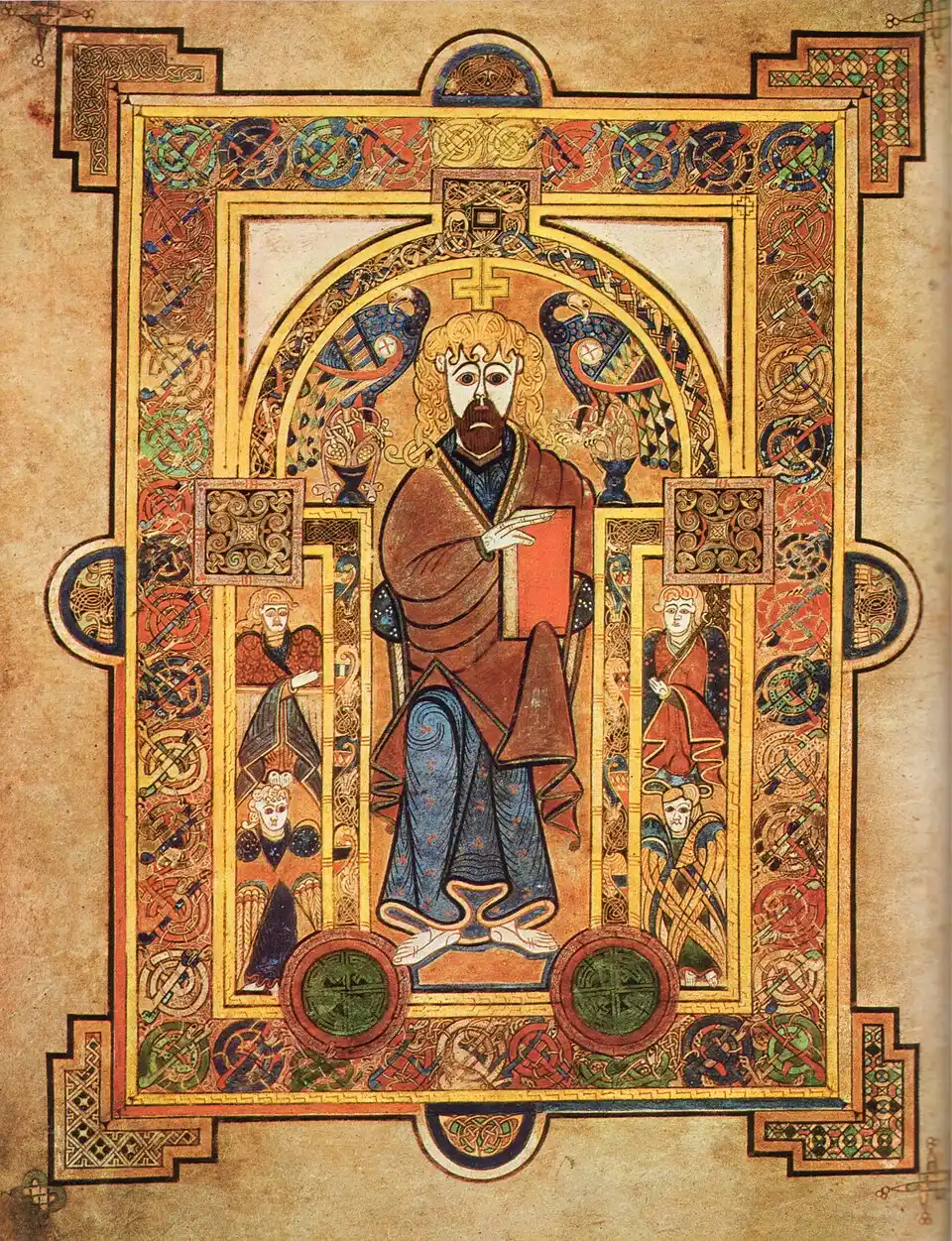
Look at the relation between the central figure and the framing ornament. The page directs attention through scale, symmetry and repeated forms. Its makers did not simply preserve a blank space for words: they shaped how a sacred book would be encountered. Those are observations about the object in front of us, rather than a claim about the literacy of the population around it.
That limitation is essential. An exceptional book tells us that such work could be supported. It does not establish that books were cheap, that education was universal or that most people lived comfortably. Using the manuscript to declare an uncomplicated golden age would repeat the same mistake as using political disorder to declare universal darkness.
Copying was work, not passive storage
In the Carolingian world, rulers and religious institutions invested in learning and the production of books. The cultural programme associated with Charlemagne included efforts to improve education and the accuracy and legibility of texts. Carolingian minuscule, a comparatively clear handwriting, formed part of that development. The Met: Carolingian Art
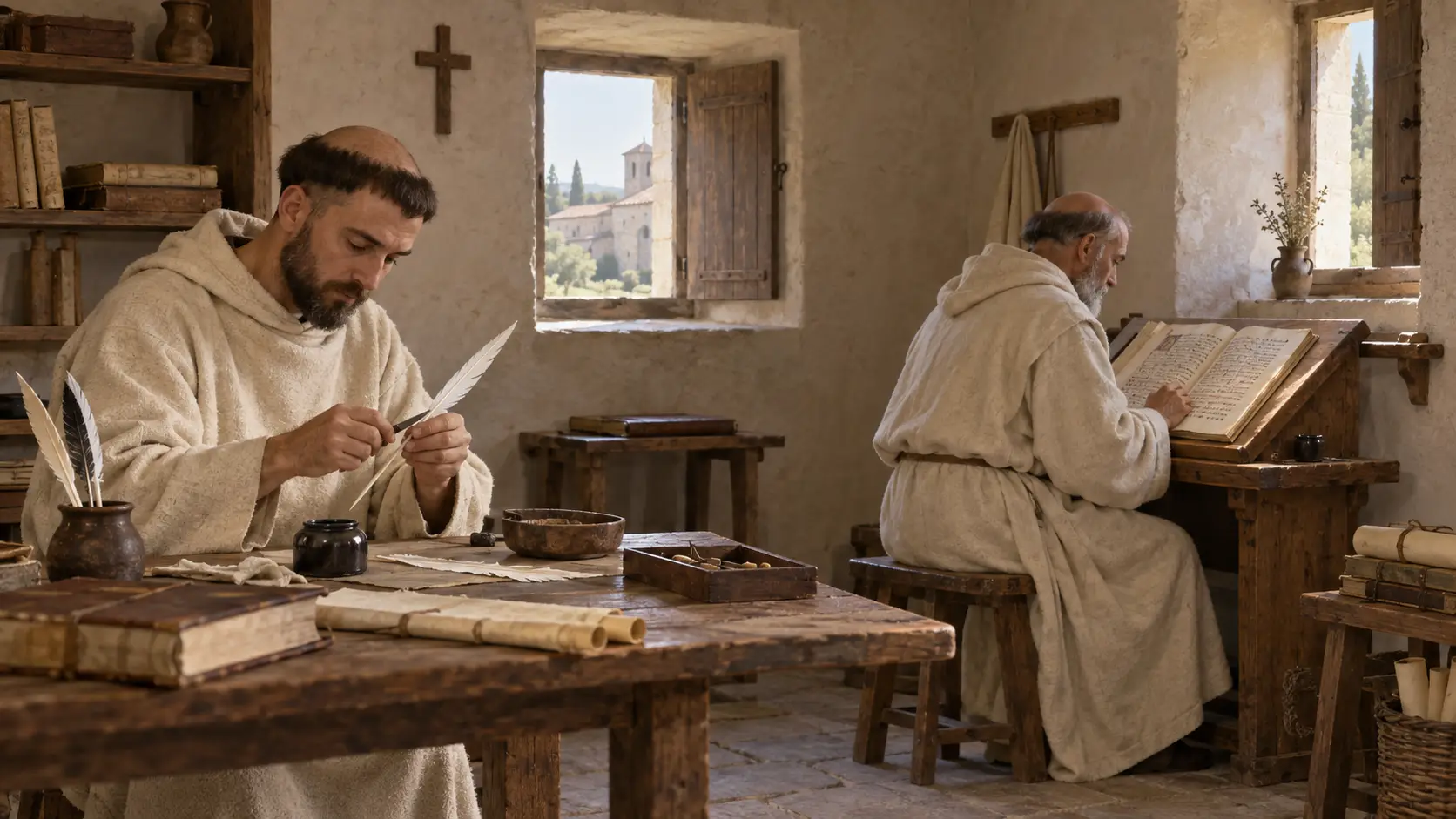
The illustration imagines a manuscript workshop in early medieval western Europe. It is not a reconstruction of the making of the Book of Kells. The distinction preserves two different contexts: an Insular manuscript tradition and the continental setting associated with Carolingian reform.
A copied text had to pass through material decisions: how to arrange a page, form letters and maintain consistency. Clearer handwriting could help a later reader distinguish words and follow a text. Yet copying also involved selection. The survival of a book depends on people choosing to reproduce and preserve it; the surviving collection is not a complete record of everything once known.
Charlemagne’s patronage also extended to art and architecture. Antique models were adapted for new Christian and imperial purposes. The result was creative reuse of the past, shaped by the ambitions of a particular court and its religious institutions. It should not be mistaken for either an untouched continuation of Rome or a sudden recovery from total cultural silence. The Met: Carolingian Art
What a helmet can tell us
The Sutton Hoo helmet offers a different kind of evidence. The image below shows a modern replica, rather than the excavated original. Its reconstructed appearance makes the decorated face mask and metalwork easier to read, but the act of reconstruction must remain visible in the description. Sutton Hoo helmet replica: photograph and source record
.jpg)
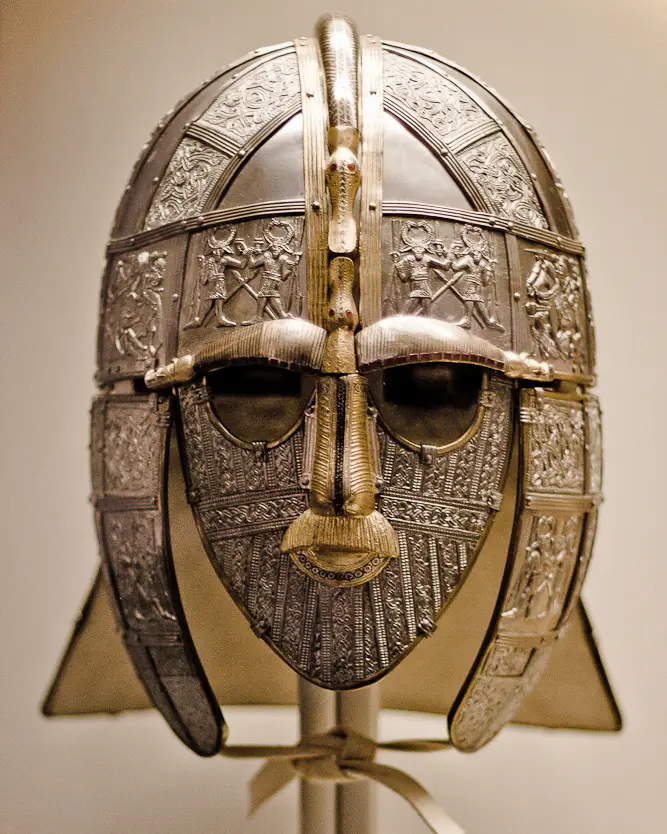
A replica invites questions that a photograph alone cannot settle. Which features follow surviving fragments? Which relationships were established during reconstruction? What can the finished object tell us about display, protection and status? These questions let an object become evidence rather than a decorative symbol for an entire era.
The same caution applies to splendid objects more generally. They can reveal elite access to materials and skilled work while leaving ordinary households much less visible. The existence of technical accomplishment and the existence of social inequality are entirely compatible.
Connections continued across the sea
Hedeby gives us a less court-centred view of early medieval activity. UNESCO identifies this Viking Age trading settlement as a connection between Scandinavia and continental Europe and between the North Sea and Baltic networks. Archaeological remains include buildings, streets and harbour structures. These are traces of exchange and settlement, not merely stories of isolated raids. UNESCO: Hedeby and the Danevirke
That does not make the period peaceful. Trade, political power and violence could coexist. It does mean that a picture of communities cut off from one another is inadequate. For more on the people behind these connections, see Who Were the Vikings?
A European label is not a world chronology
Beyond western Europe, the label becomes still less useful. Constantinople sustained Roman institutions and artistic production, even while its empire faced severe military and territorial pressures. Across the Islamic world, new centres were taking shape. Baghdad was founded as the Abbasid capital in 762; Baghdad and Samarra became major centres of cultural and commercial life. The Met: Byzantium The Met: Art of the Abbasid Period
These societies had their own conflicts and inequalities. Their significance here is not that they supply a simple opposite to a declining Europe. They show why one regional judgement cannot describe the condition of humanity at a given date.
“Were the Dark Ages really dark?” becomes a better question when we ask what changed, where, and for whom. A manuscript, a reconstructed helmet and a trading settlement answer different parts of it. Together they reveal a period whose losses were real, whose achievements were substantial, and whose variety a single adjective cannot adequately express.