
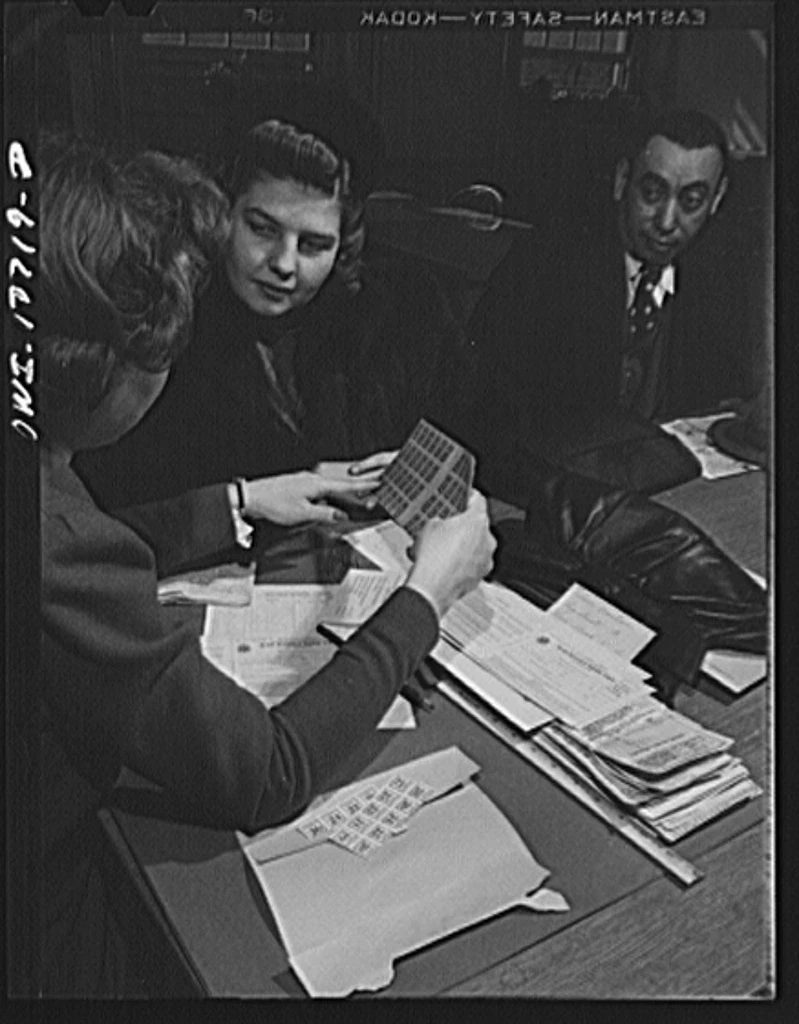
In a photograph taken in Washington, DC, in February 1943, a woman holds up a sheet of ration coupons across a crowded registration desk. Books and forms cover the table. The people opposite her are learning how to use the second ration book. A national wartime policy has reached the point where someone must explain what a shopper can hand over at a counter. Marjory Collins: ration-book registration
For Americans buying rationed food, money was only one part of the transaction. The correct coupons or points were also required. Household budgeting now involved two kinds of limits, and a choice that saved dollars could still use up scarce points. Understanding that everyday calculation brings the home front into focus.

Why control the shopping basket?
The United States had to feed its armed forces while supplying allies and maintaining civilian consumption. The pressure extended beyond the amount farmers could grow. Food needed processing, packaging and transport. Ships, labour and materials were being drawn into military service, while demand for food continued. A shortage on a shop shelf could begin far from the shop itself. National Park Service: food supply and military demand
The Office of Price Administration, or OPA, administered rationing alongside price controls. A ceiling price set the maximum charge permitted for a product under the relevant rules. A ration limited access to a quantity of goods. The two controls addressed different problems: rising prices and the distribution of restricted supplies. National Park Service: the OPA and ceiling prices
This distinction matters when looking at a surviving ration book. Its coupons represented permission to buy within the system. They did not supply the money needed to complete the purchase, and having coupons could not make an unavailable item appear.
From sugar coupons to food points
Food rationing began with sugar in May 1942. Coffee followed in November, and controls widened to many other foods in 1943. The programme changed as wartime conditions changed; a rule encountered in one month should not be treated as a fixed allowance for the entire war. The National WWII Museum: the rationing timetable
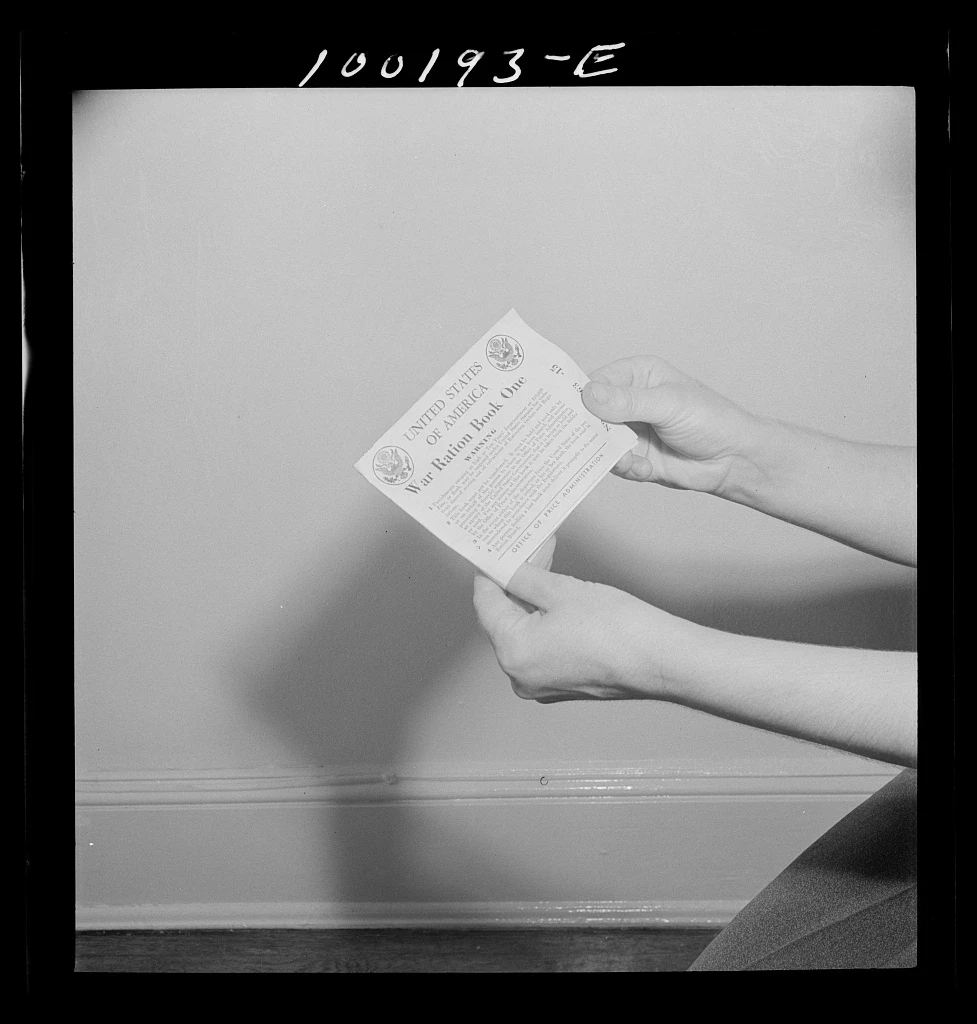

The photograph of War Ration Book One shows its printed cover held in two hands. The official title, number and issuing agency made a small paper object part of a national administrative system. Although the archive’s title refers to stamps, this particular view shows the closed book. Its contents and its outside cover are different kinds of evidence. Marjory Collins: War Ration Book One
Point rationing allowed a shopper to make choices within groups of foods. Red points covered items such as meat, cheese and fats; blue points covered many processed foods. The OPA assigned values according to supply and demand and could revise them. Each member of a family, including children, had an individual ration entitlement. Household shopping could therefore involve several books. National Women’s History Museum: books and point categories
Two budgets, one purchase
A shopper had to consider the cash price, the required points or coupon, and whether that entitlement was valid at the time. Point values described access to a restricted supply; they were not simply another way of writing the price in dollars. Sugar and coffee used their own coupon arrangements rather than following every rule for other foods.
The work behind the rules
The OPA depended on local rationing boards and volunteers to put the national programme into practice. Registration, applications and explanations brought government policy into schools and neighbourhood offices. Marjory Collins’s photograph records one of these encounters: the papers and the conversation are both essential parts of what is happening. The National WWII Museum: local administration
For a historian, the scene is more informative than a photograph of an unused book alone. It places the object between people. Someone knows enough about the rules to explain them; someone else needs that explanation before using the new system. The image cannot tell us what every registrant understood, but it makes the practical problem of communicating a policy visible.
Rules also reached businesses. Point values and maximum prices could change, requiring grocers to keep their information current. Newspapers and radio helped circulate revisions. A household planning meals and a retailer arranging stock were working with a system that demanded continuing attention. National Park Service: changing values and prices
Growing something outside the ration book
Victory gardens offered another way to supplement food supplies. Government campaigns encouraged household, school and community cultivation. Gardens appeared in backyards, vacant lots and other available spaces. Their usefulness depended on practical conditions: suitable land, light, water, equipment and the time to tend crops. Urban organisers often favoured shared plots where private gardens were unsuitable. National Park Service: garden locations and organisation
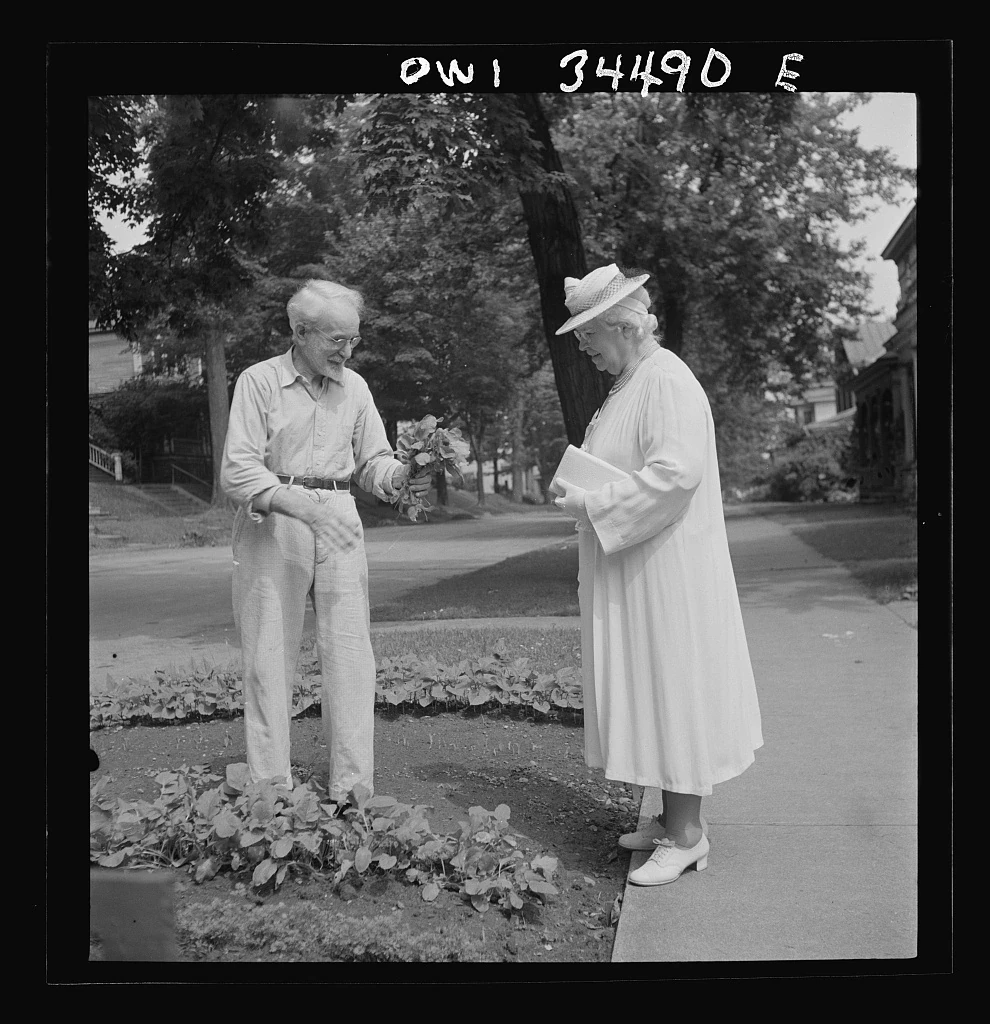

In Collins’s June 1943 photograph from Oswego, New York, a man holds vegetables beside a small planted area. The archive identifies the woman beside him as his wife. The harvest is close enough to the house and pavement to make gardening look like part of ordinary neighbourhood life. That is the scene the camera records; the picture gives us no measure of the household’s total food supply. Marjory Collins: an Oswego victory garden
Gardening itself created work. Seeds had to become edible crops, and a surplus was useful only if it could be eaten, shared or preserved. The garden programme consequently depended on instruction and local organisation as well as patriotic appeals. Its history includes the people learning unfamiliar skills alongside experienced growers. National Park Service: helping new gardeners
Preserving food took labour and equipment
Home canning connected a summer harvest with meals later in the year. Agricultural extension workers taught preservation methods, and community canning centres offered equipment and supervision. Such facilities mattered to people who lacked suitable equipment at home. Official campaigns often presented this work as a patriotic responsibility for women, linking domestic labour to the military effort. National Women’s History Museum: canning and community facilities
Access to instructions did not remove the time required to use them. Cooking, storing produce and managing a household’s books added tasks to daily life. Photographs and official publicity can show how this work was encouraged, while leaving its distribution within individual families largely out of view.
Rules, evasions and an uneven ending
Some consumers and suppliers bypassed controls through the black market. Others rushed to stock up when a new restriction was announced. The existence of a national system did not ensure universal compliance. Rationing continued to require administration and enforcement as well as public cooperation. The National WWII Museum: hoarding and black-market trade
Most US rationing ended during 1945, but sugar remained controlled until June 1947. The end of fighting and the restoration of unrestricted shopping followed different timetables. The National WWII Museum: the end of rationing
A ration book preserves a relationship between the household and a much larger supply system. Its stamps and categories turned distant pressures into everyday decisions at the counter. For a very different setting in which food connected urban households with wider organisation, explore how the first cities were fed.