
A house in a crowded city has an inside and an outside, but its life does not stop at the doorway. Walls meet other walls. Access depends on a lane. Property can pass between relatives, while people living nearby may know who bought a room, inherited a share or witnessed an agreement.
In ancient Mesopotamia, excavated houses and clay documents let us follow some of those relationships. The clearest picture emerges when we move between buildings and records: one shows where people lived, the other sometimes reveals how they claimed space or challenged another person’s rights. This article follows evidence from the later third and early second millennia BCE, with an explicitly separate comparison from Assyrian merchants in Anatolia.
Looking beyond a single house at Ur
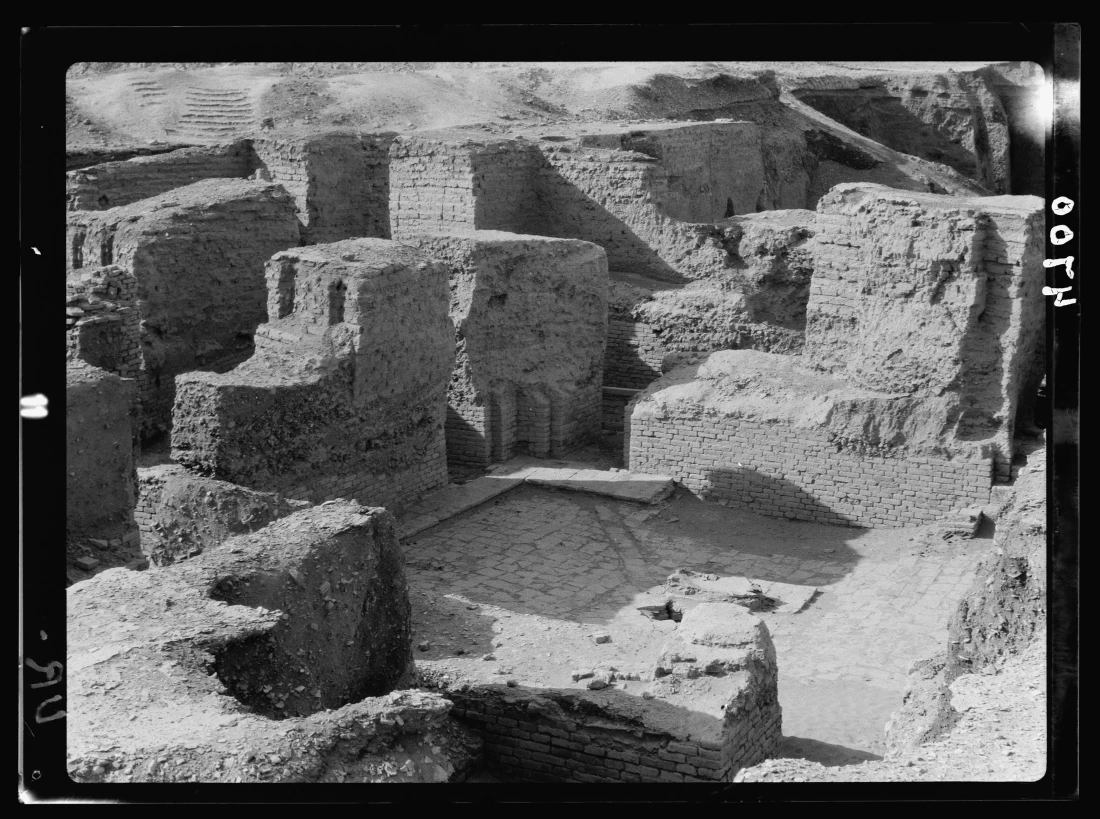
The archival photograph below shows excavated courtyards and adjoining rooms at Ur, in present-day Iraq. Taken in 1932, it records an archaeological landscape rather than a household in use. Even so, the closely fitted spaces make it easier to understand why a history of homes also needs a history of neighbours.
._Well_preserved_court_yard_and_houses_LOC_matpc.16105.jpg)
Ur’s Old Babylonian residential levels, dating to the early second millennium BCE, have played an important part in research on ancient neighbourhoods. Archaeologist Michael E. Smith reviews how scholars have interpreted the residential plans produced by Leonard Woolley’s excavations. He also notes disagreement over how confidently particular neighbourhoods can be identified within them. Smith: residential archaeology at Ur, p. 148
A neighbourhood involved more than a set of walls. People might use nearby facilities, recognise familiar households or belong to a local religious community. The exact relationships need to be investigated rather than filled in from a modern idea of neighbourliness. A surviving street plan gives a spatial arrangement; identifying a social community requires additional evidence.
What made a neighbourhood?
Archaeologist Michael E. Smith distinguishes small residential areas shaped by frequent face-to-face interaction from larger administrative districts. In his review of Mesopotamian research, neighbourhoods could include varied activities and facilities, such as chapels, shops, bakeries and workshops. The evidence does not support an automatic assumption that every occupation occupied a separate quarter. Smith: neighbourhoods and districts, especially pp. 138–140 and 148
This suggests a city understood through repeated local encounters. People’s needs connected them to places beyond their own rooms, while the household remained a significant centre of activity. Different kinds of relationship could overlap: a neighbour might also be a relative, a colleague or someone who could testify about a transaction.
The distinction between a building and its occupants is essential. One architectural unit does not automatically equal one nuclear family, and neighbouring buildings do not automatically prove a close social bond. Texts can help test those possibilities by attaching names and relationships to the excavated setting.
Property kept relationships close
Elizabeth C. Stone’s study of Nippur combines residential archaeology with legal documents. She found connections between inheritance and neighbouring property: dividing an estate could leave relatives with adjacent holdings. Witness lists also linked people through kinship, proximity and association. Property relationships could therefore reinforce the social ties already running through a neighbourhood. Stone, Nippur Neighborhoods, pp. 16–17
Close relationships could produce disagreements too. Stone follows a dispute involving branches of an important Nippur family in the eighteenth century BCE. Claims about property and a temple office reached the king and the city’s council; the resulting decision did not satisfy all parties. This was a specific, unusually well-documented family, but it shows why inheritance should not be imagined as an entirely private event contained within one house. Stone, pp. 47–49
The physical and legal histories belong together. A partition on a plan may look like a change to a building. In someone’s life, a division of property could also change access to resources, relationships with relatives and the matters that needed to be agreed with others.
A house could become a written transaction
A small tablet in the Metropolitan Museum of Art records a house sale. It belongs to the Quradum archive, dates approximately to 2350–2150 BCE and probably comes from Sippar. This Akkadian-period object is earlier than the Old Babylonian examples from Ur and Nippur. It gives us a separate glimpse of buildings treated as property whose transfer was worth recording. The Met: house-sale contract, 86.11.204

The museum identifies this tablet as a sale contract. That does not make it evidence of a quarrel. Its relevance is the way a physical place could also exist as a documented claim: something transferred, retained in an archive and potentially referred to later.
Three different kinds of evidence
- House remains
- Show walls, entrances and successive changes to space.
- A contract
- Records a transaction or obligation in an agreed form.
- A lawsuit record
- Preserves a challenge, testimony or decision; the surviving text may contain only part of the case.
Why witnesses mattered
In Stone’s reconstruction of Nippur’s families, the people who repeatedly witnessed documents help reveal connections between households. Their presence also reminds us that a written agreement existed within a social setting. A tablet preserved words, but a named witness connected those words with a person who had participated in the event. Stone: identifying people through transactions and witnesses, pp. 16–17
That relationship is easy to miss when a museum displays a tablet by itself. The object now sits quietly in a collection. Originally, its usefulness could depend on other people, other documents and an authority willing to recognise a claim. The archive was part of the practical work of maintaining rights over time.
When the archive itself was disputed
An Old Assyrian lawsuit makes that point unusually clear. The tablet shown here probably comes from Kanesh, at modern Kültepe in Anatolia, and dates to the twentieth–nineteenth centuries BCE. Kanesh was outside Mesopotamia, but its Assyrian merchant community maintained connections with Ashur in northern Mesopotamia. The Met: Old Assyrian lawsuit, 66.245.5a

According to the museum’s interpretation, two merchants, Suen-nada and Ennum-Ashur, accused each other of taking material from a private archive that both claimed to own. Testimony was given before witnesses representing the merchant authorities. Ennum-Ashur requested that the case go to the assembly and king at Ashur. The surviving account does not reveal the verdict.
Documents that could support claims were themselves valuable enough to fight over. The case also shows a dispute reaching beyond the place where the merchants lived. It offers a comparison with Mesopotamian urban records, not evidence that the same proceedings occurred in every neighbourhood at Ur or Nippur.
What the records bring into view
Lawsuits attract attention because conflict creates a story. Yet the surviving record is selective: a disagreement committed to clay can be easier to recover than years of cooperation. We cannot calculate how quarrelsome a street was from the mere existence of a legal document, or assume that everyone had equal resources to defend a claim.
Royal statements about justice answer another question. Our article on Hammurabi’s laws explores the ruler’s presentation of order. House plans, contracts and particular disputes bring us closer to the arrangements people actually made and challenged.
Neighbours helped give property its everyday meaning. They shared a setting, appeared in transactions and sometimes contested one another’s claims. To continue from the spaces between homes to the activities within them, read Daily Life in Early Mesopotamia in Life in the First Cities.