
A coin, a bead and a broken bowl seem like modest survivors beside the walls of a palace. Yet each can preserve a different kind of connection. A coin carries a claim to authority; a bead embodies choices about material and appearance; a ceramic fragment may have travelled far beyond the kiln in which it was fired.
On the Swahili coast, these objects help us study both exchange and the lives into which traded things entered. Their stories become more interesting when we ask what happened after arrival, rather than treating them only as evidence that a town was connected to somewhere else.
Coins made on the African coast
Kilwa produced its own coins during its medieval history. Local minting matters because it places the town among the makers of monetary objects, not simply among the destinations for somebody else’s currency. UNESCO identifies coin production as part of the site’s significance. UNESCO: Ruins of Kilwa Kisiwani and Songo Mnara
The museum display below presents coins associated with Kilwa. It introduces their small physical scale and their place in the town’s history. A photograph of a group behind glass does not allow every piece to be read, dated or assigned to a ruler independently.
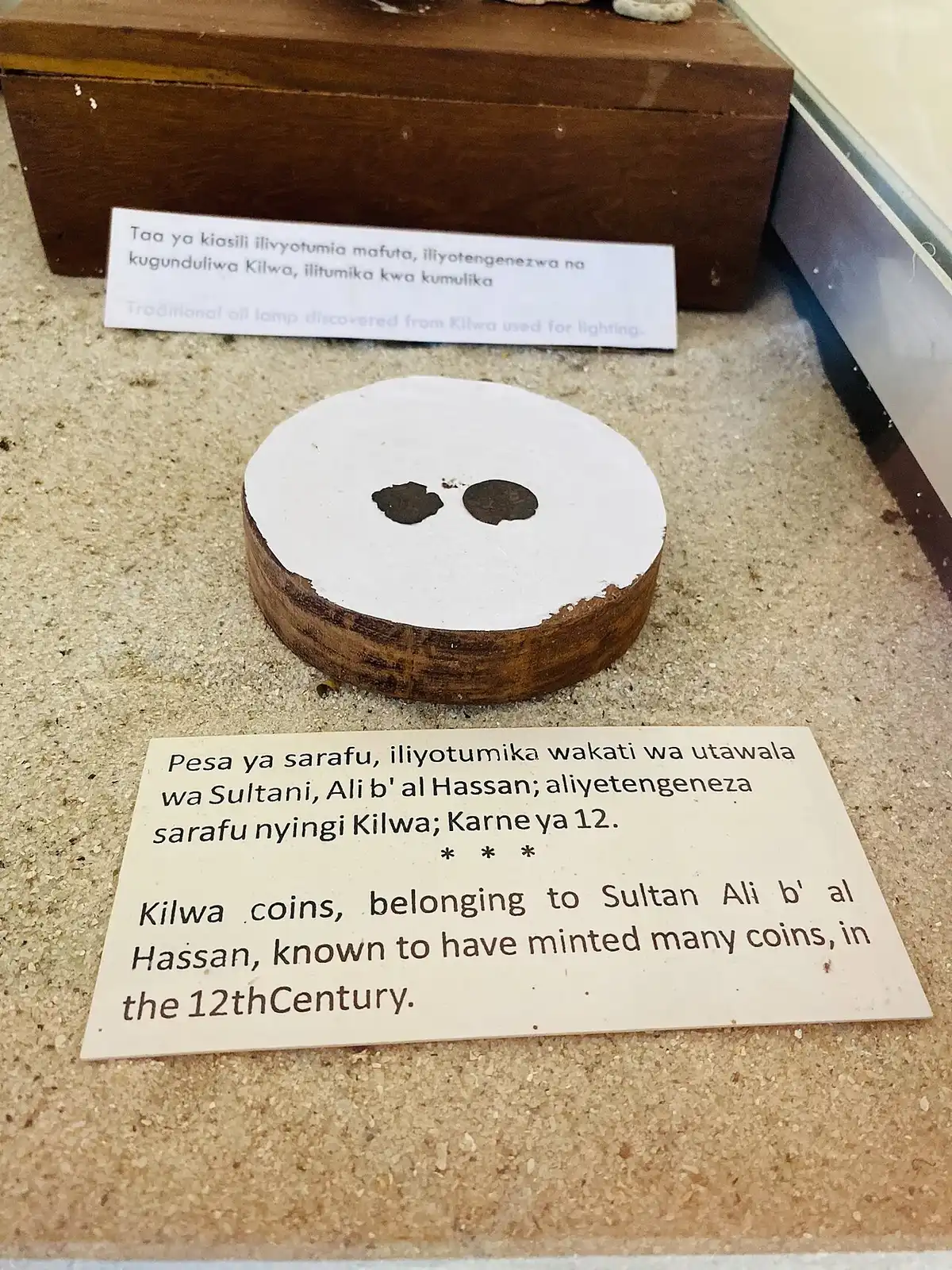

Coin evidence also requires a distinction between manufacture and use. An object may remain in circulation after the reign whose name it bears. It may later be saved, buried or incorporated into a building. The date of a coin and the date of the deposit containing it are related questions, but they are not necessarily the same answer.
A deposit that complicates the story
A study by John Perkins, Jeffrey Fleisher and Stephanie Wynne-Jones describes more than 300 copper coins deposited at Songo Mnara in the late fourteenth or very early fifteenth century. They were associated with the foundations of a stone house and a carnelian necklace. Some coin types referred to rulers of much earlier centuries. Perkins, Fleisher and Wynne-Jones (2014): A Deposit of Kilwa-Type Coins from Songo Mnara
The researchers interpret the grouping in relation to the value and significance of the building. This is more than evidence of buying and selling. The objects had been brought together in a particular place, creating a context that matters as much as their individual descriptions.
It also shows why coins cannot automatically supply exact dates for everything found beside them. A deposit must be interpreted as a whole. Its position, associated objects and relationship to construction help establish when and how it was formed.
Beads were made from many materials
Glass beads are familiar indicators of long-distance contact, but they were not the only beads used on the coast. Stephanie Wynne-Jones’s research follows a wider range of materials, including marine shell and fired clay. Shell-working traditions bring local manufacture into a story that can otherwise be dominated by imports. Wynne-Jones (2024): Material Taxonomies and Beads on the East African Coast
The same study discusses unusual folded glass beads at Kilwa and Songo Mnara, apparently made using glass of varied origins. Such objects complicate a simple separation between something “local” and something “foreign”. Material could move across great distances and then enter a new process of manufacture.
Beads could also be valued for qualities that a trade map cannot show: colour, texture, sound or their arrangement with other beads. Those meanings have to be investigated in context. We should not assume that a more distant origin always meant greater value, or that every small ornament functioned as money.
Why broken pottery is useful
The next photograph shows pottery fragments associated with Kilwa. Their broken condition makes them less immediately impressive than a complete museum vessel, but breakage can expose useful details: the fabric of a ceramic body, the thickness of a wall, a rim profile or the relationship between a glaze and the surface beneath it.
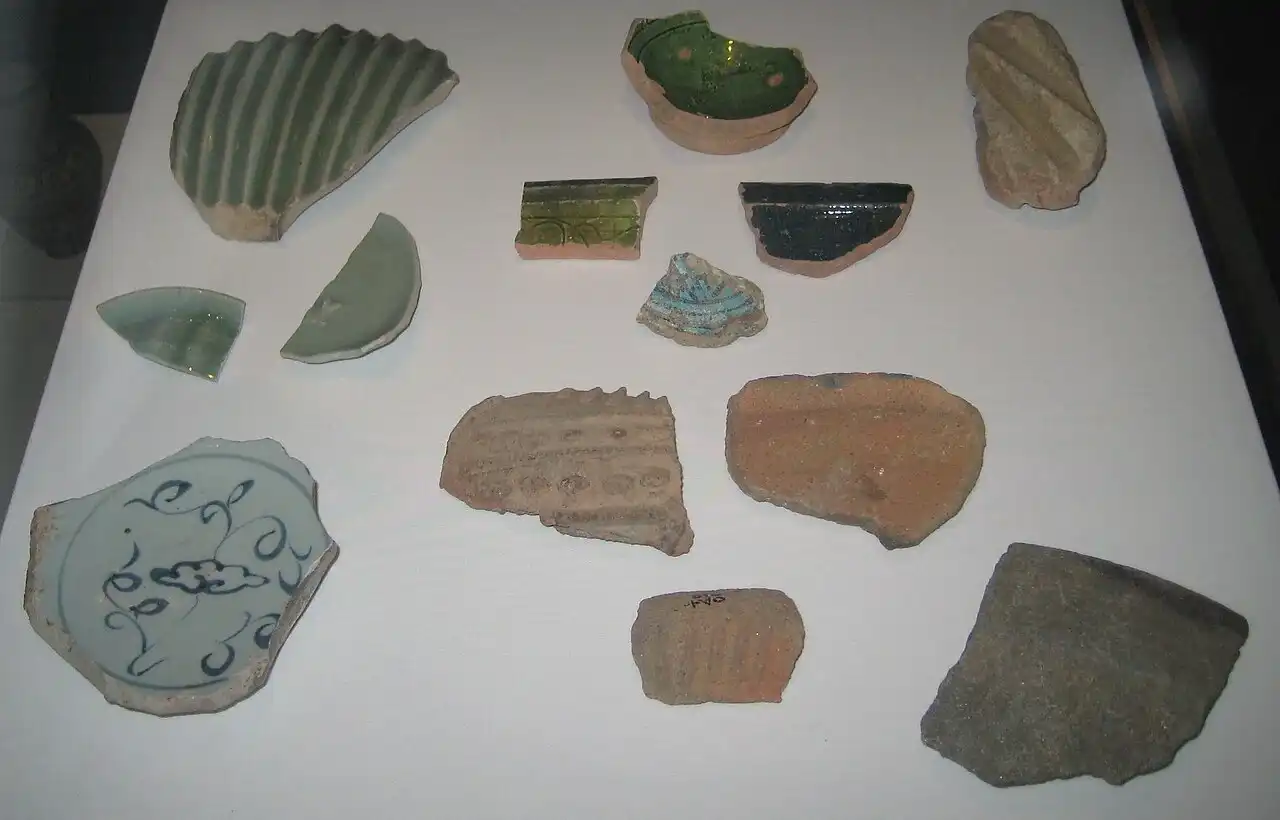

Archaeologists compare such characteristics with securely identified material elsewhere. When several kinds occur together in dated deposits, they can help build a history of contact and consumption. The method relies on the combination of classification and context, not on guessing a place of origin from colour alone.
A museum photograph should consequently be read with its catalogue information. Not every sherd in a mixed group must come from the same workshop, century or region. Nor is a display case necessarily an exact reproduction of the arrangement in which objects were excavated.
A Chinese dish as a comparison
The complete Longquan dish below offers a different view of a ceramic object: its overall shape, glazed surface and decoration are visible together. It is a Chinese museum piece used here as a comparison. It was not excavated at Kilwa.
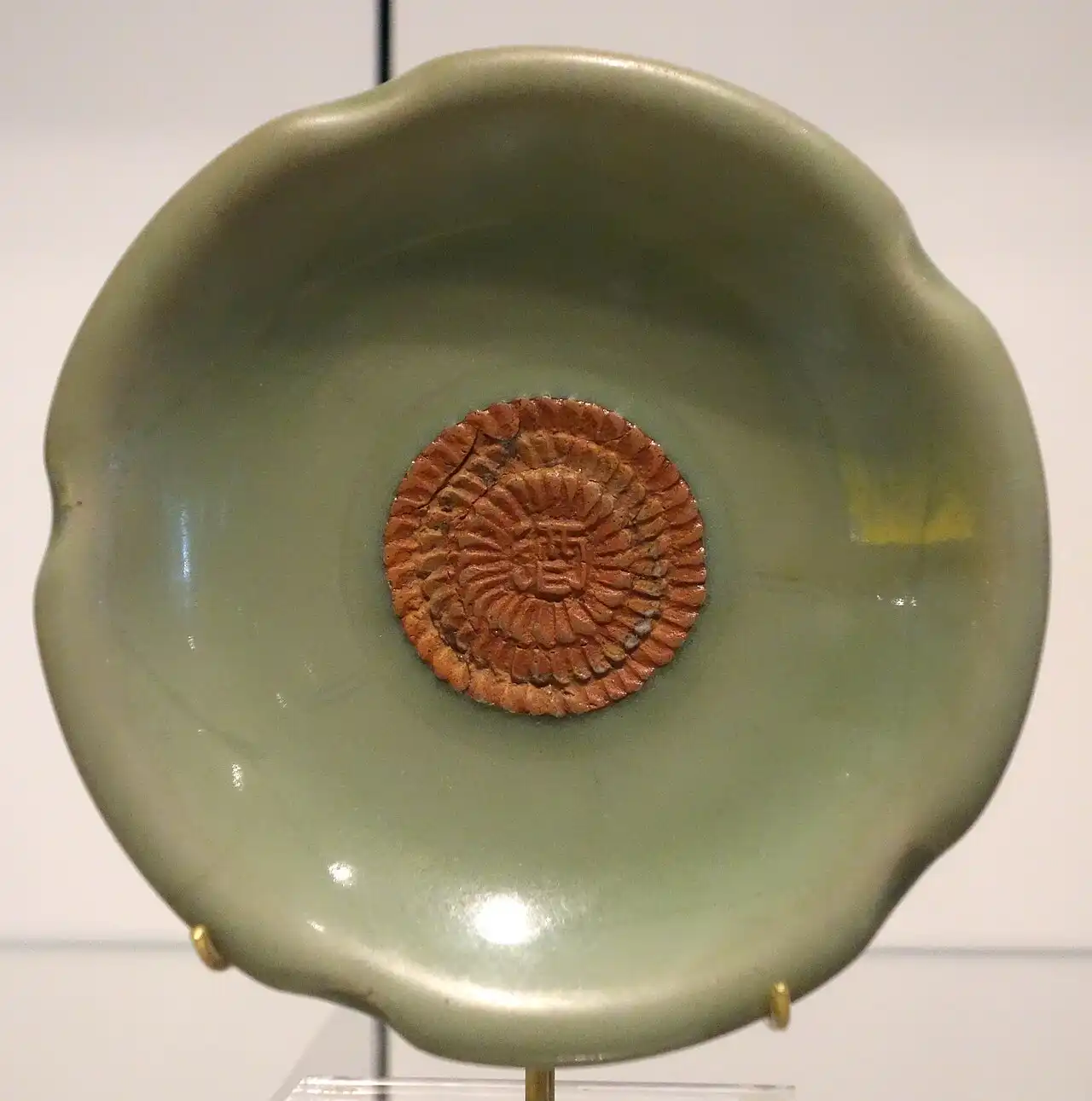

The distinction is important because the presence of Chinese ceramics in East African archaeological contexts is well established, but this particular dish cannot serve as a find from one of them. A comparison can explain a class of objects without inventing a journey for the object pictured.
Imported ceramics could also acquire uses beyond serving food. At Songo Mnara, research reported by Archaeology describes Chinese celadon vessels set into a water feature beside a mosque. There, a valued imported object became part of a built setting for washing, rather than remaining a movable possession. Benjamin Leonard (2023): Saving for the Season
Four questions to ask of an object
- Made where?
- Its place of manufacture, where evidence allows that to be established.
- Used how?
- Its role may have changed during its life.
- Found where?
- The archaeological context is different from the current museum location.
- Dated by what?
- Style, inscriptions and associated deposits do not always give identical kinds of dates.
Connections became part of local life
A coastal town did not merely receive things and pass them on. People chose, used, altered and sometimes deliberately deposited them. Coins entered the history of a house; beads were made into new combinations; ceramic vessels could become architectural features.
That is why small finds are so valuable. They make long-distance exchange visible at a human scale. They also remind us that the end of a voyage was often the beginning of another part of an object’s history.