
On 27 July 1914, the American ambassador in Berlin reported that he had reason to expect the crisis would be settled without a general European war. The following day, Austria-Hungary declared war on Serbia. Within another week, Germany was at war with Russia and France, and Britain had entered the conflict. FRUS: Gerard’s telegram, 27 July 1914
The ambassador’s expectation was not a forecast we should adopt. It is evidence of the uncertainty people faced before the outcome was known. The July Crisis is best understood by following decisions as they were made, rather than treating every event after Sarajevo as an unavoidable step towards a world war.
Sarajevo opened a crisis; it did not settle its outcome
On 28 June, Gavrilo Princip shot Archduke Franz Ferdinand, heir to the Austro-Hungarian throne, and his wife Sophie in Sarajevo. The attackers opposed Habsburg rule and sought a different political future for the South Slavs. The assassination was a direct assault on the dynasty, but its consequences depended on what governments chose to do afterwards. German Historical Museum: The Sarajevo assassination
Austria-Hungary treated the crime within a wider confrontation with Serbia. Its ambassador Constantin Dumba explained his government’s position to the United States by linking the assassination investigation to alleged long-running agitation among the monarchy’s southern Slav population. That diplomatic note tells us how Vienna justified its demands; it does not independently prove every accusation it contained. FRUS: Dumba’s note, 24 July 1914
German support changed Vienna’s calculation
In early July, Germany assured Austria-Hungary of support. The National Army Museum dates the assurance to 5 July and identifies the danger against which it mattered: Russian opposition to an Austrian attack on Serbia. This backing is commonly described as the German “blank cheque”. It was a political commitment, not a literal payment. National Army Museum: First World War timeline
The commitment made the possible involvement of other powers central to the crisis. Vienna’s choices concerned Serbia, but Berlin had already accepted the risk of a confrontation extending beyond the two states. The German Historical Museum describes both the backing and the wider calculations surrounding the alliance system. German Historical Museum: The July Crisis
An alliance did not act by itself. Leaders still had to decide what support meant, what risks to accept and whether pressure would cause an opponent to retreat. The danger lay partly in making commitments while remaining uncertain about how others would respond.
The ultimatum brought a deadline
Austria-Hungary delivered its note to Serbia on 23 July, allowing forty-eight hours for acceptance of its demands. Dumba’s communication of the next day explicitly records both the delivery date and the deadline. A demand with a short time limit narrowed the space available for negotiation and outside mediation. FRUS: Dumba’s note, 24 July 1914
Among the contentious issues was the role Austria-Hungary sought in investigations within Serbia. This touched the authority of the Serbian state over its own territory. The German Historical Museum treats the intrusion into sovereignty as a central obstacle to acceptance. German Historical Museum: The July Crisis
Vienna judged the Serbian response unsatisfactory. In a further note, dated 26 July, Dumba reported that the Austro-Hungarian envoy had broken diplomatic relations and left Belgrade. The same communication described military mobilisation. Its language matters: this is the Austro-Hungarian government’s account of why relations had ended, not an impartial verdict on the entire exchange. FRUS: Dumba’s note, 26 July 1914
Preparing for war increased the danger of war
Austria-Hungary declared war on Serbia on 28 July. From St Petersburg that evening, the American chargé d’affaires reported alarm and intense pressure around the Russian emperor. He also described military preparations already under way and warned that Russian intervention could bring German intervention. The report captures a widening crisis as a contemporary observer understood it. FRUS: Wilson’s telegram, 28 July 1914
Mobilisation meant putting armed forces on a war footing. It could be presented as a precaution, but opponents could interpret it as preparation for an imminent attack. The same movement could therefore appear defensive to those ordering it and threatening to those watching it. This is an explanation of the escalation problem, not a claim that every mobilisation had the same purpose.
Military planning added pressure. German preparations for a war involving Russia and France prioritised a major offensive in the west, involving entry into neutral Belgium. The plan connected a confrontation in eastern Europe to an operation against France. Decisions about where armies would move had diplomatic consequences far beyond the place where the original crisis began. German Historical Museum: The Schlieffen Plan
From the Balkans to a European war
Germany declared war on Russia on 1 August and on France on 3 August. German forces invaded Belgium on 4 August; Britain entered the war against Germany that day. These dates show the rapid expansion of the conflict, while also distinguishing declarations of war from the movement of troops across a frontier. National Army Museum: First World War timeline
Britain’s position was not simply a treaty mechanism switching on. Addressing Parliament on 3 August, Foreign Secretary Edward Grey distinguished the Franco-Russian alliance from Britain’s diplomatic relationship with France. He argued about British interests, obligations and the consequences of standing aside. His speech is evidence of a case being made for action, not a detached explanation of every government’s conduct. UK Parliament: Grey’s statement, 3 August 1914
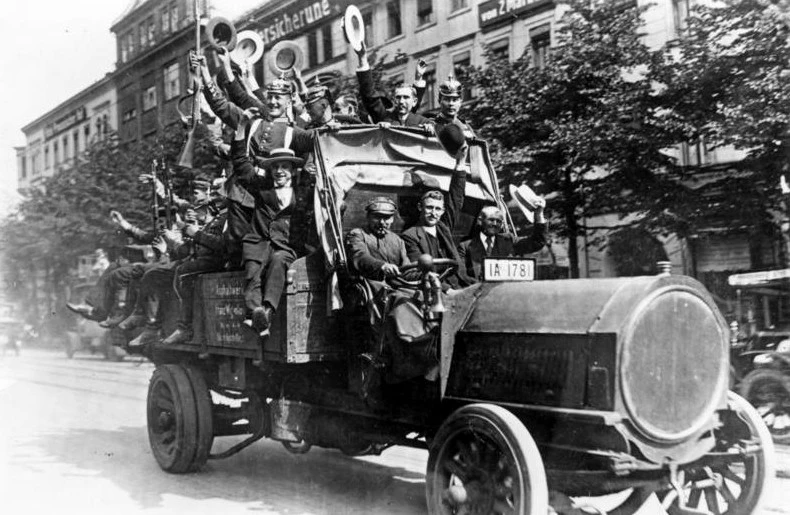

The photograph shows reservists in Berlin during mobilisation, approximately in August 1914. It belongs to the unfolding consequences of the crisis. Hats raised towards a camera can tell us about the people visible in that moment; they cannot establish what every German, or every European, felt about war. Bundesarchiv photograph: Berlin mobilisation, via Wikimedia Commons
Why the sequence matters
A chronology alone cannot assign responsibility. But it prevents several misleading shortcuts: the assassination did not instantly put all powers at war; diplomatic alignment was not identical to a binding military obligation; and military preparation was not the same act as a formal declaration.
The documents also require different questions. An ambassador’s report can reveal what he believed at a particular hour. An official note can show the position a government wanted another state to accept. A parliamentary speech can expose the arguments used to justify a choice. None provides an unrestricted view into every decision-maker’s intentions.
The July Crisis became a wider war through the interaction of coercive diplomacy, alliance commitments, military preparations and decisions to use force. Austria-Hungary’s action against Serbia, German backing and subsequent escalation, Russian intervention and the choices of France and Britain belong in that explanation. Understanding how these decisions interacted is more informative than saying that an assassin single-handedly caused everything that followed.